Pakistani regime Handcuffed My Father’s Dead Body
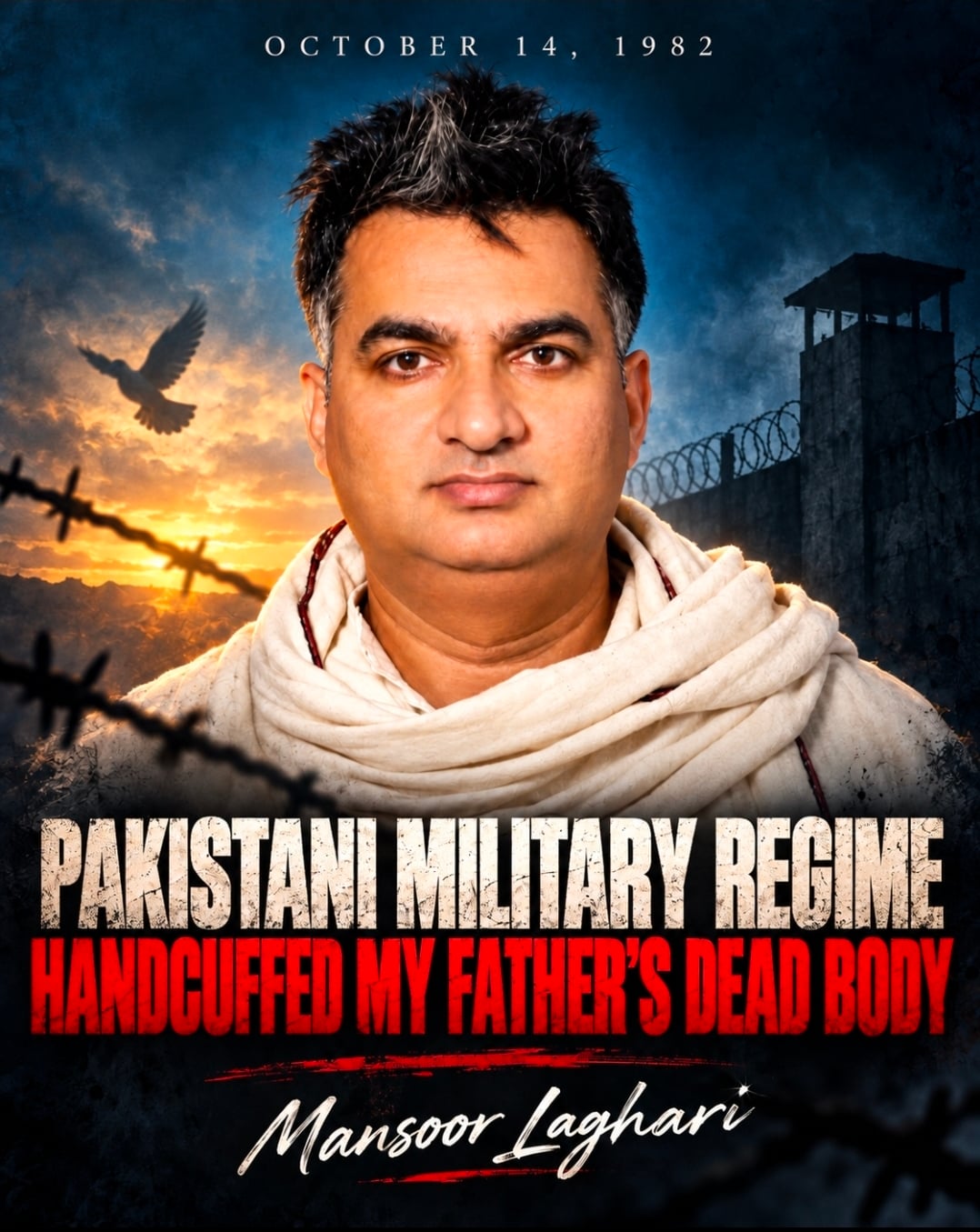
The Pakistani Military Regime Handcuffed My Father’s Dead Body. I Was 12.
Forty-four years after Ghulam Mohammad Laghari died under General Zia’s martial law, his son is still asking what kind of state fears a dead man.
Some childhood memories soften with time. Some wounds close. Mine has not, not after 44 years.
On October 14, 1982, my father, Ghulam Mohammad Laghari, died in the custody of General Zia-ul-Haq’s military regime. I was 12.
His death did not end his punishment. When his body was brought home, police came and put handcuffs on it.
My father was dead. He could not run, speak, or organize anyone. The state handcuffed him anyway.
What kind of regime fears a dead man? I have been asking that question for 44 years. I still don’t have an answer.
A childhood lived around prison walls
My father was a journalist, a leader of Sindh’s peasant movement, and a defender of religious minorities. He believed dignity belonged to every person, whatever their wealth, caste, or faith.
Over his lifetime he spent roughly 27 years in prison under successive governments.
For a child, that number is not history. It is birthdays without a father. It is lying awake wondering if he is alive. It is watching other boys walk home to their fathers after school.
When I was about seven, I visited him in prison. When it was time to go, I held on to him, crying, and refused to leave. I would rather have stayed inside that prison than go home without him.
Other children were afraid of the dark. I was afraid of the knock on our door.
In October 1982 he finally came home to us. He came home dead.
Why Sindh called him Comrade
Across Sindh, people knew him as Comrade Ghulam Mohammad Laghari.
Western readers may hear “comrade” and think of the Soviet Union. In Sindh’s political culture the word carries a wider meaning: a companion, a fellow traveler in a common cause. Sindh’s peasant movements drew activists from leftist and nationalist traditions alike, and my father’s own politics crossed some of those lines. The title said less about ideology than about loyalty.
To landless farmers, he was the man who stood up to powerful landlords. To laborers, he was someone who would confront the people exploiting them. To Hindus and Christians, he was a Muslim who believed their lives and their faith deserved the same protection as his own.
He did not ask a person’s religion before defending them. He asked whether they were being treated unjustly.
That was the Comrade people knew. That was my father.
Declared an infidel
Defending minorities cost him dearly. A prominent cleric issued a fatwa declaring him a kafir, an unbeliever.
A practicing Muslim, condemned in the name of his own religion, for refusing to accept that some human beings could be abandoned.
The fatwa added religious danger to the political persecution our family already lived with. Our home, our safety, and our name became targets.
I learned early that religious extremism does not always start with a bomb or a gun. Sometimes it starts with a cleric declaring another man an unbeliever. Those words give permission, and violence often follows.
When I speak against extremism today, I am not describing something I studied. I grew up inside it.
The handcuffs
The image that returns most often is not a rally, a prison wall, or a headline. It is my father’s body.
I remember being a child among adults, unable to change anything. I wanted him to wake up. I wanted one more embrace, one more conversation, one more chance to tell him I loved him.
Instead I watched the police put handcuffs on him.
Writing this now, I feel the same pain I felt then. The people who had taken so many years of his freedom would not give him dignity even in death.
To the state he was an enemy to be controlled. To his supporters he was a symbol. To me he was Baba.
The Nelson Mandela of Sindh
Admirers call my father the Nelson Mandela of Sindh, for the years he spent in prison and for his refusal to abandon ordinary people. Like Mandela, he believed a society cannot call itself just while it denies basic rights to the powerless.
His struggle was rooted in Sindh’s soil, among farmers, workers, journalists, political prisoners, and minorities. His weapon was the written word. Through his newspapers, Sachai (Truth) and Bedari (Awakening), he exposed abuses of power and gave a voice to people whose suffering no one else would print.
But political courage is never paid for by the activist alone. Mothers pay. Children pay. A whole generation inherits the cost.
We celebrate political prisoners. We rarely ask about the children growing up outside the prison walls, or who gives them back the years they lost.
Why I still speak
I eventually left the country of my birth and built a life in the United States. I served in the American military, raised a family, and kept working for human rights.
Today, as a Muslim who openly opposes antisemitism, religious extremism, and the persecution of minorities, I hear the same words once thrown at my father. Traitor. Infidel. Enemy of the faith.
I know where that language leads. I know what happens when a society lets religious identity become a weapon, when clerics claim the right to decide whose humanity counts, when a government treats dissent as a crime.
That is why I work for Muslim-Jewish understanding and for the protection of religious minorities. My father taught me that a Muslim who defends a persecuted Hindu, Christian, or Jew is not less faithful. He is keeping faith with the belief that every human life has value.
Still that boy
On this anniversary I don’t want to remember my father only as a political figure. I want to remember the father I needed. The man who should have watched me grow up, met his grandchildren, and grown old among people who loved him.
I am older now than he was when I lost him. I have crossed oceans and survived my own battles. I have seen remarkable kindness and terrible cruelty.
And part of me is still 12, standing beside his body, not understanding why grown men were handcuffing someone who could no longer resist.
History may remember him as Comrade Ghulam Mohammad Laghari. His admirers call him the Nelson Mandela of Sindh. The world remembers the struggle. His children remember the father they never got back.
Baba, they handcuffed your body after you were gone. They could not handcuff what you believed.
Your son has not forgotten.