
Political analysis, conflict dynamics & human rights
Pakistan’s Global Repression: Silencing Dissent Beyond Its Borders
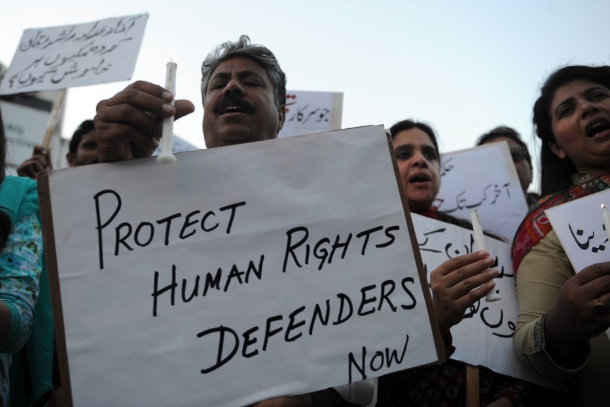
Protesters in Pakistan passionately demonstrate for the protection of human rights defenders, holding signs like "Protect Human Rights Defenders Now" amid calls for justice and reform. This image is copyright-free and available for public use. Source CIVICUS
For years, Pakistan’s human-rights crisis was seen as a domestic problem. That is no longer the case.
Today, critics of the Pakistani state are being targeted far beyond the country’s borders — in Europe, North America, and Africa. Journalists, activists, and former officials who believed exile would offer safety have instead found intimidation, violence, and pressure following them abroad. This practice is known as transnational repression (TNR), and Pakistan has become one of its most troubling practitioners.
Transnational repression is not about isolated threats or rogue actors. It is about states extending their coercive power across borders to silence voices they cannot control at home. In Pakistan’s case, this strategy has expanded alongside growing military dominance, legal immunity for top officials, and the erosion of judicial independence.
What follows is a clear picture of how this system works, why it has intensified, and why the international community is now paying closer attention.
A Legal Shift That Enabled Impunity
In November 2025, Pakistan adopted its 27th Constitutional Amendment, a turning point that alarmed legal experts and human-rights groups.
The amendment fundamentally altered the balance of power in the state. It created a Federal Constitutional Court able to override Supreme Court rulings, centralized military authority more firmly under the Army Chief, and granted lifetime immunity from criminal prosecution to the president and senior military leadership.
In plain terms, it placed the most powerful actors in Pakistan above the law.
Legal watchdogs described the amendment as a direct assault on judicial independence. Human-rights organizations warned that insulating military and executive leaders from accountability would make abuses not only more likely, but harder to challenge — both at home and abroad.
Since then, reports of intimidation, surveillance, and violence against critics outside Pakistan have increased sharply.
Violence and Intimidation Beyond Pakistan’s Borders
The pattern of transnational repression is no longer subtle.
One of the most shocking cases was the 2022 killing of journalist Arshad Sharif in Kenya, after he fled Pakistan due to repeated threats. His death sent a clear message: distance offers no guarantee of safety.
In the United Kingdom, former government adviser Shahzad Akbar survived an acid attack on his home in 2023, while his brother was abducted in Pakistan around the same time. Investigative journalist Ahmad Noorani, reporting from abroad, saw his family attacked and his brothers beaten and detained in retaliation for his work.
Other prominent critics — including journalists, filmmakers, and political commentators — have reported threats, surveillance, and harassment across the United States, Europe, and Africa. In many cases, pressure is applied not directly to the dissident, but to family members still inside Pakistan. This tactic turns relatives into hostages, forcing silence through fear.
By 2025, UK counter-terrorism police were investigating attacks and threats linked to Pakistani dissidents, acknowledging that these incidents were not random but part of a broader pattern.
What International Watchdogs Are Saying
Human-rights organizations have been documenting this trend for years.
Freedom House has identified Pakistan among governments responsible for physical acts of transnational repression, including assaults, abductions, and forced returns. Its reports show that these actions are increasingly coordinated, targeting critics who expose military abuses, enforced disappearances, or corruption.
Human Rights Watch has repeatedly criticized Pakistan’s use of counterterrorism laws to justify enforced disappearances, torture, and extrajudicial killings — especially in Balochistan. Amnesty International has highlighted Pakistan’s growing use of digital surveillance and censorship tools, often purchased from foreign companies, to monitor critics abroad and intimidate their families at home.
Together, these findings point to a system — not isolated misconduct — in which repression is normalized, bureaucratized, and exported.
Enforced Disappearances: The Domestic Engine of Transnational Repression
To understand Pakistan’s transnational repression, one must look at enforced disappearances inside the country.
For decades, activists — particularly in Balochistan — have documented abductions carried out by security forces. Victims often vanish without charge, are tortured, or are later found dead. Despite thousands of complaints, accountability has been virtually nonexistent.
By 2024, activists estimated that more than 7,000 people had disappeared since 2004. UN experts have repeatedly urged Pakistan to criminalize enforced disappearances and end their use as a counterterrorism tool.
This domestic machinery of fear does not stop at Pakistan’s borders. It is the foundation that allows threats against families, in-absentia convictions, and intimidation abroad to be effective.
Trade Privileges and the Question of GSP+
These abuses now have concrete economic consequences.
Pakistan benefits from the EU’s GSP+ trade scheme, which grants tariff-free access to European markets in exchange for compliance with 27 international human-rights conventions. In late 2025, an EU monitoring mission identified 13 serious areas of concern, including disappearances, torture, and restrictions on media freedom.
Failure to address these violations strengthens the case for suspending Pakistan’s GSP+ status. The message from Brussels is increasingly clear: trade privileges are conditional, not automatic.
Growing Political Pushback in the West
Victims’ testimonies are now being heard at the highest political levels.
In 2025, the US Tom Lantos Human Rights Commission held hearings on Pakistan’s repression, featuring firsthand accounts from exiled critics. In the UK, members of Parliament formally condemned threats against Pakistani dissidents and urged institutions to protect them from foreign intimidation.
Human-rights groups have pressed governments and universities alike to recognize transnational repression as a national-security and human-rights issue — not merely a diplomatic inconvenience.
A Critical Moment: The US Senate Briefing
On January 29, 2026, the US Senate will hold its first formal briefing focused specifically on Pakistan’s transnational repression. The agenda includes political prisoners, digital censorship, and the use of overseas intimidation as a tool of state policy.
This briefing could mark a turning point. Congressional scrutiny opens the door to sanctions, visa restrictions, and conditional aid — measures that directly affect the cost-benefit calculus of repression.
A Test for International Credibility
Pakistan’s transnational repression is no longer deniable, nor is it confined within its borders. Enabled by legal immunity, enforced disappearances, and military dominance, it now poses a direct challenge to democratic norms worldwide.
The question facing the international community is simple: will accountability follow documentation?
The upcoming Senate briefing, the EU’s GSP+ review, and growing parliamentary action suggest that patience is wearing thin. Without meaningful reform, Pakistan risks deeper isolation — not because of criticism, but because repression has become policy.
For dissidents, journalists, and activists living in exile, the stakes are not abstract. They are personal, immediate, and often deadly.
Related Posts