Examining Extremism, Identity, and Influence
Pakistan’s War on Afghans: The Ummah Is Silent — and So Is the World
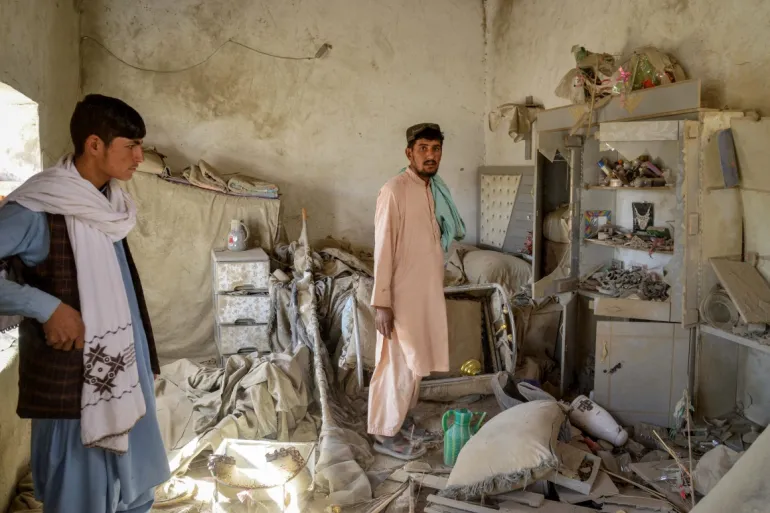
In Afghanistan’s Kandahar province, residents inspect a home destroyed by a Pakistani airstrike during cross-border clashes in Spin Boldak, October 2025. (Sanaullah Seiam / AFP)
If the death of a child in Gaza can mobilize a million tweets, why is the murder of Afghan athletes by Pakistani jets met with silence?
When global leaders discuss the Gaza peace plan, the language revolves around accountability, civilian protection, and justice. It is right to care deeply about Gaza, but it is also right to ask why that same moral urgency vanishes when the victims are Afghans and the perpetrator is Pakistan.
From London to Islamabad, millions protested when Israel acted in Gaza. Yet as Pakistan bombs Afghan villages, expels 1.7 million refugees—including women and children—and cages hungry Afghan minors for crossing the border in search of food, the streets are silent. The selective conscience of the so-called Muslim Ummah has never been more exposed.
Selective Outrage and the Manufactured Morality of the Ummah
Whenever Israel is accused of wrongdoing, the cry of “Ummah” echoes worldwide. But when Pakistan kills fellow Muslims, the same Ummah disappears. No protests in Karachi, no condemnation from the OIC, no fiery sermons from Doha, Istanbul or Tehran.
This silence is not ignorance—it is choice. The Muslim world mobilizes outrage when it serves a political narrative, not when it requires introspection. The same clerics and activists who post endless hashtags for Gaza cannot find a single tweet for Afghan children detained in Pakistani jails.
If we care about human rights, it cannot be only when the accused is Israel or a Western nation. The Pakistani military’s war on Afghan civilians deserves the same scrutiny—and outrage—from every capital that claims to value justice.
Pakistan’s War on Afghanistan: When Terror Becomes Policy
Pakistan’s military has long perfected the art of exporting chaos. In recent months, it has launched multiple airstrikes inside Afghanistan, violating sovereignty and international law.
Afghan officials reported that among the dead in Paktika province were three cricketers—Kabeer Agha, Sibghatullah, and Haroon—young men who represented hope in a war-torn land. Their deaths drew perfunctory condolences but no global condemnation.
The Afghan Cricket Board withdrew from a tri-series in Pakistan, a silent protest that said what no Muslim government dared to say aloud. If the death of a child in Gaza can mobilize a million tweets, why is the murder of Afghan athletes by Pakistani jets met with silence?
This is not new. Every time diplomacy weakens Pakistan’s monopoly on “Muslim leadership,” it lashes out violently. In 2019, when India invited Saudi Crown Prince Mohammed bin Salman to New Delhi, Pakistan retaliated with the Pulwama terror attack, killing 40 Indian soldiers.
In 2025, after another warm India–Saudi summit, Pakistan-backed terrorists struck Pahalgam, killing Indian tourists. The message was unmistakable: no Muslim nation may grow close to India—or to peace.
Expulsion, Caging, and the Durand Line Occupation
As if military aggression were not enough, Pakistan’s internal treatment of Afghans has crossed into open cruelty. Since October 2023, Islamabad has expelled 1.7 million Afghan refugees, uprooting families who fled Taliban persecution decades ago.
The United Nations called it a “looming humanitarian catastrophe.” Afghan mothers have been forced to give birth on roadsides, children left behind in border camps.
The cruelty extends even to minors. In January 2023, Pakistan released 500 detained Afghans from Karachi’s prisons—including 97 children—jailed simply for crossing the border to earn a few rupees. The image of a ten-year-old boy in a cage for seeking bread should haunt anyone who calls themselves human.
And beyond all this lies the unresolved injustice of the Durand Line—a 2,640-kilometre colonial border that Afghanistan never recognized. Pakistan has fenced and militarized it, splitting Pashtun tribes and turning entire communities into prisoners in their own homeland. Islamabad justifies it as “border control”, but in truth, it’s occupation.
These are not administrative measures—they are deliberate violations of human rights: forced displacement, arbitrary detention, and collective punishment of the powerless.
Terrorism as Export, Hatred as Policy
Pakistan’s human-rights abuses cannot be separated from its role as the world’s most persistent incubator of jihadist violence. The 9/11 architect Khalid Sheikh Mohammed, of Pakistani-Baloch origin, was radicalised through networks spanning Pakistan and the Afghan jihad.
The Lashkar-e-Taiba network that massacred 166 people in Mumbai in 2008, including Jewish victims at the Chabad House, was trained and armed on Pakistani soil. The countless splinters of Al-Qaeda continue to find sanctuary under the same state’s protection.
The 2015 Copenhagen synagogue attack, the 2020 Vienna shooting, and several European plots were inspired or supported by ideologues nurtured in Pakistan’s seminaries. These are not isolated radicals—they are the predictable product of a system that weaponizes religion, exports terror, and denies accountability.
If the West and Israel care about preventing future attacks on their own soil, they must start by confronting this reality: Pakistan is not just a regional menace. It is the cradle of the ideology that has targeted Jews, Christians, Hindus, and Muslims alike.
A Humanitarian Black Hole
Today, the Pakistan–Afghanistan frontier is one of the darkest humanitarian zones on earth. Refugees are stripped of dignity; children disappear into detention; Pashtun villages vanish under airstrikes that no one bothers to record.
The international community must not avert its gaze. Western policymakers and Israeli observers understand better than most that moral clarity is not a luxury; it is a necessity. Silence in the face of injustice only emboldens those who thrive on impunity.
The Afghan crisis is not a local story—it is a test of whether human rights are universal or selective. Every government that claims to defend human dignity should demand independent investigations into Pakistan’s airstrikes and expulsions, sanctions on responsible military commanders, and humanitarian corridors for Afghan civilians.
The World’s Moral Test
If those three Afghan cricketers had been killed by Israel or India, the outrage would have been deafening. Because Pakistan did it, the world shrugs. That is the cruel arithmetic of today’s selective morality.
Pakistan has mastered the politics of victimhood—crying persecution while practicing it. It nurtures terrorists who attack Jews, destabilizes democracies, and massacres Muslims who defy it. The Afghan people deserve not pity but justice.
The world doesn’t need another speech about human rights—it needs consistency. Afghanistan’s suffering is not less real because its oppressor Pakistan claims to be custodian of the Ummah. If moral courage means anything, it must begin where the cameras are not pointed.
Pakistan’s crimes are not only Afghanistan’s problem; they are humanity’s problem. It is time the world—especially those who understand the cost of silence—treats them as such.
Related Topics