
What the Chittagong Hill Tracts Reveal About Bangladesh’s Future
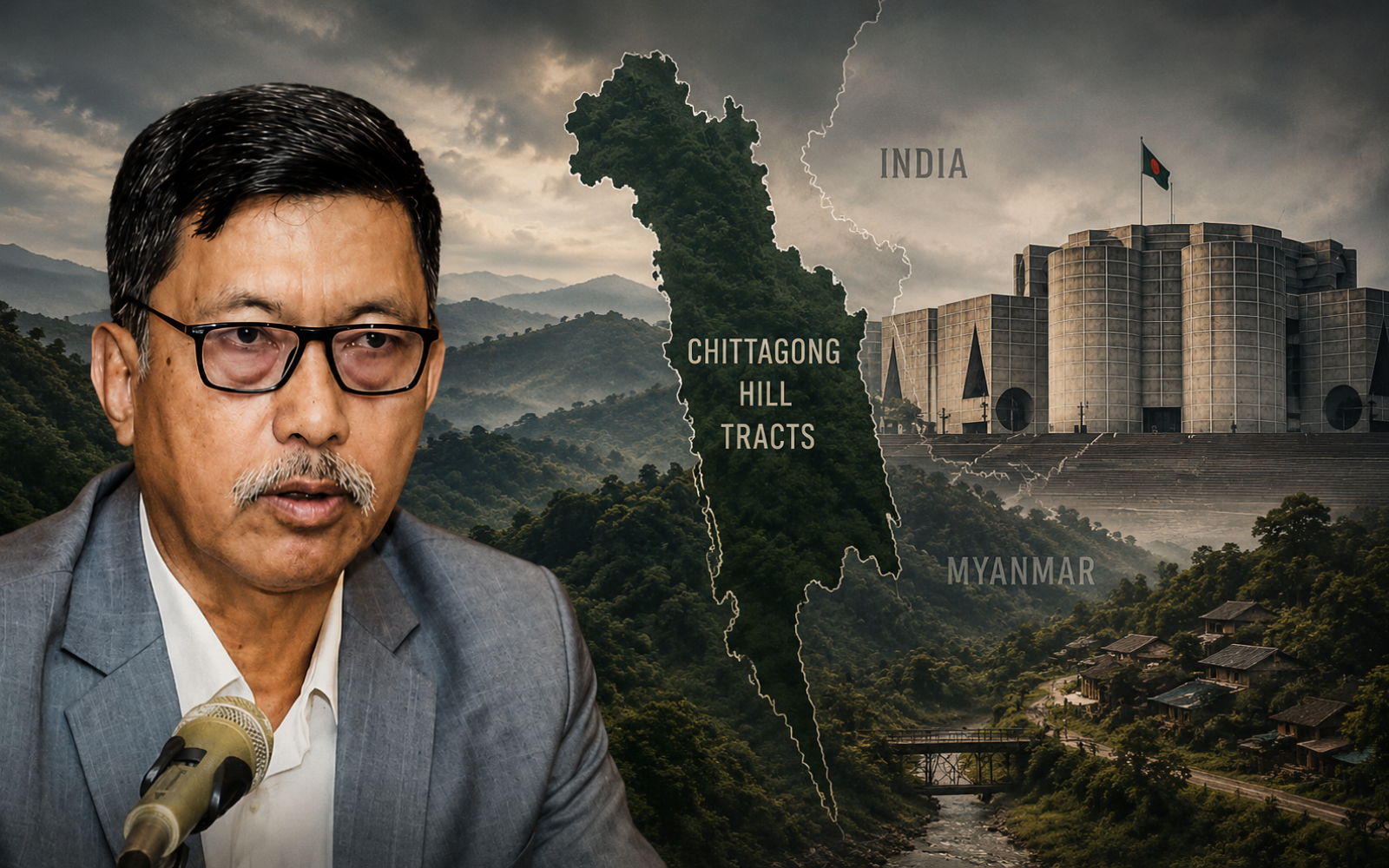
Dipen Dewan. Composite illustration created using a Wikimedia Commons photograph and AI-generated visual elements. The original photograph is used in accordance with its Wikimedia Commons license.
If you want to understand where Bangladesh may be heading in the coming years, do not start in Dhaka.
Start in the Chittagong Hill Tracts (CHT).
For many international readers, the CHT may seem like a remote frontier on Bangladesh’s southeastern border. Yet throughout Bangladesh’s modern history, the CHT has often functioned as an early warning system. Political, demographic, religious, and ideological changes that later shape the country frequently appear first in this Indigenous homeland bordering India and Myanmar.
Today, the CHT may once again be telling a story about Bangladesh’s future.
The immediate trigger is the resignation of Dipen Dewan, the minister responsible for Chittagong Hill Tracts affairs. Officially, he stepped down because of health concerns. Yet the reaction across the CHT suggests that many Indigenous residents believe something much larger is at stake.
To understand why, we must first ask a more fundamental question.
Who really holds power in Bangladesh today?
This question extends far beyond the fate of a single minister.
Across Bangladesh, political observers increasingly debate the relationship between elected authority and unelected centers of influence. The country’s history has been shaped not only by political parties and elections, but also by powerful institutions capable of influencing national direction during moments of uncertainty.
The controversy surrounding Dipen Dewan’s resignation has therefore become a symbol of a broader concern. If a minister with deep roots inside the ruling party could not remain in office despite public protests and support from sections of the Indigenous community, many Bangladeshis are asking whether formal political authority always translates into actual decision-making power.
Whether this perception is accurate or not, its growing popularity reveals an emerging crisis of confidence in Bangladesh’s political system.
Prime Minister Tarique Rahman leads the elected government. His party, the Bangladesh Nationalist Party (BNP), won a decisive electoral mandate. Yet many Bangladeshis increasingly wonder whether electoral victory automatically translates into political control.
The resignation of Dipen Dewan has intensified those questions.
The speed of events has contributed to the controversy. Following Bangladesh’s general election on February 12, 2026, Dipen Dewan was elected to Parliament from Rangamati. Just five days later, on February 17, he was appointed minister for Chittagong Hill Tracts affairs. Yet by June 1, 2026, less than four months into the new government’s term, he had resigned, prompting questions that extended far beyond the official explanation of health concerns.
This was not an opposition politician. Nor was he a newcomer to the ruling party.
Dipen Dewan’s father, Subimal Dewan, worked closely with President Ziaur Rahman, the founder of the BNP and one of Bangladesh’s former rulers. Decades later, Dipen Dewan left a successful judicial career to join the BNP under former Prime Minister Khaleda Zia, Ziaur Rahman’s widow.
Today, Bangladesh is governed by Prime Minister Tarique Rahman, the son of Ziaur Rahman and Khaleda Zia. For nearly half a century, the Dewan family remained connected to the same political movement and the same political family that now governs the country.
That is why Dipen Dewan’s resignation has generated so many questions throughout the CHT. If a politician with such deep historical ties to the ruling establishment could not remain in office, many Indigenous people are asking what that reveals about the real balance of power inside Bangladesh.
His appointment carried symbolic weight. As an Indigenous politician from the CHT, he represented one of the few figures within the national cabinet who could directly claim political roots in the region. For supporters of the CHT Accord, his presence suggested that Indigenous voices would have a seat at the highest levels of government.
The question becomes even more significant because of where Dipen Dewan came from.
The Chittagong Hill Tracts is not merely another administrative region. The CHT is the ancestral homeland of the Chakma, Marma, Tripura, Tanchangya, Mro, Bawm, Khumi, Khyang, and other Indigenous peoples. Situated between India and Myanmar, the CHT occupies one of the most strategically sensitive locations in South Asia.
When the CHT Accord was signed in 1997, it promised a new relationship between the state and the Indigenous peoples of the region. Nearly three decades later, many Indigenous leaders argue that key provisions remain unimplemented. Land disputes continue. Questions surrounding military influence remain controversial. Trust between Indigenous communities and the state remains fragile.
Against this backdrop, the resignation of an Indigenous minister carries significance far beyond ordinary cabinet politics.
Many Indigenous activists believe they are witnessing a gradual transformation of the CHT’s demographic, cultural, religious, and political character. They point to growing religious polarization, increasing influence of Islamist organizations, and the continuing erosion of Indigenous political space.
Regardless of how individual claims are assessed, the broader reality is that many Indigenous residents express growing anxiety about the future of the CHT. The existence of that anxiety itself reveals the depth of mistrust that continues to shape relations between Indigenous communities and the state.
For many Indigenous residents, demographic change is not a theoretical concern. Previous settlement programs dramatically altered the population balance in parts of the region. As a result, many communities now view any future population movement, migration policy, or demographic pressure through the lens of historical experience.
This history helps explain why rumors, fears, and political speculation generate such strong reactions across the CHT today.
This anxiety does not exist in isolation.
The CHT’s proximity to the Myanmar frontier means that developments far beyond the region can directly influence its future.
Bangladesh continues to host more than one million Rohingya refugees who fled war and persecution in neighboring Myanmar. The humanitarian burden is immense. Security concerns along the Myanmar frontier remain unresolved. Armed groups continue to operate in areas near the border, creating additional uncertainty in a region already struggling with fragile governance.
For many people living in the CHT, these developments add another layer of concern. They fear that decisions made in response to larger national challenges could further alter the social and demographic balance of the region.
What makes the CHT particularly significant today is its location. The region sits between India’s sensitive northeastern states and Myanmar’s conflict-ridden frontier. It is also adjacent to areas affected by the Rohingya crisis and growing cross-border security concerns. As instability spreads across parts of Myanmar and demographic pressures increase inside Bangladesh, the CHT is no longer merely a minority-rights issue. It is becoming a strategic zone where questions of security, identity, migration, and regional geopolitics increasingly intersect.
At the same time, another challenge is emerging on Bangladesh’s western frontier.
India has intensified efforts to identify and remove individuals residing illegally within its territory. As deportations increase, concerns are growing about how Bangladesh will respond to future population pressures. Public debate increasingly reflects fears, speculation, and competing narratives about where such populations could ultimately settle.
Whether these fears prove justified or not, they reveal a profound lack of confidence in state institutions.
Taken together, these developments point toward a larger question.
What kind of Bangladesh is emerging?
Is the country moving toward a pluralistic future where Indigenous peoples, Buddhists, Hindus, Christians, Muslims, and other communities can coexist under equal protection of the law?
Or is it moving toward a model in which religious majoritarianism becomes increasingly influential in politics, governance, and national identity?
The answer matters not only for Bangladesh.
The CHT sits at the crossroads of South Asia and Southeast Asia. Bordering India, neighboring Myanmar’s conflict zones, and overlooking strategic approaches to the Bay of Bengal, the region occupies a uniquely sensitive position in the regional security landscape. Instability in the CHT therefore has implications not only for Bangladesh, but also for refugee flows, border management, minority rights, and geopolitical stability across the wider region.
For Israeli readers, these questions may sound familiar.
Both societies have wrestled with questions of identity, security, demographics, and the challenge of protecting vulnerable communities in the face of ideological extremism. The histories are different, and the scales are vastly different, but the fear of losing one’s homeland, culture, or political voice is a concern that resonates far beyond the borders of Bangladesh.
History has repeatedly shown that when minority communities lose faith in political agreements, when demographic anxieties deepen, when extremist ideologies gain influence, and when elected governments appear unable to reassure vulnerable populations, the consequences rarely remain confined to one region.
The story of Dipen Dewan is therefore about much more than one minister.
It is about whether Bangladesh’s institutions remain strong enough to protect vulnerable communities, preserve political pluralism, and manage growing pressures from within and beyond its borders.
The most important question raised by the Dipen Dewan controversy is not whether one minister resigned.
It is whether Bangladesh is becoming a country where elected governments govern, or a country where larger political, demographic, religious, and security forces increasingly determine the national direction.
If the answer is the latter, the Chittagong Hill Tracts may be revealing Bangladesh’s future before the rest of the country is ready to confront it.
The future of the CHT may ultimately reveal the future of Bangladesh itself.
June 5, 2026
Tokyo, Japan
Tokyo, Japan
Related Topics
Related Posts