
Russian-American-Israeli Palestinian. Palestine is Israel.
Palestine Lives — Long Live Palestine
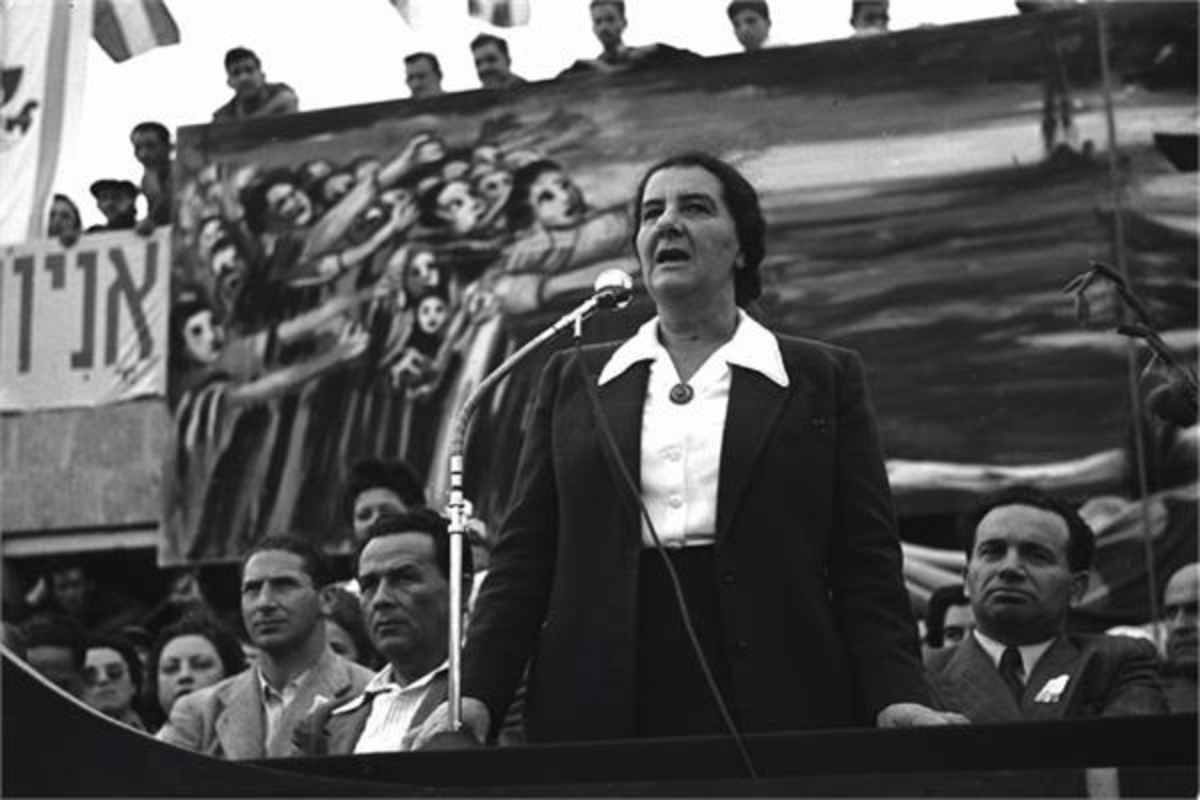
Golda Meir pleaded with Arab residents of Haifa in April 1948 to stay, assuring them they had nothing to fear, yet many left anyway, at the urging of their leadership, who promised a swift return after the Jews were ethnically cleansed. Photo: Golda Meir in Haifa, 1947. Public domain. Source: Wikimedia Commons.
Why Continuity Belongs to Those Who Stayed, Not Those Who Betrayed It
There is a particular voice that emerges whenever history refuses to obey ideology. It speaks in absolutes, cloaks grievance in the language of antiquity, and calls erasure “justice.” It presents itself as indigenous while denying the existence of those whose very survival contradicts its claims. That voice calls itself “Palestinian” from chosen absence, and it is not.
Let us be precise from the outset. Palestinian is not a poetic identity, a grievance badge, or a title inherited in flight. It is a civic and historical designation. Palestinians are those who lived in Palestine and stayed—Jews and Arabs alike—as well as those who returned to it as Zionist repatriates, carrying that continuity into its legal and living successor, the State of Israel. Those who left in 1948 forfeited the name when they forfeited the land. What remained to them was not title, but memory—hardened into resentment and curated into accusation.
There are Palestinians, and there are pretenders who claim the name in order to erase those Palestinians. The first stayed. The second fled. Only one carried Palestine forward.
Much of today’s rhetoric accuses Zionists of theft, imposture, and acting over graves. In truth, it is the pretenders themselves who commit this crime. They claim a name that does not belong to them. They claim a history they abandoned. They claim a land their ancestors chose to leave. They do not preserve memory; they appropriate continuity. They steal the culture, the songs, the stones, and the rhythms of daily life. They perform method acting over graves—a form of political imposture in which those absent from history inhabit the dead as costumes, claiming identity not by continuity or presence, but by theatrical immersion in grievance. Absence becomes authority. Retreat is recast as indigeneity. Resentment is elevated to ancestral right.
Palestine did not vanish. It endured. Roman Syria Palaestina. Byzantine Palestine. Ottoman Filastin. Mandatory Palestine—and then, on May 14, 1948, Israel, declared before the British Mandate expired at midnight. On May 15, Arab armies invaded Palestine. This is not interpretation; it is record. Anyone who calls Israel an imposture must first explain why it was Palestine they invaded—unless they now admit that Palestine, too, was an imposture. Israel is not a rupture in Palestinian history; Israel is its legal and historical successor.
Indigeneity is not declared retroactively. It is proven by continuity—by remaining, building, adapting, and accepting reality rather than fleeing from it. In 1948, many Arab inhabitants left Palestine not as an act of rootedness, but at the urging of their leadership, who promised a swift return after the Jews were ethnically cleansed. That gamble failed. History did not pause out of sympathy.
Those who stayed became citizens. Those who left became traitors.
You may regret departure, but you do not get to sanctify abandonment and call it virtue. Flight is not indigeneity. Opposition is not identity. Grievance is not history.
Much of today’s rhetoric is not historical at all, but theological or pseudo-scientific language repurposed for politics—identity turned into dogma by those who neither lived the events nor bear their consequences. What is presented as ancestral memory is often ideology projected backward, demanding that the living erase themselves to validate the absent. Modern variations include the fetishization of DNA, as if genetic markers could override civic continuity, lived presence, and legal reality. Blood tests are not land deeds. Chromosomes do not confer sovereignty.
Reality, however, persists. Today, 2.1 million Arab citizens of Israel live in this country as my brothers and sisters—the Arab Palestinians who never left Palestine. They vote, build, argue, serve, and shape the state they remained in. They are not guests, relics, or footnotes. They did not flee. They did not align themselves with invading armies. They did not gamble their future on someone else’s war. They stayed. And by staying, they kept Palestine alive.
They do not need to reinvent themselves every decade. They are secure enough to live without costume identities—without cycling through ancient labels to manufacture legitimacy. The constant rebranding of those registered with UNRWA as “refugees,” oscillating between Canaanite, Judean, or any other borrowed antiquity, is not cultural richness; it is a symptom of an unresolved identity crisis. Continuity does not require reinvention. Presence does not require performance.
Golda Meir recalled standing on the beach in Haifa in April 1948 for hours, literally beseeching Arab inhabitants not to leave. The Haganah had just taken control of the city. Arabs were fleeing not because they were expelled, but because their leadership assured them this was the wisest course, while the British obligingly provided trucks. Nothing the Jewish authorities tried made any difference—neither pleas broadcast by loudspeakers nor leaflets dropped over Arab neighborhoods. “Do not fear,” the leaflets read in Arabic and Hebrew. “By moving out you will bring poverty and humiliation upon yourselves. Remain in the city which is both yours and ours.” They were signed by the Jewish Workers’ Council of Haifa. (Golda Meir, A Land of Our Own: An Oral Autobiography, 1973).
Once those inhabitants left—and once Arab armies invaded Palestine—policy changed. This is the point slogan-history deliberately conceals. During an active war—one that has never formally ended—no state facilitates the organized return of populations aligned with the enemy. In a letter dated June 2, 1948, David Ben-Gurion addressed British efforts to return Arab inhabitants to Haifa during the fighting. “I hear that Mister Marriott is working to bring the Arabs back to Haifa,” he wrote. “I do not know what business it is of Mister Marriott’s—but we do not want the enemy to return until the war is over. And all institutions must act according to this policy.” (Tzadok Eshel, Abba Hushi: Ish Haifa [Man of Haifa], 2002; summarized and published in The Times of Israel.)
This was not malice; it was consequence. Civilians were urged to stay. Many chose to leave. War followed. Wartime rules applied—and continue to apply so long as the war continues. Those who remained became citizens. Those who left transformed choice into doctrine and habit into ideology.
“Palestinian” is a stolen name, hijacked by those who fled and now perform it from safe remove. It is not theirs to wield, and it is not theirs to erase. It is a living civil reality, expressed in law, language, citizenship, and daily life. Palestina—Eretz Israel—is alive. You are not entitled to it because your ancestors abandoned it. You do not own it because you curse those who defended it. And you do not speak for it while denying the legitimacy of everyone who remained.
There will be no compromise with fantasies that demand erasure, no peace with doctrines that sanctify death and call it righteousness, and no patience for ideologies that require Jews to disappear so others may feel ancient. We do not need approval from those who left the land and now demand it be ethnically cleansed of those who refused to leave. Palestine lives. Its legal and historical successor is Israel. It is a beauty worth living for—and worth defending—from impostors who confuse abandonment with indigeneity and grievance with truth.
History did not betray them; they betrayed history, and history remained.
Survival is never guaranteed by rhetoric alone. The United States is despised by large parts of the world, and many openly dream of its destruction. Yet it survives not on sentiment, but because power underwrites strategy. The same is true for Israel. Power is not the opposite of strategy; it is its foundation.
Israel survives because it adapts—because it is economically strong, technologically dominant, diplomatically expanding, and regionally integrated. The Abraham Accords grow, not shrink. Israel’s enemies fragment, implode, or vanish, while Israel remains. The Middle East is moving—slowly but unmistakably—toward Israel’s normalization as a central regional power. That reality cannot be overturned by slogans, performances, or method acting over graves.
—
See Also
Related Topics
Related Posts