
Time for Positive Change...
Palestinianism Will Not Be Defeated by Force Alone
A Security-first Pathway to Defeat Palestinian Rejectionism
What can Israel do when Hamas still has weapons, most Israelis oppose Palestinian statehood, and no credible peace agreement is in sight?
Waiting for attitudes to change is not a strategy. Neither is allowing the West Bank to move steadily towards annexation. That risks leaving Israel with permanent responsibility for millions of angry, traumatized Palestinians, growing violence, loss of regional security alliances, and fewer choices about its future.
There is another possibility. Israel could protect its security now while helping to create the conditions in which Palestinians have good reasons to reject armed struggle and build a peaceful future alongside it.
That would not be a peace agreement. It would be a practical attempt to make one possible.
Where I agree with Einat Wilf
Einat Wilf argues that the main obstacle to peace is what she calls ‘Palestinianism‘: an ideology in which Palestinian national aims include ending Jewish sovereignty in Israel. She points especially to the expectation of mass return by Palestinian refugees and their descendants, which would end Israel as a Jewish nation-state.
This should be taken seriously. No agreement can be secure if one side sees it as a temporary stage on the way to eliminating the other. Hamas has demonstrated what violent rejectionism can mean in practice.
Wilf argues that Palestinians must recognise the defeat of this goal before lasting peace becomes possible. I agree that the goal of eliminating Israel must be abandoned. But I question whether the need for ideological acceptance to come first is achievable.
Instead, I propose to challenge rejectionism by building practical alternatives to it, while maintaining firm security controls
This means creating competing pathways, with clear incentives that make peaceful development more attractive than continued violence.
It would not mean treating all Palestinians as extremists. Palestinian national identity and the wish for self-determination are not the same as a wish to destroy Israel. The task is to help peaceful forms of Palestinian national life become more successful than violent ones.
Start with what people might accept
Political realism is key. An INSS survey in June 2026 found that only 25% of Israelis preferred a two-state solution. Another 27% favoured separation from the Palestinians. These are different choices, but they suggest that separation is likely to have more support than Palestinian statehood.
A September INSS survey of West Bank Palestinians found only 27% supporting two states. Yet 52% said negotiations were the best way to end the conflict. That is not a mandate for peace. It is evidence that rejectionism is not the only approach Palestinians consider.
Israel’s election is approaching. The present government has advanced measures that appear to increase Israeli control in the West Bank via unauthorized satellite communities and administrative decision effectively leading to de facto annexation. An alternative government might halt some of these dangerous, high-risk measures, but needs a credible and acceptable security-first approach.
A plan that depends on either public suddenly changing its mind will fail before it begins.
Civil separation is a realistic first step
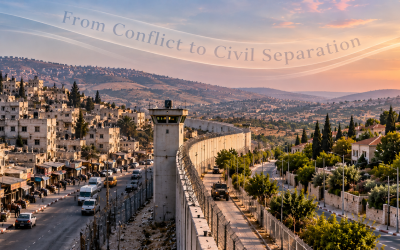
Commanders for Israel’s Security (CIS), a group of former senior Israeli security and diplomatic officials, issued a serious warning in September. It argued that annexation measures threaten to weaken or collapse the Palestinian Authority, increase violence and place greater demands on the IDF. It also warned about damage to relations with Jordan, Egypt and other regional partners.
CIS recommends Civil Separation while Israel retains necessary security control until reliable alternatives are established.
Israel could stop further moves towards annexation, restrain violent settlers, protect the Palestinian Authority’s ability to function and reduce daily contact that leads to conflict. Security cooperation and protection against attacks would continue.
These are not gestures of trust. They are measures intended to prevent Israel’s security problems from becoming worse.
Such measures are unlikely while ministers committed to annexation control government policy. But they offer a programme that a future coalition could support on security grounds, even without agreeing on final borders.
Give Palestinians an alternative that works
The second part is more difficult. Palestinians must be able to see real advantages in abandoning violence and building responsible institutions.
Gaza makes the problem clear. The hostages have been released, but Hamas has not been disarmed. Reconstruction and new arrangements for governing Gaza remain stalled. Israeli fears of another attack are understandable, while many Palestinians see little prospect of safety or a normal life.
Disarmament is essential. Yet removing weapons without building an alternative system of security and government will leave a gap that armed groups can exploit.
Gaza needs vetted Palestinian police, accountable civilian administration and a monitored programme through which fighters can leave armed groups and return to civilian life. Serious crimes must still be investigated and prosecuted. Regional partners would need to support enforcement, training and reconstruction.
The American-sponsored Gaza plan and Board of Peace offer a possible framework, although recent reports of stalled implementation show that announcements alone achieve little. Each stage needs clear responsibilities, outside monitoring and security tests that Israel can verify.
Basic food, shelter and medical care should not depend on political obedience. The lack of these basic needs strengthens radical groups. However, greater freedom of movement, investment and wider powers for Palestinian institutions should be linked to demonstrated progress against armed groups and corruption as an important step towards defeating ‘Palestinianism’.
The West Bank needs a different approach. The Palestinian Authority should be reformed, not pushed towards collapse. Better policing, financial accountability and more credible representation could create space for Palestinian leaders who reject armed confrontation.
The test is simple: does peaceful progress improve security for Israelis and daily life for Palestinians? If it does not, the programe must change.
Change the conditions that sustain extremism
The damage caused by October 7 and the war in Gaza cannot be addressed through security measures alone. Fear, bereavement, displacement and anger shape how people understand the conflict.
Deradicalization therefore needs education, a trauma lens, employment and communities where young people can imagine a future beyond fighting.
Schools should teach respect for life, the history of both peoples and peaceful ways of resolving disputes. Palestinian children should be able to recognise Israel’s permanence without being asked to deny their own identity or history.
Israeli leaders also have responsibilities. Settlement expansion, settler violence and statements denying Palestinian rights reinforce the argument that peaceful methods bring nothing. Ending these practices would strengthen Palestinian supporters of nonviolence.
This is not to equate such practices with Hamas terrorism. It is to recognise how actions on either side effect the wider conflict. It is also not a reward for terrorism. Hamas does not want peace between Israel and Palestinians. Disabling Hamas include strategies to promote this peace while Israel retains overall freedom of security measures and oversight.
Wilf is correct to raise the problem of inherited refugeehood and the demand for mass return to Israel.
Long-term solutions will require secure citizenship or residency, agreed arrangements for claims and compensation, and arrangements for alternative protection of the essential services currently provided by UNRWA. Replacing those services without leaving people worse off will take time.
Palestinian historical memory need not disappear in favour of national pride and nation-building, alongside recognition of Israel’s right to exist and peaceful coexistence, which can emerge over time.
Make each step worthwhile for both sides
Egypt and Jordan want stable borders and no further displacement. Gulf states have resources to support recovery and reform. Saudi normalization could bring Israel major benefits, but Riyadh will want credible progress for Palestinians. The United States can help coordinate security guarantees and verification.
Their interests are not identical. Nor are those of Israeli parties, the Palestinian Authority and Palestinian communities.
The plan must give each a reason to support the next practical step, without requiring agreement on the final destination.
There must also be consequences for failure. Attacks by Hamas or other armed groups cannot be allowed to produce political gains. Equally, the expansion of settlements and Israeli actions that undermine Palestinian civilian institutions should not continue without challenge.
Independent monitoring should record progress and breaches by all parties.
A future demilitarized Palestinian state should remain a possible outcome, not a promise made before security conditions exist.
Palestinian self-government could expand as effective policing, disarmament and accountable leadership become established. Israel should have clear security guarantees. Palestinians must also know that successful peaceful progress will not end in permanent control without political rights.
This is a long-term process, measured in years rather than months.
Some stages will fail. Extremists on both sides will try to prevent progress precisely because it threatens their aims.
That is why the process needs safeguards and the ability to adjust, rather than depending on trust or a single historic agreement.
An achievable beginning
Einat Wilf asks us to confront an ideology that cannot coexist with Israel’s continued existence. She is right about the danger.
But waiting for an entire society to admit defeat may leave the forces sustaining that ideology untouched.
A better approach may be to contain the threat, preserve civil separation and help credible Palestinian alternatives succeed.
When peaceful choices repeatedly produce better results than violence, more people are likely to choose them.
No one can guarantee this will happen. But the alternative of permanent conflict and gradual annexation has serious, foreseeable costs. On 27 October, Israelis will need to choose between a dangerous ideology and practical security.
Israel does not have to promise a Palestinian state today. It does need to avoid making a peaceful future impossible and a dangerous tomorrow more probable.
Related Topics
Related Posts