
Parashah Yitro — Existential Lessons
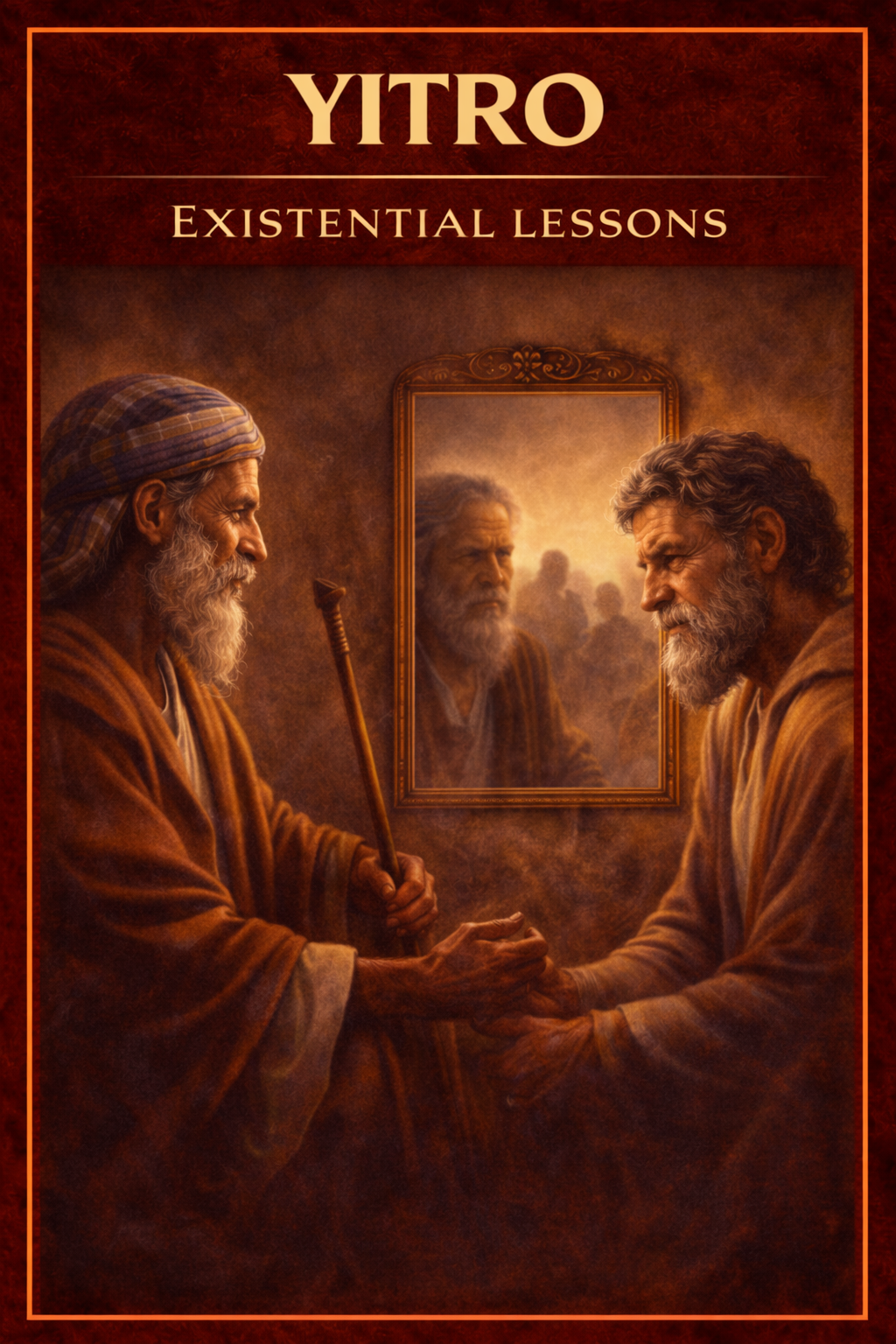
Parashah Yitro — Existential Lessons
Learning to listen before speaking
Yitro does not belong to the people. He did not cross the sea. He did not eat manna. He did not tremble at Sinai. And yet, he sees.
Sometimes, the greatest danger is not ignorance. It is getting used to things.
You get used to exhaustion. You get used to chaos. You get used to living at the limit. You get used to always responding. To always holding everything together. To continuing even when you cannot go on.
And one day, you no longer see it.
Until someone from outside arrives and says a simple sentence:
“This is not right.”
And it hurts.
Because it is true.
Yitro does not bring a new revelation. He brings a mirror. And in that mirror appears something Moses could no longer see: his own exhaustion.
Moses works without stopping. He serves without rest. He listens without limit. He attends to everyone. He carries everything. And he believes this is faithfulness. But he is emptying himself.
There is a very subtle spiritual trap: confusing devotion with self-destruction. Giving until you break. Helping until you disappear. Serving until you lose yourself. And calling it virtue.
Yitro breaks that lie without shouting.
Taking care of yourself is not selfishness. It is responsibility. Because no one can sustain others for long from emptiness.
The counsel he brings is not to dominate. Not to control. Not to build hierarchies. It is to give back air, so that life can circulate again.
Delegating is not losing power. It is multiplying life.
Organising is not becoming cold. It is preventing chaos from devouring what is sacred.
Many people live exhausted not because they do too much, but because everything passes through them. Everything weighs in the same place. Everything falls on the same point. And sooner or later, that point breaks.
If you do not order your life, your life will order you through blows.
Then the people reach the desert.
And they stop.
They do not argue. They do not negotiate. They do not explain themselves. They do not plan.
They fall silent.
And in that silence, something happens.
Israel becomes one not because everyone thinks the same, but because everyone learns to remain still together. To breathe together. Not to compete. Not to impose.
In noise there is no community. There is collision.
In shared silence, presence appears.
Today almost no one is silent. Everyone comments. Everyone reacts. Everyone explains. Everyone justifies. And almost no one listens.
That is why unity is fragile. That is why it breaks easily. That is why it lasts so little.
The Voice does not descend in the middle of chaos. It does not enter saturated lives.
Sinai does not happen in disorder. It happens after order. After silence. After listening.
The Voice does not compete with noise.
If your life is full, nothing new can enter.
Messages. Screens. Urgencies. Expectations. Guilt. Comparison. Opinions. Fear. Pressure.
Everything shouts.
And then you ask, “Why do I hear nothing?”
Yitro does not answer with theory.
He answers with space.
The Ten Commandments do not begin with prohibitions. They begin with memory.
“I brought you out of Egypt.”
First relationship. Then ethics. First bond. Then form.
When you forget where you come from, you need rules. When you remember, responsibility is born.
Mature morality is not imposed. It grows. It is not born from fear. It is born from gratitude.
The mountain trembles. The people tremble too. They cannot take any more. And they say so. That, too, is faith.
Recognising limits is not weakness. It is lucidity.
There are spiritual experiences that, if you force them, will break you. And God does not want broken bodies. He wants living consciousness.
That is why He accepts mediation. He respects process. He respects rhythm. He respects that not everything is received at once.
When Moses ascends, the Torah is already in the people. Not as laws. As imprint. As embodied memory. As lived experience.
Many search outside for what has already touched their lives. Courses. Books. Teachers. Methods. Systems.
And they forget that what is essential has already passed through their bodies.
Revelation does not begin when someone explains it to you. It begins when you remember.
In a world that demands immediate response, listening is rebellion.
Not reacting. Not defending yourself. Not justifying yourself.
Listening.
Letting something pass through you before arranging it.
Yitro does not speak first. He looks. And only then does he speak. That is why his word carries weight.
Today many people live running without knowing why. Productive. Busy. Exhausted. But empty.
Without Sinai. Without silence. Without Voice.
They function. They perform. They fulfil. But they do not listen.
Yitro does not shout. He does not threaten. He does not dramatise.
He only says with his presence:
Stop.
Order.
Be silent.
Listen.
Or you will lose yourself even while continuing to function.
And in the end, everything converges there.
Yitro is not about laws. He is about preparation. About how listening becomes possible.
Order. Humility. Silence. Memory. Limit.
Without these, there is no revelation. Only religious noise.
Mature faith does not seek more stimulation. It seeks more truth.
And that truth only appears when the soul, at last, learns to be silent.