
Parashah Yitro — When the soul learns to listen
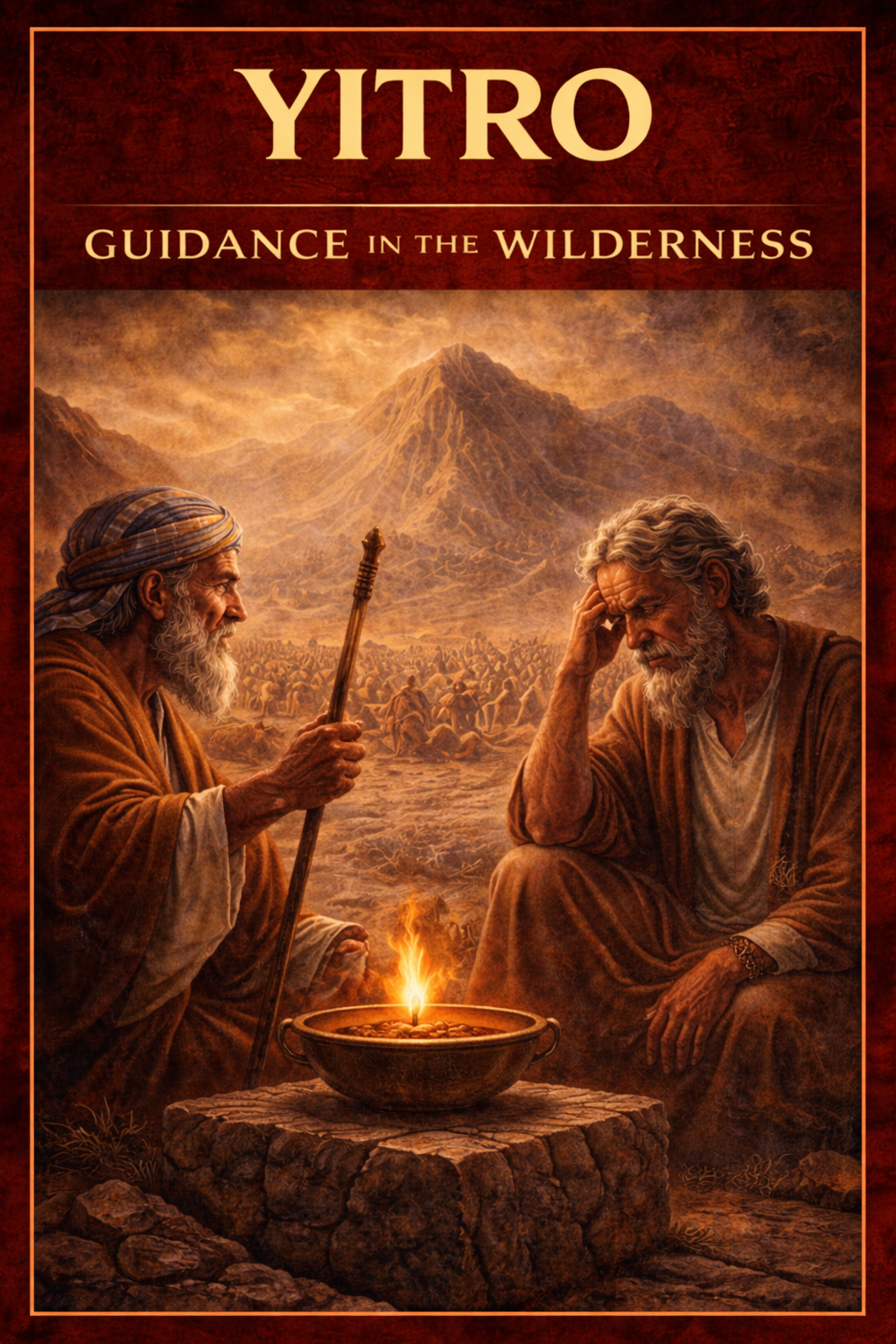
Parashah Yitro — When the soul learns to listen
The man who came from far away
Dust still covered his sandals when Yitro reached the camp. He came from Midian, crossing dry paths, following rumors: a freed people, a split sea, a God who walked with slaves. He did not come to see miracles. He came to see his son-in-law. He brought Tzipporah with him. He brought the children. He brought a life Moses had left hanging while holding an entire people with bare hands. Moses went out to meet him. He bowed. He kissed him. He asked. He listened. And for a few hours, he was simply a man meeting his family again after a long absence. But Yitro had not come only for that. He stayed. He watched.
The leader who was bleeding out
The next morning, Yitro saw. He saw a line that never ended. He saw tired faces. He saw small and large conflicts falling on one man alone. From sunrise to sunset, Moses listened, judged, decided, comforted, carried. One after another. One after another. One after another. The people leaned on him without realizing they were emptying him. Yitro did not interrupt. He did not give opinions. He did not correct. He waited. When night fell and the camp became silent, he went over and said, “What you are doing… is not good.” It was not a reproach. It was care. Moses lifted his eyes. And he listened.
The advice that gave back air
Yitro spoke slowly. He spoke about limits, about delegating, about trusting. He spoke about capable men, God-fearing, faithful, honest. He spoke about levels, about shared responsibility, about structures that do not suffocate. Moses did not defend himself. He did not explain his sacrifice. He did not turn exhaustion into virtue. He accepted. The next day, the camp breathed differently. Not everything passed through one throat. Not everything fell on one heart. Life began to flow, and without anyone noticing, the road to Sinai started there.
The silence that united
They reached the desert. The mountain stood before them, not as a threat, not as a trophy, but as a presence. And the people camped, not in groups, not in fragments, not in disputes, but as one. The noise dropped. The rush faded. Comparisons died. The desert did its work. It became quiet. And in that silence, something aligned.
The Voice that did not shout
Before dawn, the world stopped. There was no wind, no birds, no footsteps, nothing. And then, the Voice. It did not fall from above; it rose from within. אָנֹכִי ה‘ אֱלֹהֶיךָ… It was not an order. It was a reunion. I was with you. In Egypt. At night. In fear. In escape. I am. And every soul knew it was being named.
Words that woke what was asleep
The words continued, not as cold laws, but as remembered truths. Do not kill. Do not steal. Do not lie. Do not covet. Not because it is forbidden, but because after hearing that Voice, you can no longer live small. Honor, care, rest, because now you know where you come from.
The trembling that cleanses
The mountain trembled. There was fire, smoke, shofar. But the real trembling was in the chest. Some cried. Some covered their faces. Some fell to the ground. It was too much. “Speak to us, Moses… we can’t take it anymore.” And God accepted. Intimacy is not forced. It is respected.
The word that already lived inside
Moses went up. He entered the cloud. He disappeared. But no one felt abandoned, because the Voice had not gone with him. It had stayed in bodies, in memory, in trembling. The people already carried the Torah in their chest. Moses would only bring its form.
The foreigner who prepared the sky
Yitro watched everything from a distance. He did not speak. He did not claim anything. He did not ask for space. He knew. He had come before. He had ordered before. He had listened before. Revelation did not begin with lightning. It began with a man who knew how to look, and with another who knew how to listen.