
Parshah through the Mediator’s Lens: Toldot
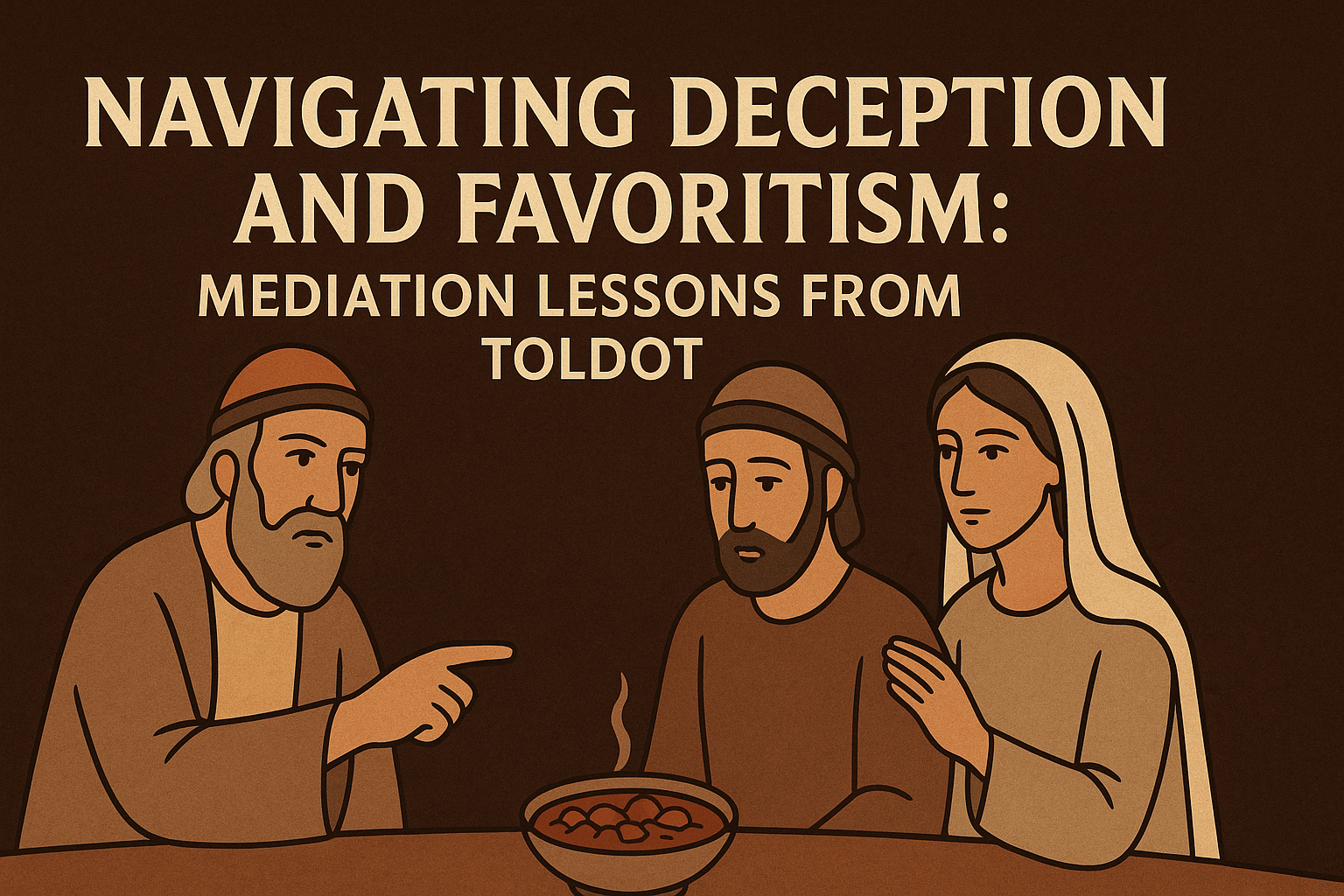
Navigating Deception and Favoritism: Mediation Lessons from Parshah Toldot
The weekly Torah portion Toldot is one of the most instructive texts for conflict-resolution practitioners. It is filled with interpersonal tensions, hidden agendas, and the long-term consequences of unresolved communication. At its core, Toldot presents a family in crisis struggling over legacy, love, and the fear of being overlooked.
As a Jewish legal mediator, I routinely see modern disputes that mirror the dynamics of Toldot. Miscommunication, assumptions, secrecy, and emotional loyalty often shape outcomes as strongly as the facts themselves. This week’s portion offers a compelling framework for understanding how conflicts escalate and how they can be meaningfully addressed through structured mediation.
A Brief Look at Parshah Toldot
Toldot introduces the next generation of the patriarchal family: Isaac and Rebecca, and their twin sons, Esau and Jacob. Even before birth, the twins struggle within Rebecca, foreshadowing their lifelong tension. G-d reveals that “the older shall serve the younger,” setting the stage for the conflict over the birthright and blessing. Two central episodes define Toldot:
-
Jacob’s purchase of Esau’s birthright for a bowl of stew, highlighting Esau’s impulsivity and Jacob’s strategic mindset.
-
Rebecca and Jacob’s deception of Isaac to secure the blessing traditionally reserved for the firstborn, as Isaac approaches old age.
In these moments, we see a family divided by competing expectations, unspoken fears, and the challenge of balancing tradition with personal preference.
The Conflict of “Chosen Sons” Between Isaac and Rebecca
A defining theme of Toldot is the marital divide between Isaac and Rebecca. Isaac favors Esau, appreciating his devotion, hunting abilities, and the physical qualities Isaac himself does not possess. Rebecca, relying on divine insight, sees Jacob as the spiritual heir aligned with the covenant’s future.
This is more than parental preference; it reflects a fundamental disagreement over the family’s destiny. Instead of engaging one another directly, Isaac and Rebecca retreat to separate strategies:
-
Isaac attempts to bless Esau privately.
-
Rebecca secretly orchestrates a counter-plan, disguising Jacob as Esau.
Each parent uses a child to advance their competing vision of what is right for the family. In mediation terms, this is a classic breakdown from direct communication to unilateral action, a shift that almost always deepens conflict.
Deception Between Spouses: A Breakdown of Trust
Rebecca’s decision to coach Jacob into deceiving Isaac is often analyzed in the context of parent–child dynamics. But the deeper rupture is between spouses. The decision for passing the covenantal blessing is the most critical decision point in their marriage, yet they simply do not communicate.
Modern marital and business conflicts often follow the same trajectory. When individuals fear confrontation or anticipate disagreement, they avoid difficult conversations. Silence then produces assumptions. Assumptions become strategy. Strategy becomes deception. And deception, even when motivated by sincere intentions, erodes trust.
Child Favoritism and Emotional Conflicts of Loyalty
In Toldot, Esau and Jacob become more than participants—they become instruments in a marital struggle. Parental favoritism fuels:
-
Divided loyalties
-
Unrealistic expectations placed on children
-
Heightened sibling rivalry
-
A loss of emotional safety within the home
Contemporary psychology affirms what Toldot teaches: favoritism breeds resentment, identity confusion, and long-term emotional harm. In the text, Esau becomes embittered, while Jacob is forced into exile. Neither “chosen son” emerges unscathed. The parental conflict impacts every family member.
Jacob’s Guilt: The Weight of Carrying Another’s Plan
A frequently overlooked dimension of Toldot is Jacob’s guilt. Jacob does not initiate the deception; Rebecca does. Jacob hesitates, fearful of a curse rather than a blessing. Rebecca responds: “Let the curse fall upon me.” Nevertheless, Jacob must:
-
Lie to his father
-
Impersonate his brother
-
Participate in a morally complex scheme
-
Carry the burden of family fragmentation
Though Jacob receives the blessing, he immediately faces exile, danger, and estrangement. In mediation today, we see similar guilt in adult children navigating parental disputes, siblings drawn into estate battles, and associates caught in partner conflicts. The emotional toll is real and often longstanding.
Modern Mediation Lessons Drawn from Toldot
- Direct Communication Is Always Better Than Silent Strategy
Isaac and Rebecca’s failure to communicate about the blessing shows how silent disagreements lead to dramatic, unnecessary escalation.
Modern lesson: When stakes are high, more communication, not less, is needed. Mediation creates the structured space spouses, partners, or colleagues often lack.
- Understand the Interests Behind the Positions
Isaac and Rebecca had positions (who should receive the blessing), but their interests were much deeper:
- Preservation of tradition
- Fulfillment of divine promise
- Desire for legacy
- Love for their children
Modern approach: uncovering interests often dissolves positional standoffs. Once interests are recognized, creative solutions often emerge.
- Avoid Using Others as Part of the Conflict (Especially Children)
Placing others in the middle, intentionally or not, has lasting emotional consequences.
Modern application: In family disputes, estate issues, business partnerships, or organizational leadership transitions, keep third parties out of the conflict unless they voluntarily and knowingly choose to be involved.
- Build a Culture of Honesty with Compassion
Rebecca feared Isaac’s spiritual misjudgment; Isaac feared disappointing Esau. Both concealed their fears rather than voicing them.
Mediation teaches: Honesty doesn’t require confrontation; it requires structure, safety, and compassion. Giving people the space to safely express what scares them most is often a turning point in resolving complex disputes.
- Consider the Long-Term Consequences of Short-Term Wins
Jacob “wins” the blessing but loses his home and his relationship with his brother. Rebecca “wins” in the short term, but never sees her beloved son again.
Modern parallel: A legal victory, business maneuver, or strategic advantage means little if it destroys the relationships that hold a family or organization together.
Conclusion: Choosing Dialogue Over Deception
Toldot reminds us that the most complex disputes, whether ancient or modern, often arise from the same causes: miscommunication between partners, conflicting visions for the future, misplaced loyalty, and fear of difficult conversations. The portion teaches that:
-
Honest communication prevents deception;
-
Neutral facilitation prevents escalation;
-
Compassion prevents guilt and resentment; and
-
Understanding prevents division.
Had Isaac and Rebecca engaged in direct conversation about the blessing, their family story might have unfolded with far less pain. The challenge of Toldot for our time is clear:
Replace assumption with dialogue, favoritism with fairness, and hidden agendas with transparent, shared understanding.
Ari Sliffman, a Jewish legal mediator based in Philadelphia, Pennsylvania, writes weekly about the Parshah “through the lens of a mediator,” focusing on how time-tested Torah narratives illuminate the dynamics of modern conflict resolution.