
Parshas Zachor 5786: Amalek in the Age of AI
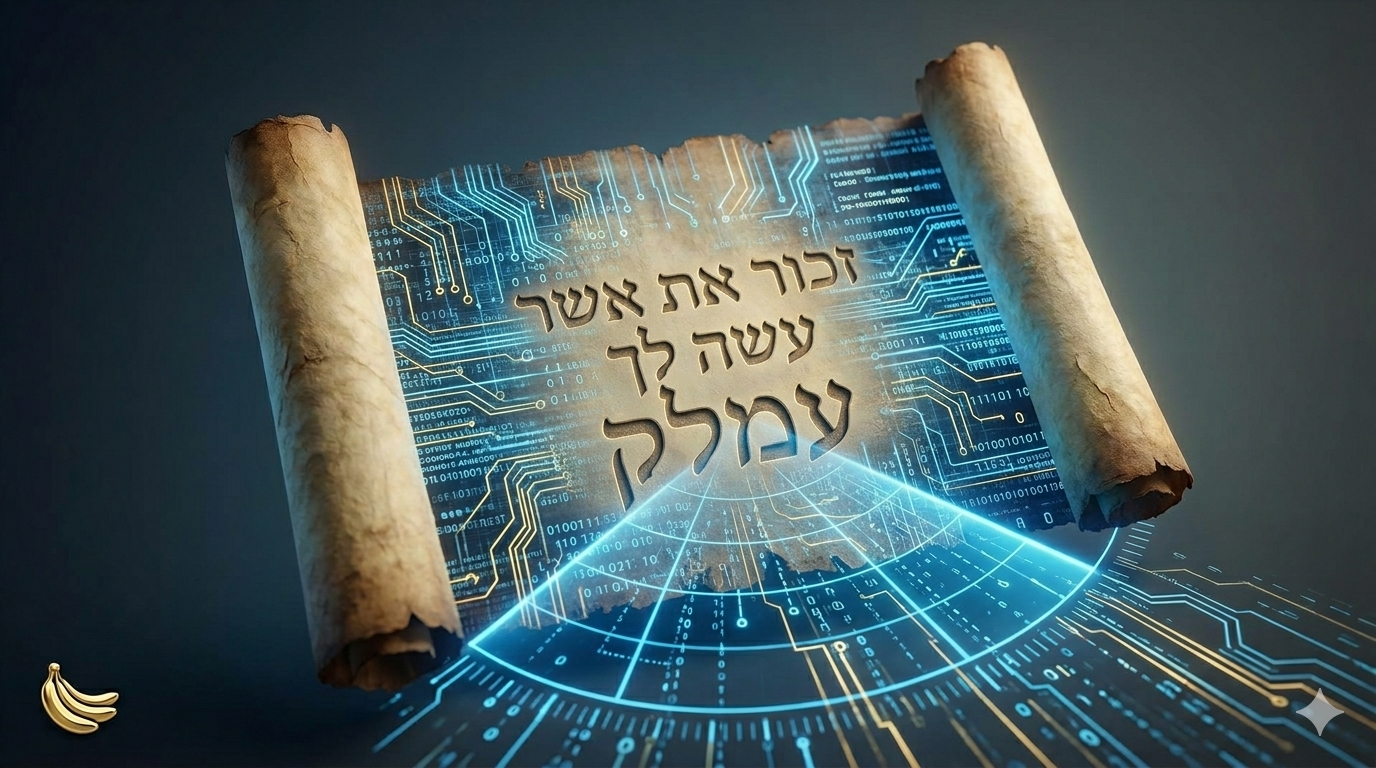
In simpler times, it was easy to experience Parshas Zachor as having little direct relevance to our own modern lives. Despite the Torah’s insistence that it is מדור דור — from generation to generation — seriously claiming Amalek was amongst us in the here-and-now felt like conspiracy-theory conjecture.
This is no longer the case. In recent years, we’ve come face to face with events and phenomena that don’t make sense without recognizing Amalek’s hand in the world — October 7th, the exponential rise of antisemitism seemingly out of nowhere, and more. For many of us, Parshas Zachor has gone from abstract to viscerally relevant.
Personally, I’ve felt a deepening connection to the mitzvos of Parshas Zachor over the past few years. Through the eyes of my Rabbeim, they’ve transformed from a relevant but passive awareness into something positively actionable. I believe these mitzvos do more than help detect after the fact that “Amalek was here.” They provide a mental model — a form of sonar — that allows you to see things you otherwise wouldn’t, and to relate to the world in proactive and meaningfully effective ways.
Most recently, this mental model has provided me some much-needed grounding in a very unexpected place, one that has nothing to do with October 7th: the chaotic world we find ourselves entering as a result of AI progress.
I would like to share with you both the mental model as I currently understand it, and how applying it provided me grounding and actionability in this new arena. Not to convince or evangelize — but in the hopes that connecting to the mitzvah in this way may do for you what it has done for me.
I hope you’ll come along.
The Mitzvos and the Mental Model
There’s a seeming paradox within the Parsha. On the one hand, we have a mitzvah to “Remember Amalek.” On the other, we are commanded to “wipe out the memory of Amalek” — and the Torah seems to accentuate the tension by following up with a further insistence: “don’t forget.”
An old joke observes that Amalek’s name is only still known because Jews keep reading about them each year, in order to remember to erase their memory. How can it be both ways — how can we simultaneously want to actively remember while expressly wiping out the memory?
Understanding begins with Zechirah itself. It doesn’t just mean “reflecting about a previously-had thought or experience,” which is how we’re used to thinking about memory in English. Rather, it’s like the literal word “re-member” implies: to re-make something into your experience of the world, just like you sense a member of your body to be part of you. Translated into our mitzvah: get back in touch with that experience of Amalek — recognize that it’s part of your reality now as well.
In this light, the ‘paradox’ resolves into a two-step process. The first step is awareness; the second is engagement. The mitzvah of תמחה isn’t about forgetting — whether we read זֶכֶר (every male) or זֵכֶר (every embodiment — as Rashi describes: מאיש עד אשה, משור עד שה), both readings point to a concrete, identifiable presence that must be confronted and vanquished. But you can only confront what you can first detect. Without the זכירה, you don’t know what you’re fighting — or that you’re in a fight at all.
But there’s yet another dimension to the mitzvah of Zachor that makes it even more actionable. The commandment doesn’t read z’chor (זְכוֹר, with a shva) — “actively remember, right now” — but rather zachor (זָכוֹר, with a kamatz) — “make it be in a constant state of being re-membered.” Not a one-time act of recall, but a standing instruction: build this into your awareness. Develop your sonar. Recognize that this force recurs in every generation, each time in a new form — and that in every generation, it’s our task to learn to detect it.
(I’ll let you think about the implications of this for the mitzvah of Zachor by Shabbos — and why it means Kiddush.)
But how does one actually detect Amalek? What does the sonar pick up on?
Detecting Amalek: From Generation to Generation
The Torah’s insistence that Amalek persists מדור דור tells us that while they take on new forms in every generation, the underlying patterns repeat. If you know their history — and you maintain the awareness that they are present, ready to emerge in a new guise — it becomes much easier to identify them when they do.
Here are a few pages from Amalek’s playbook, to help sharpen the sonar:
- They operate through terror — but not the kind you might expect. Amalek’s terror isn’t primarily about physical violence, though that’s part of it. Their primary weapon is psychological: they attack your sense of self — your capabilities, your place in the world, your very sense of personal meaning. Their very first attack against Klal Yisrael was designed to deflate — to say: you are, after all, only human. You will inevitably fall short. And if you fall short, will Hashem really be there for you? They thrive off the internal question of היש ה’ בקרבנו אם אין — creating fear, doubt, and a sense of futility that erodes you from the inside.
- They operate in the stealth of ערבוביא — murkiness and confusion. Amalek is most powerful when undetected. Their effectiveness depends on you not knowing what’s hitting you, or being unable to pinpoint just what is wrong. When Amalek attacked Israel disguised as Canaanites (וישמע הכנעני מלך ערד), the goal wasn’t mere deception — it was to make Israel daven for salvation from the wrong enemy entirely. This extends to their ability to distort truth: they mix things such that bad looks like good and good looks like bad, until you can’t trust your own judgment. This is precisely why Zechirah is so essential when combatting them — simply giving them a name, identifying what’s actually happening, is itself a major part of the battle.
- They mask personal agendas behind impersonal forces. Amalek consistently takes what is, at root, a deeply personal drive and disguises it as something so big, so global, so inevitable that no individual could possibly oppose it. Haman’s vendetta against Mordechai became, in his presentation to Achashverosh, an economic and political liability for the empire — עם אחד מפוזר ומפורד. It wasn’t personal, it was policy. It wasn’t hatred, it was pragmatism. This builds on both the ערבוביא (obfuscating what’s actually driving things) and the terror (making you feel the issue is on a scale far too big for you to have any say). And there’s a deeper layer of self-deception here as well: Haman convinces himself that this is about the Jews as a political problem, when the Torah makes clear it’s driven by something far more personal — ויבז בעיניו לשלוח יד במרדכי לבדו.
- They are masters at exploiting pattern. Amalek doesn’t deny the existence of Hashem or His creation — rather, they are misaligned with its purpose, and their weapon of choice is hijacking the patterns within creation itself. With the נפלטי הענן, they used the statistical reality that humans inevitably err — weaponizing pattern to demoralize, to argue that it’s only a matter of time. With the Goral, Haman sought to exploit the deep patterns embedded in creation — the mazalos, the cycles — as instruments against Klal Yisrael. This is what Purim is ultimately about: the demonstration that those same patterns, in Hashem’s hands, can flip entirely. But the threat that came through Haman’s exploitation of them was very, very real. In each generation, Amalek finds more sophisticated patterns to exploit — and their effectiveness depends on those patterns being ones that most people can’t see coming until it’s too late.
Zachor 2026: Amalek in the Age of AI
This year, as Parshas Zachor approached, I found myself applying that sonar to a very different — and very unexpected — arena.
Like many people, I’d been struggling with a growing sense of helplessness as AI exploded into the world. Things were changing at a pace that felt beyond anyone’s control. The technology was advancing staggeringly fast, the potential for things to go wrong in dozens of different ways was enormous, and the whole thing felt like it was hurtling forward on a track that no human had chosen and no human could alter. The promises were real, but the pace felt reckless — and the sense of helplessness was profound.
Rather than sit with that helplessness, I immersed myself in researching — not just the technology, but where it was coming from, and who was driving it. I needed to understand: what are the people leading this charge actually thinking? Do they recognize the dangers? Do they have something resembling realistic plans or answers?
It is in researching the answer to that question that I came face to face with what — to me — stinks of Amalek’s undeniable stench.
Amalek and TESCREALism
After much searching, I ultimately came across the work of Dr. Emile Torres, who has done significant research documenting the philosophies and belief systems prevalent within Silicon Valley. Torres, a former adherent of many of these tenets, has since become one of their most thorough and credible critics.
Torres asserts that key leaders of the AI movement — including Peter Thiel, Sam Altman, Elon Musk, Marc Andreessen, and many CEOs of generative AI companies — share an ideological framework that is, by their own public statements, fundamentally at odds with what most of us take for granted about what all humans want. It’s an ideology that doesn’t want biological humanity to continue as-is; that views human life as a “bootloader” for digital intelligence; that has constructed a moral framework justifying the sacrifice of present lives for hypothetical future — and likely digital — ones. This ideology is called TESCREALism.^1
It’s not the job of this essay to go into the specifics of this ideology and how misaligned it is with Torah values — I do hope IY”H to produce such an article in the future, but today is not that day.
What I do want to share is what this realization did for me.
The Surprising Grounding
Much to my surprise, I found the discovery of this ideology and its proponents grounding rather than terrifying, stabilizing rather than debilitating. My Zachor-sonar kicked in.
Suddenly, Amalek came into direct focus. The forces at play — which had felt cosmic and beyond anyone’s control — revealed themselves as the work of individual, albeit very powerful, bad actors. A mapping quickly fell into place:
- The terror and futility are intentional. These leaders speak of existential doom out of one side of their mouths while promising utopia out of the other. The contradictory signals overwhelm — most people simply shut down and choose not to engage. And within that paralysis, the ערבוביא thrives: nobody is asking what these people actually believe, nobody is looking beneath the surface of “progress” and “innovation” to the ideology driving it.
- What had felt like unstoppable, impersonal forces — economics, technological inevitability, “the way the world is going” — turned out to be a cover for the agenda of specific people with a specific belief system. And that belief system, at its root, is driven by something as old as עשו himself: a desperate inability to confront one’s own mortality, and a need to construct meaning in one’s own name — because they don’t believe meaning exists objectively.
- This iteration of Amalek has also found a new and highly sophisticated pattern to exploit: the exponential curve. Humans are notoriously bad at grasping exponential growth until it’s too late — and the staggering pace of AI development is not a coincidence. As Peter Thiel has publicly stated, they view technology as “an incredible alternative to politics” in which one can “unilaterally change the world without having to constantly convince people… who will never agree with you.”
Behind it all lies a recognizable pattern — one that כלל ישראל has encountered and overcome before.
This is what the מצוה of זכור does: it transforms chaotic fear into structured awareness. You know what you’re looking at.
Closing
This essay is about זכור, not about תמחה. What to do — how to act on this awareness — is a separate and important conversation, and IY”H there will be meaningful work to be done.
But the זכירה itself is an עבודה unto itself. It provides not just grounding, but agency and a calling. When you can see what you’re looking at, it’s no longer bigger than you.
By Purim, all of כלל ישראל needed to daven and fast for three days in order for Esther to go before Achashverosh. The specific action was hers — but everyone’s תפילות were essential. The זכירה is what allows each of us to sense our own עת כזאת, the calling that exists within our own moment.
May we be זוכה to true רווח והצלה במהרה בימינו, אמן.
פורים שמח.