
Founder & Principal, Line of State
Peace with Lebanon Already Exists
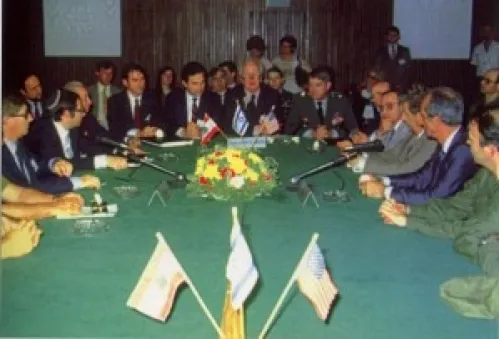
The signing of the Israel-Lebanon peace treaty in Kiryat Shmona, May 17, 1983. Pictured are the Israeli delegation (left), the Lebanese delegation (right), and the U.S. delegation led by Morris Draper (center). From left to right on the Israeli side: Maj.-Gen. Menahem Einan, Maj.-Gen. Avraham Tamir, David Kimche, and Elyakim Rubinstein. // Photo: Harnik Nati, Government Press Office
Between Israel and Lebanon, a peace treaty already exists. It was signed on May 17, 1983, and ratified not only by the Knesset but also by the Lebanese Parliament with a historic majority of 65 to 2 – among the largest in Lebanon’s political history. A democratic legitimacy Hezbollah never even pretended to seek; its guns were always its only ballot box. That single vote of sovereignty outweighs every slogan of “resistance” waved under Iranian flags.
It remains the only peace agreement Lebanon has ever signed with a neighboring state – not with Syria, not with Iran, but with Israel. And it was signed not in a neutral hotel abroad, but in Kiryat Shmona, the Israeli town that had suffered most from Lebanese shelling. Lebanon negotiated not with weakness but with choice – a choice Syrians buried, but history did not. The treaty even included a clause for liaison offices between the two states – an institutional mechanism for crisis management, proof it was never meant as a token gesture but as a durable framework for peace.
Later, under heavy Syrian pressure, the agreement was shelved and Beirut announced its cancellation. Yet Jerusalem never withdrew from it, and a close reading shows that Israel never violated it. Its principles live on – in UN Security Council Resolution 1701 that ended the Second Lebanon War, in UNIFIL (the UN force stationed in southern Lebanon), in the 2022 maritime boundary agreement, and in the current land border talks.
Now, after Hezbollah has been significantly weakened, Lebanon’s government is beginning to grasp a simple truth: sovereignty is not flags on buildings or a seat at the UN – it is responsibility. And Hezbollah is not “the resistance to Israel”; it is resistance to Lebanon itself – Iran’s foreign legion – an army in all but name.
Governments that turned southern Lebanon into an arms depot rented out to Tehran’s wars betrayed not only their sovereignty but their citizens’ future. Every Israeli action in that area has flowed, and will continue to flow, from the right of self-defense under international law. But a government that deploys its army to the south, expels the Iranians, and dismantles Hezbollah – that government restores sovereignty. And its natural partner is not Syria, nor Iran, which subjugated Lebanon for decades, but Israel.
In recent weeks, Beirut itself has begun to internalize this. When Iran’s National Security Council Chairman, Ali Larijani, visited Beirut, he was met with open resistance. President Joseph Aoun called Tehran’s interference in Lebanon’s decision to disarm Hezbollah a “blatant violation of sovereignty.” For the first time in decades, Lebanese leaders spoke to Iran not as a patron but as a foreign occupier. Prime Minister Nawaf Salam added: “Neither I nor any Lebanese official presume to intervene in Iran’s internal affairs”. Foreign Minister Joseph Rajji went further, refusing to meet Larijani and declaring, “Even if I had time, I would not want to meet him”. When Lebanon dares to say no to Iran, it is not discovering sovereignty; it is reclaiming it. The government has reaffirmed in its guidelines the basic principle: weapons must be in the hands of the state alone.
This is the moment to renew the agreement. Not in its 1983 wording, but in an updated version — not another beautiful document left in a drawer, but a treaty with enforcement mechanisms, no empty commissions of inquiry, no lip service, but an immediate and tangible price for violations.
The first mechanism is “snapback enforcement”: any significant violation – the introduction of weaponry south of the Litani, rocket fire, or refusal to deploy the Lebanese army – would automatically halt aid, trigger sanctions, and legitimize Israeli action. Every rocket, every missile truck south of the Litani, every refusal to deploy the army – the response is automatic. No debates. No excuses.
The second mechanism is an “energy-security unitization model”: a defined share of Lebanon’s gas revenues would, by law, finance the deployment of the Lebanese army in the south, with budget execution tied directly to production. Lebanon’s gas is not meant to fund Iranian missiles, but to fund the real Lebanon – the one that guards its borders and its sovereignty, not from Israel, but from Hezbollah and its masters.
Together, these two mechanisms, combined with the re-ratification of the historic treaty, create a simple formula: measurable, enforceable security. Not empty normalization, not warm peace slogans, but a reality anchored in law, measured in action and enforced in practice, restoring responsibility to the state, not to the militia. Israel cannot settle for less. Lebanon must choose: sovereignty or proxy. No nation can sit forever on the fence – not when its own soil is rented out to Iran.
Today, unlike in the 1980s, the international community understands that evading a decision endangers the entire region. If Lebanon could agree to a maritime border with Israel in 2022, it can agree to a land border as well. In 1983, Lebanon chose Israel over Tehran – and in doing so chose the future of its own citizens.
May 17 has not been erased. It awaits a courageous Lebanon to reaffirm it, a determined world to enforce it, and above all, a resolute Israel to anchor it anew – the ultimate insurance policy for its north. This border will either be one between states – or the graveyard of a militia whose fate is sealed: eradication, by Lebanon if it chooses sovereignty, or by Israel if it must.
—
Related Topics
Related Posts