The views expressed herein are solely mine.
Pickaxe Mountain: Turn Tehran’s Shield Into a Trap
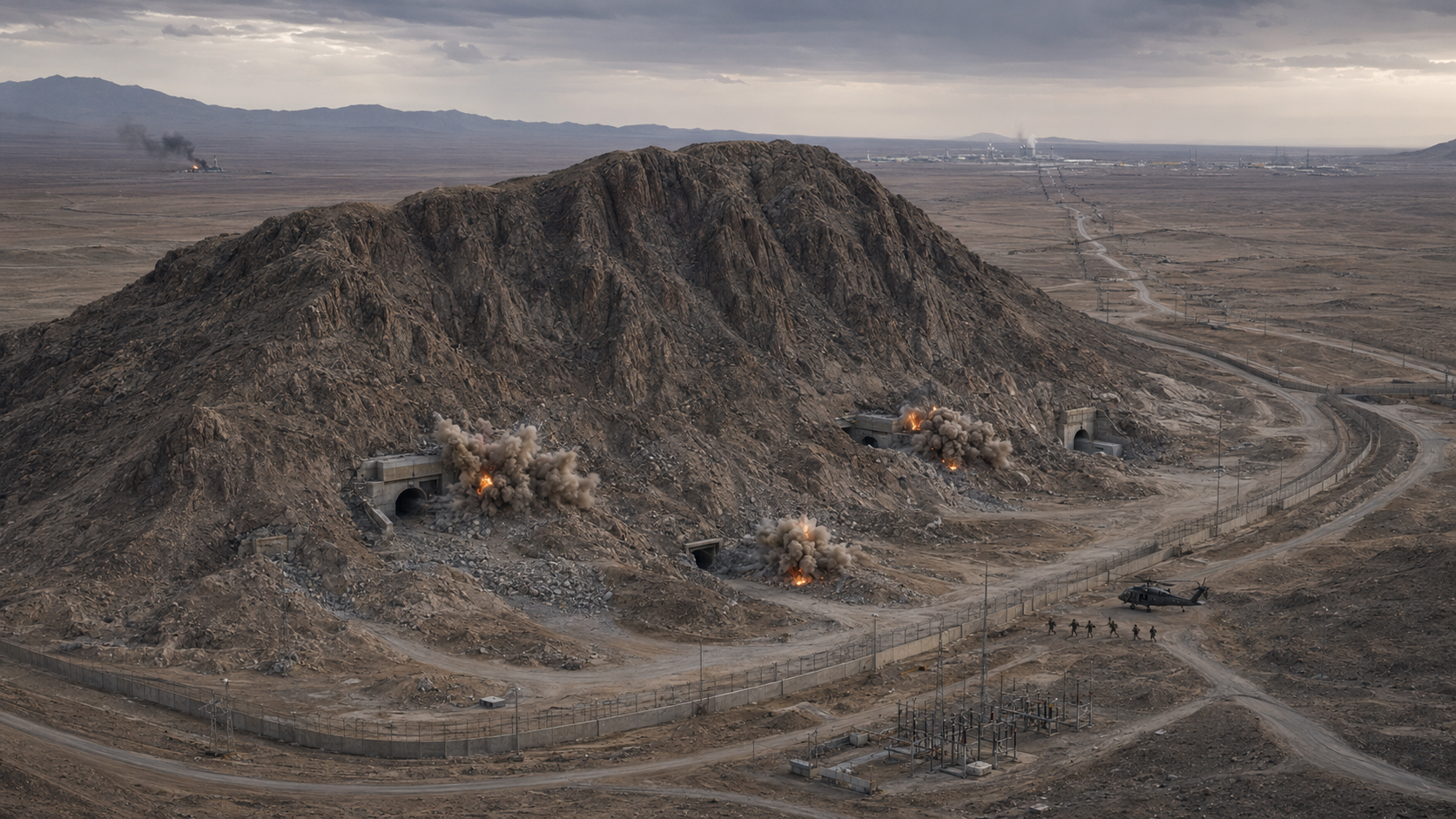
Credits: AI-generated image.
President Trump’s threat to strike Pickaxe Mountain exposes the gap between rhetoric and reality. Iran’s Kuh-e Kolang Gaz La rises 1,608 meters in the Zagros, just 1.5 kilometers south of Natanz. Analysts place its main halls at least 100 meters beneath granite. Construction there began in late 2020 after the sabotage of the Natanz workshop. Four tunnel mouths—the only known means of access—sit in two pairs, east and west. The International Atomic Energy Agency has never entered the complex. However, Israeli assessments indicate that Iran moved centrifuges there after the June 2025 strikes. Those facts, not the force of Washington’s rhetoric, define the mission.
Equating Pickaxe with Fordow conflates two entirely different eras of Iranian fortification. Prior to the 2025 summer campaign, Fordow presented a significantly lower tactical threshold: its sedimentary geology was softer, its ventilation infrastructure was transparently mapped, and Western intelligence had spent fifteen years building a complete targeting profile. Pickaxe offers none of those advantages.
The U.S.-made GBU-57 massive ordnance penetrator can pierce roughly 60 meters of earth and 18 meters of reinforced concrete. But the hard granite shielding Iran’s “Pickaxe” site changes the math entirely, sharply degrading the weapon’s margins. Firing blindly at deep-buried barriers of unknown thickness is worse than a gamble; it risks squandering a scarce strategic asset while leaving the cascade halls completely untouched.
Conversely, a nuclear strike fails on every count. A surface or sub-surface detonation leaves the facility permanently inaccessible, sealed by lethal radiological contamination. Battle damage assessment becomes impossible; ground forces could neither verify the destruction of Iran’s centrifuges nor account for the 440.9 kilograms of 60-percent enriched uranium Tehran held before the 2025 war. Radioactive rubble and poisoned aquifers would permanently blind international monitors. In short, lasting strategic victory requires exactly what a nuclear strike prevents: eyes and boots inside the mountain.
Yet Pickaxe is no isolated vault. American and Israeli planners must treat this mountain and the Natanz threat as a single nervous system. Tehran cannot bury the 1.5 kilometers of vulnerability connecting them. Shared power lines, fiber-optic routes, and secondary roads bind the two complexes together; hence, sever those arteries first.
In parallel, concurrent standoff strikes and electronic warfare must then open a temporary air corridor by degrading air defenses, ballistic-missile batteries, and command nodes across a 250-to-300-kilometer radius. Once that outer ring collapses, concentrated penetrator attacks must batter all four tunnel mouths. Repeated impacts should create rubble plugs that block movement; any residual openings would then provide entry routes for short-duration joint special-operations teams under continuous close air support.
Their mission should be clear: destroy the remaining centrifuges with conventional high explosives, collapse the critical sections, and withdraw. A partial destruction would mean failure; Pickaxe must become a sealed tomb, not a recoverable redoubt.
The strike must simultaneously decapitate Iran’s regional terror network. Intense and unexpected strikes must crush Hezbollah’s logistics, Houthi launch sites, and Iraqi terrorist networks. Since Tehran cannot reinforce the mountain while its external levers burn, the Abraham Accords partners must grant the overflight and basing access required to compress operational timelines. Finally, Washington must deliver a blunt ultimatum to Beijing: any post-strike procurement or reconstruction assistance to Iran will trigger immediate U.S. secondary sanctions on Chinese oil imports.
This operational sequence eliminates two dangerous strategic illusions: a nuclear strike, which guarantees lethal contamination while blinding intelligence monitors, and a pure air campaign, which leaves unmapped underground complexes fully operational. Only a strategy of sequential isolation followed by subterranean clearance can neutralize the geological barriers, overcome the intelligence gaps, and permanently block Tehran from resuming its underground tunneling.
America’s credibility rests on finishing the job, not merely striking a target. Trump’s half-measures against a facility built to survive previous attacks would invite reconstitution and signal weakness. In this case, Israeli participation is vital since Jerusalem would be able to provide unique intelligence and operational depth. In any case, geography leaves the Jewish state no realistic option to stand aside.
This strategy forces Tehran into a corner: either swallow the permanent loss of the Pickaxe site, or launch a suicidal escalation against a coalition that has already shattered your regional defenses. By executing this sequence, Washington transforms an underground stronghold into a tomb for Iranian ambition.
History proves the Iranian regime yields only to costs it cannot absorb. This strategy inflicts those costs without the catastrophic, multi-decade radiological contamination of a nuclear strike. Half-measures that leave the granite vault intact will not deter Tehran; they will merely embolden its revolutionary hubris. Instead, systematic isolation followed by subterranean clearance will force the Iranians to choose between a collapsed mountain and a wider war it cannot survive.
Washington must stop treating Pickaxe as another bunker to bomb and start seeing it as a regime vulnerability that can be turned against its builders. Anything less would repeat the familiar cycle of temporary damage followed by deeper hardening. Tehran must pay the full strategic price for its granite fortress now; this is the time.
The Mullahs’ regime built the Pickaxe complex to outlast American patience. Washington and Jerusalem should make it outlast Iran’s nuclear program instead.
Related Topics
Related Posts