Pillay’s Nobel Rests on a Number Nobody Checked
Oslo gave its Peace Prize this month to the woman who chaired the UN panel that accused Israel of genocide, and one of the two men who sat beside her has now said the panel never checked the number its case leaned on.
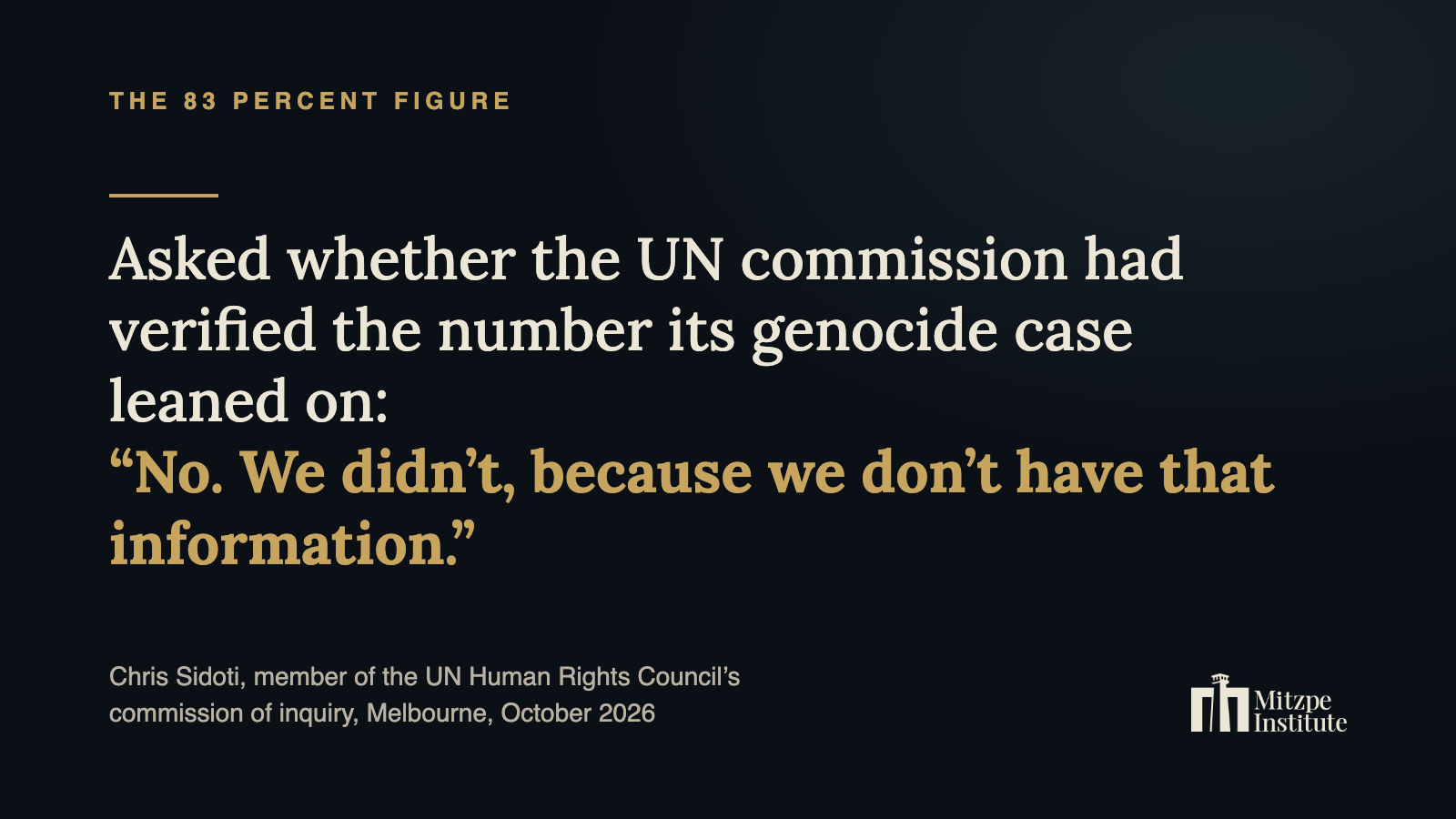
Chris Sidoti, the Australian jurist on the Human Rights Council’s commission of inquiry, debated the American military-law expert Brian Cox at Caulfield Hebrew Congregation, an Orthodox shul in Melbourne, earlier this month. Someone in the audience asked about the commission’s claim that 83 percent of the Gazans killed were civilians. The panel took that figure from a newspaper report and used it as evidence that Israel goes after civilians on purpose. Had it verified the number? “No. We didn’t, because we don’t have that information,” Sidoti said.
He gave the room more than that. Proving genocidal intent, he told them, is “a very, very high test,” higher than beyond reasonable doubt. Then he said the commission’s own finding rested on “reasonable grounds,” and called that “not a high standard.” “We are not a court,” he said. “We are not even prosecutors.” And even if Israel only meant to destroy Hamas, he argued, that “does not preclude the possibility of genocide being the strategy.”
So by his own account the crime needs proof above beyond reasonable doubt, and his panel reached for a bar well below it. Their September 2025 report still put the word genocide in its conclusion, and it has spent a year being quoted as though a court wrote it.
Pillay tells it another way. When the prize was announced on the 9th she was in Nuremberg, and she told the crowd that nobody should need courage to speak the truth. “You interpret the law and you look at all the facts.” Then she joked that, being a lawyer and a judge, she still wanted to verify the news.
She checked the prize. Her own commissioner says nobody checked the 83 percent.
The report leaned on the International Court of Justice too, writing that the court had “put all States on notice of the plausibility” of Israel committing genocide. Joan Donoghue presided over that court when it ruled, and she told the BBC in April 2024 what it actually found: that Palestinians had “a plausible right to be protected from genocide,” and South Africa had the right to bring the claim. The court never decided the genocide claim itself was plausible. Cox played the clip for the audience in Melbourne. Sidoti said his commission’s paragraph was “entirely consistent” with her comments. It isn’t.
Jorgen Watne Frydnes, who chairs the Nobel committee, called Pillay “one of the great defenders of international legal principles in our time.” The first principle any judge learns is that you prove the crime before you announce the verdict. Her panel announced it, and one of its members has now told a shul in Melbourne that proving it wasn’t their job.
That matters well beyond Oslo. The report gets quoted everywhere as a finding, and a Nobel makes it sound like one. Sidoti has now told us what it is.
So the next time somebody waves the UN’s genocide finding at you, ask the question that audience asked in Melbourne. One of the men who wrote it has already answered.
Uriel Zehavi is Managing Director of the Mitzpe Institute (mitzpe.org) and writes the Israel Brief (israelbrief.com), Sunday to Friday. He is the author of four books, most recently Rooted in Judea: Lives and Law in the Heart of Israel.