
"These fragments I have shored against my ruins"
Ploughed Jewish Graves: Another Short History of Tractors in Ukrainian
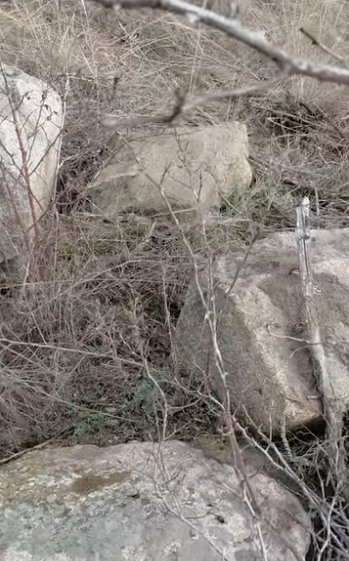
Damaged gravestones (Photo courtesy of Vitaliy Kamozin)
Against the odds, it survived everything: pogroms, occupations, the collapse of empires, famine, the bureaucratic erasures of the Soviet decades, the slow indifference that settles over places where history has been too heavy for too long. In its gradual decay, it even survived the disappearance of its own community. A small Jewish cemetery near the village of Pankratova, in the city of Yuzhnoukrainsk in southern Ukraine’s Mykolaiv region — one of the many such sites in the country that still remain — endured all of this. Until now.
Last week, local historians and researchers Vasyl Selyavin and Oleksander Shiva discovered the devastation: gravestones had been destroyed; the ground itself ploughed over. They documented the damage and raised the alarm. Following their report, Ukrainian police opened a preliminary investigation. The CEO of the United Jewish Community of Ukraine (UJCU), Vitaliy Kamozin, announced that the organization had submitted a formal request for an urgent examination of the circumstances surrounding the destruction of a recognized burial site, verified by historical maps and testimonies, and asked to be informed of the investigation’s progress.
UJCU also requested that the Pivdennoukrainsk municipal authorities conduct a land survey and designate the cemetery as a separate cadastral plot. An agreement has been reached with the European Jewish Cemeteries Initiative (ESJF) to install protective fencing once the necessary documentation is in place. Both organizations have committed themselves to the site’s restoration and long-term preservation.
Ukraine has, in recent years, developed a relatively solid framework for the preservation of Jewish cemetery heritage. Approximately 95 per cent of known Jewish cemeteries have been indexed. UJCU has installed memorial markers at 124 sites, while ESJF provides fencing whenever possible. The system generally works, although it does not entirely prevent incidents such as this one. Rural cemeteries remain particularly vulnerable, where unclear boundaries and limited oversight leave historic burial grounds exposed to gradual encroachment.
This case is not without precedent. In 2017, farmers in Hulyaipole incorporated part of a Jewish cemetery into their fields, disturbing the soil so deeply that human remains surfaced and lay exposed for years while officials failed to intervene. Only a handful of local residents gathered the bones for reburial. In Khorol, in the Poltava region, heavy machinery was brought onto a cemetery site despite the presence of an installed memorial marker; public outcry and intervention eventually led to its protection. In 2021, in Lanchyn in the Ivano-Frankivsk region, a local businessman began construction on a partially built-over Jewish cemetery; the project was halted after swift action by UJCU. Court proceedings are currently ongoing in Odesa in a similar case involving a proposed development on a Jewish burial site.
Unlike in much of Central and Western Europe, such incidents in Ukraine are rarely driven by explicit antisemitism. As Vitaliy Kamozin notes, he is not aware of recent cases in which cemetery destruction was motivated specifically by antisemitic intent. More often, the cause is indifference or ignorance. Nevertheless, such actions fall under Article 297 of Ukraine’s Criminal Code, which criminalizes the desecration of graves and burial sites.
In this instance, a local farmer who had leased land adjacent to the cemetery gradually expanded his activities into the burial ground itself; land that had never been allocated or transferred to him. The encroachment was incremental: first by inches, then by meters, and finally by driving a tractor directly through the gravestones. In the midst of war, with the country exhausted and attention fixed elsewhere, the destruction came not from an external aggressor but from a neighbor who assumed that the chaos would conceal the damage.
The irony is difficult to ignore. A cemetery that survived the violence and ideologies of the long twentieth century was destroyed not by hatred, war, hunger, or desperation, but by someone with a tractor who assumed no one would notice.
Many did not. Public reactions ranged from shock to indifference. Some comments beneath the photographs were openly antisemitic; others merely weary. War-weariness may explain exhaustion, but it does not explain the ease with which certain losses are dismissed as inconsequential. It is always easier to disregard the dead when they are not one’s own. Yet the loss is real.
Ukraine has approximately 1,350 known Jewish cemeteries scattered across the country. According to Vitaliy Kamozin, around 80 per cent face similar potential risks. This is precisely why systematic documentation and legal designation are essential. In this particular case, the cemetery was little known. It belonged to a small nineteenth-century German settlement with only a handful of Jewish families and was remembered mainly by elderly local residents. Such cases are rare, but they do occur.
The United Jewish Community of Ukraine operates under severe constraints. Yet Vitaliy Kamozin remains accessible; he answered questions on New Year’s Day simply because the cause — ensuring that such destruction is seen and not repeated — matters to him, and because silence is what allows these losses to happen again. The community is shrinking; conditions are difficult. Even so, its work continues. In addition to the 124 memorial markers already installed, permits and documentation have been completed for a further 280 sites, allowing their formal recognition and protection.
UJCU encourages Jews of Ukrainian origin — most of whom now live far from the places where their families are buried — to make contact: to learn about a cemetery’s condition, to locate relatives, to understand what is at risk, and, where possible, to help ensure that memorial markers can be installed. Their work is as much about providing information as it is about preservation, and both attention and support strengthen their ability to safeguard sites that would otherwise be forgotten.
From a distance, Jewishness is often treated as a stable category, and Jewish history as something indestructible. On the ground, neither is guaranteed. Both depend on care, and both disappear quickly when responsibility becomes diffuse. For minority communities, a cemetery is not merely a place of burial or a collection of stones; it is often the last physical trace of a community that no longer exists. In Jewish tradition, it is also a place of particular sanctity, and the desecration of human remains is regarded in the Talmud as a violation akin to taking a life. The importance of preservation is therefore both historical and religious: when such a place is destroyed, something irretrievable is lost; not only material remains, but the fragile continuity they anchored.
Losses like this are rarely spectacular, and they do not dominate headlines. They are small, avoidable, and occur quietly, at the margins; losses born not of hatred or necessity, but of convenience. They are revealing precisely because of their ordinariness. They show what is valued, and what is allowed to disappear.
History is not fragile; responsibility is. What remains unprotected is eventually erased. The dead cannot defend their own memory. It is always the living who decide what survives, and what does not. Nothing endures by accident. The question, now, is whether this place will be allowed to vanish as though it never existed — or whether the living will choose to remember.
Related Topics
Related Posts