Political Roots to Revolutionary Ambitions: Eman Abdelhadi and the University
Her resurfaced family posts have attracted headlines. Her own statements explain how she wants campus organizing to help advance a much larger political project.
University educator Eman Abdelhadi has described her employer, the University of Chicago, as “evil” and “a colonial landlord.” She has also identified it as a place where she can organize her own political agenda to build the organizational power she wants a movement to wield.
The resurfaced posts about her family’s Muslim Brotherhood history offer an earlier glimpse of how she discussed political activism. Her later statements turn to her own organizing choices, including how to use the institution where she works.
Across her interviews, Abdelhadi assigns the university two connected functions: a base for building political power and a place where collective protest can introduce participants to the society she personally wants to make possible.
Past: Political Inheritance in Her Own Words
In October 2026, renewed attention was brought to Abdelhadi’s social media posts from 2012 and 2013. In one, she described her mother’s Muslim Brotherhood activism during college in Egypt in the early 1970s, adding “#respect.” In another, she wrote, “My family has long been MB.”
Political participation was part of the family history she chose to discuss publicly.
The posts attracted scrutiny especially as Abdelhadi’s half-brother, Michigan Senate candidate Abdul El-Sayed, had denied any personal and family ties to the organization.
And while they do not establish her own Muslim Brotherhood membership, the posts prove that activism and building political power are long-established traditions for Eman Abdelhadi.
Present: A University She Condemns, a Platform She Wants to Use
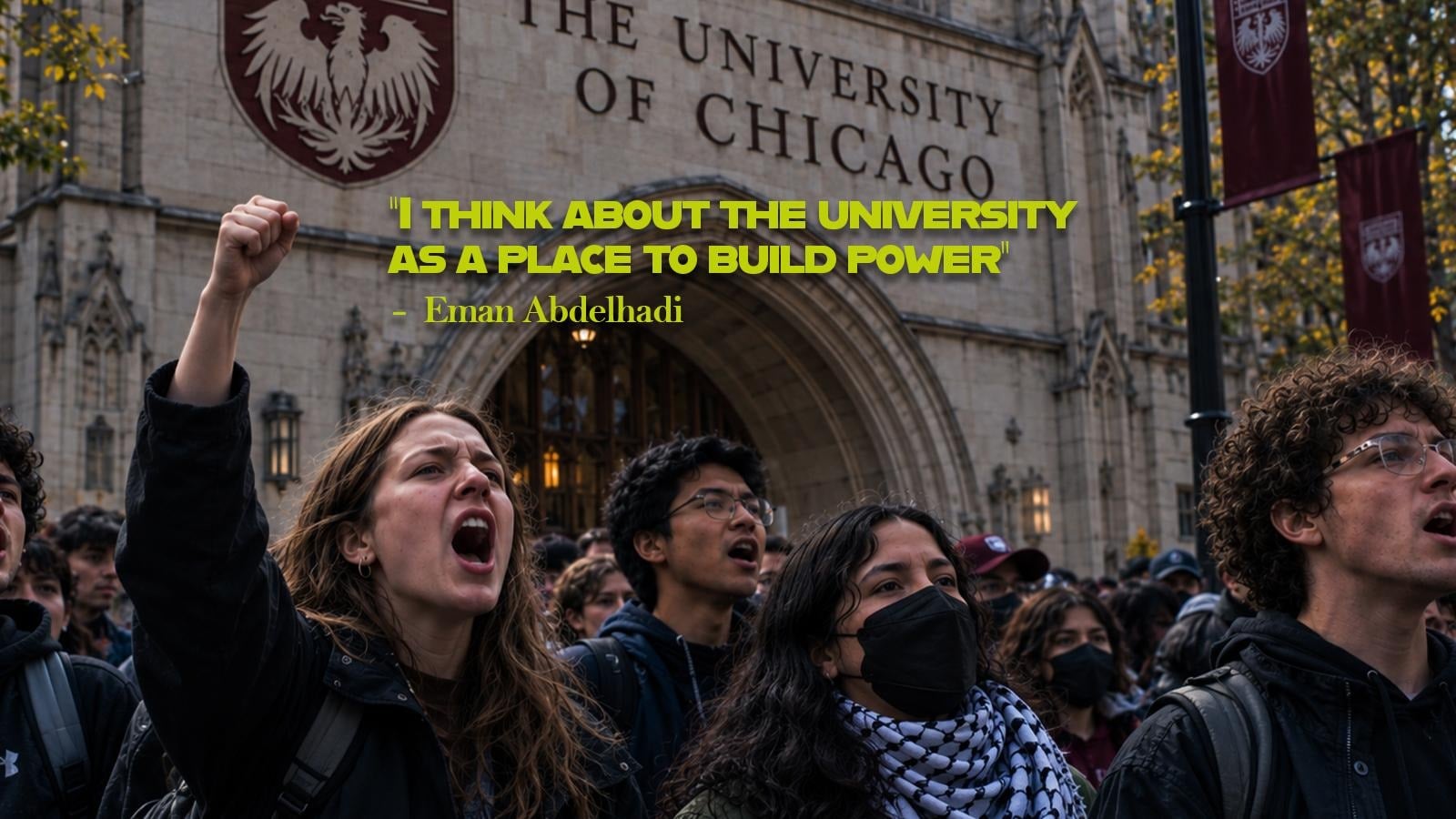
In a November 2024 interview, Abdelhadi stated: “I think about the university as a place to build power.”
She assigned different campus groups to complementary roles. Students could advance radical demands and impose costs through disruption. Faculty and staff could challenge institutional rules from within. Organized workers could add pressure through their position in the workplace.
She praised encampments for interrupting ordinary university life and creating spaces for political education. She also raised the possibility of coordinated work strikes by educators across Chicago.
A university’s everyday relationships become resources for the movement she describes.
And at the July 2025 Socialism conference, she paired her condemnation of the University of Chicago as an “evil…colonial landlord” with an explanation of its organizing potential: access to thousands of people.
That’s “structural leverage,” she stated.
Future: Campus Organizing in Service of Her Revolutionary Vision
Abdelhadi’s ambitions extend beyond changing just university policy. In 2022, she and M. E. O’Brien published Everything for Everyone: An Oral History of the New York Commune, 2052–2072, a speculative novel imagining a revolutionary future.
In a July 2024 interview with the “Institute for the Critical Study of Zionism,” Abdelhadi described the book’s future as “anarcho-communist” with the collapse of Israel and the “Jewish supremacy” of Zionism – a post “global revolution” imagining.
Abdelhadi explicitly brought that imagined future into her discussion of present organizing, namely with students.
When asked about campus encampments, she said that students were in a “better position to take risks” when it came to protesting and connected their collective practices to the communal arrangements envisioned in her book.
Student protests can serve her project twice: by exerting pressure on the university and by giving participants an experience they may want to reproduce beyond it.
They also serve as evidence for the possibilities explored in her fiction and as experiences that can shape future activism.
Her own explanation supplies the link: the university is the setting where Eman Abdelhadi sees her global “anarcho-communist” revolution building.
The Role She Wants the University to Play
Her past reveals the political inheritance she discussed with pride.
Her present shows how she wants to build power through campus organizing.
Her imagined future gives that organizing a destination.
Within that ambition, the university supplies people to mobilize, institutions to pressure, and collective experiences she hopes will sustain political commitments long after a protest ends. Her faculty role places her inside that organizing base, with access to the community she wants to activate.
In the political project Eman Abdelhadi describes, the campus is just the staging ground. The world beyond it is the target.