Politicization and Commercialization: Selichot Traditions
The annual cycle prompts memories at certain times of year. As a young adult, it hit me that for several consecutive years I made critical decisions amidst the Tishrei holidays, if not at the end of Elul, then by the end of the holidays beginning with Rosh Hashana, ending with Simchat Torah at the end of Sukkot. A lot of ends and beginnings.
When ends and beginnings meet, reflection often ensues. The selichot prayers, asking to be pardoned and forgiven during Elul, before the intensity of the Days of Awe from Rosh Hashana to Yom Kippur, set that scene. As with many Jewish traditions, different practices evolved among Jews of different ethnic backgrounds in lands where diaspora communities flourished. In the State of Israel, these traditions meet, assimilate into one another with the North African spicy fish, hreime, superseding gefilte fish, or remain separate and distinct, if not co-opted by intermarriage (among Jews from different ethnic origins).
When it came to our selichot tour in Jerusalem on September 3, 2026, the guide joked about the difference between Eastern European Jews (Ashkenazi) and those who came from Arab lands (Mizrahi). The former read selichot from midnight the Saturday night before Rosh Hashana (unless that falls less than four days before the holiday, in which case selichot are said from the previous Saturday night). Mizrahi Jews hold selichot services every night for the entire month of Elul, the month before Rosh Hashana. You can imagine which group says the other must have more sins to atone for. The Mizrahi response, according to the joke, is that considering the Ashkenazi melodies, it’s just as well that we don’t have to hear them chanting selichot for a whole month.
Nuanced differences are not limited to the binary categorization. Among Mizrahi Jews, traditions vary between Yemenites, Persians, Libyans, Moroccans, Syrians, Tunisians, Bukharians, and every other group, and among Jews from different locations within these countries. It must be over 40 years since selichot tours were instituted in Jerusalem. Midnight tours accompanied by a scholar of liturgy, or a contemporary poet, going from synagogue to synagogue, one neighborhood after another, or focused on one neighborhood like Nachlaot filled with residents of diverse ethnic origins. The tours offered a glimpse at synagogues serving different communities – olim (immigrants) and their children from San’a or Aleppo, Teheran or Tripoli, Casablanca or Tunis – with momentary impressions of melodies and liturgical variations.
On occasion, I have visited synagogues of different ethnocultural traditions – the Italian synagogue in the center of Jerusalem on Purim, a Yemenite synagogue outside of Jerusalem on Yom Kippur, Moroccan, Iraqi, and Kurdish synagogues, as well as Ashkenazi synagogues, and Reform/Progressive Movement, Conservative/Masorti Movement and Reconstructionist synagogues throughout Israel. Yet, I never participated in a selichot tour.
When our oldest granddaughter, almost 12-years-old, posted on social media that she was going to selichot in Ra’anana, which complements other expressions of her new interest in religious traditions, I suggested taking her to Jerusalem for a selichot tour. Haim agreed. I wanted us to be part of her exploration, hopefully able to encourage her to explore with curious inquiry in a society where religification encroaches upon public space, where impressionable youth are easily drawn by older teenagers, or directly by rabbis with absolutist agendas teaching those teens, to practices not necessarily representing traditions or schools of thought that encourage critical thinking.
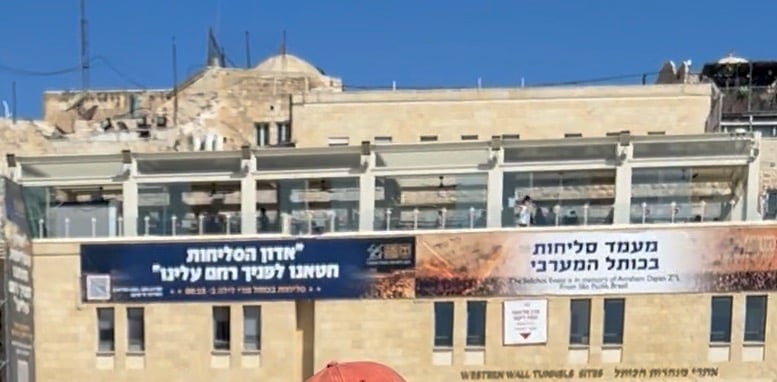
Selichot tours – concluding at the Kotel – were easy to find. Numerous options found online included overnight accommodations at Jerusalem hotels. Considering selichot begin at midnight, a hotel makes sense.
The Kotel was our granddaughter’s ideal selichot destination. Not a destination in the tours I recall. However, understandable that people choose to pray there. Yet, as I saw names of the Kotel selichot tour sponsors, I expected nothing less than a discotel experience. (The term was coined by the late Prof. Yeshayahu Leibowitz, z”l, combining “discotheque” and “Kotel,” cynically commenting on the veneration of the sacred site for political purposes.) Discotel this was.
But first, the tour did a service to Jerusalem. The guide for our hotel was an architect, a young man, who provided historical information and commented on noteworthy sites, including synagogues, as he led us through Nachalat Shiva, past an area of lively pubs and restaurants, to Mamilla Mall. His remarks were spiced with anecdotes about neighborhoods throughout the city.
From the outdoor mall passageway to the Jaffa Gate of the Old City, we approached the Armenian Quarter. Our guide mentioned the Armenian genocide without using the G-word. Did this reflect a position of his own, or guidelines provided by organizers, indifference to the nuance? He certainly made no mention of those religious Jews who harass Armenian clergy near their church. Spitting. Attacking. Barely acknowledged in Israel.
While Jewish terrorism in the West Bank has gained primetime, mainstream news coverage, attacks on Armenian clergy in the Old City mostly remain under the public radar. The phenomenon is addressed by volunteers for the Religious Freedom Data Center operating a hotline, documenting incidents, and demanding police attention to the attacks upon Armenians. Were it not for the fact that an RFDC founder and activist is a friend, I might be unaware of this piece in the disturbing puzzle of Jewish behavior in Israel, at odds with the Jewish values and beliefs I treasure. My activist friend, tour guide and scholar, would not have omitted explicit reference to Armenian genocide.
Our tour guide next led us to a splendid rooftop view of the Old City. We proceeded to the heart of the Jewish Quarter, entering the Hurva Synagogue, and moved towards the Kotel.
The masses were astounding. Later reported as 50,000 people. I have been to the Kotel at times when masses gather – Erev Tisha B’Av (commemorating the destruction of the First and Second Temple located just beyond the Kotel), Tikkun Leil Shavuot, and Friday evening Kabbalat Shabbat. Never had I seen anything like this. Safety? Security had to be massive, yet they could not possibly administer routine scanning of personal with visitors walking through a metal detector.
Were it not for our granddaughter, we would not have ventured into the Kotel plaza, much less approach the imposing structure. After winding through the crowds, Haim patiently waited at a spot where men and women must separate (for religious reasons). Our granddaughter and I took turns, holding hands or the back of the other’s shirt, maneuvering through the densely packed women’s area until eventually she stood next to the Kotel, touching it.
Perfect timing. An amp system carried a presenter’s voice welcoming the crowd, announcing the presence of Minister of Education, Yoav Kisch, without interruption. He then announced the presence of Minister of National Security, Itamar Ben-Gvir. Cheers filled the air. Confirmation of my suspicions – selichot, commercialized and politicized. Perhaps there were people refraining from booing in deference to selichot? But it felt like a gala celebrating this advocate for genocidal policies and ethnic cleansing, making the relevant political deals to which Netanyahu succumbs.
After the Kotel touching thrill for our granddaughter and her whispered prayers, we joined in chanting some selichot prayers and heard the sounding of the shofar.
We returned to the hotel, plan intact for Friday morning: Kotel tunnels’ tour, by request of our granddaughter. With adequate time to reach the Kotel before the tour, she prepared a note to place in the wall.
Accompanying our granddaughter to the Kotel in the morning, I followed a tradition of reading Psalms, appropriately choosing those designated for Friday. Reading psalms tends to be moving, sometimes passages praising militarism disturb me, while other verses are soothing, or offer wisdom with phrases used in contemporary conversation – many people unaware of their source as they say them. I came across one such expression,
מִכָּל מְלַמְדַאי הִשְׂכַּלְתִּי
The Jewish Publication Society 1988 translation of the Tanakh, The Holy Scriptures, translates this phrase, Psalms 119:99, “I have gained more insight than all my teachers…” Common usage suggests, “I have learned from all who have taught me.”
Reading that, knowing I gain new insights through the experience of our granddaughter – her teaching me – and hoping she is learning things she will examine from multiple angles, I revisited the earlier verse,
מֵאֹיְבַי תְּחַכְּמֵנִי מִצְוֺתֶךָ כִּי לְעוֹלָם הִיא לִי
translated by JPS as, “Your commandments make me wiser than my enemies; they always stand by me.” Interpretable as God’s commandments bringing one wisdom and protection from one’s enemies, or that they make one wiser than one’s enemy. Assuming no presumptuous allusion to supremacy, simply taken as innocuous praise for commandments that should we follow them, our lives would be made safer, protected from our enemies.
Following such commandments however must, arguably, be inseparable, from leveraging commandments to pursue justice!
צֶדֶק צֶדֶק תִּרְדֹּף לְמַעַן תִּחְיֶה וְיָרַשְׁתָּ אֶת הָאָרֶץ אֲשֶׁר ה’ אֱלֹהֶיךָ נֹתֵן לָךְ
“Justice, justice shall you pursue, that you may thrive and occupy the land that the LORD your God is giving you.” (Deuteronomy 16:20, JPS translation)
The biblical context of the verse relates to establishing a legal system to fight corruption with righteous judges. The Talmud, Sanhedrin 32b, interprets the repetition of “justice” as stressing our responsibility to seek peace amidst a conflict.
That will bring us protection from our enemies, as the psalmist wrote. That will bring us protection from ourselves.
Harriet Gimpel
September 7, 2026