Politics Has an Ask. “Free Palestine” Has a Target.
Less than a day after I wrote about how Macklemore traded a fake nose for a keffiyeh and led a stadium of Ed Sheeran fans in “Free Palestine” while Jewish families walked out, I got fan mail. Opening line: “His music is awful his cause is valid.” Then, before I could get to the conspiracy-theory-laden diatribe that followed: “Go back to Israel.” He hates Jews so much he became a Zionist. Classic.
I get a lot of love letters in this genre, and most are low effort. This one I appreciate. Real work went into it, and I am a lawyer, so I keep exhibits.
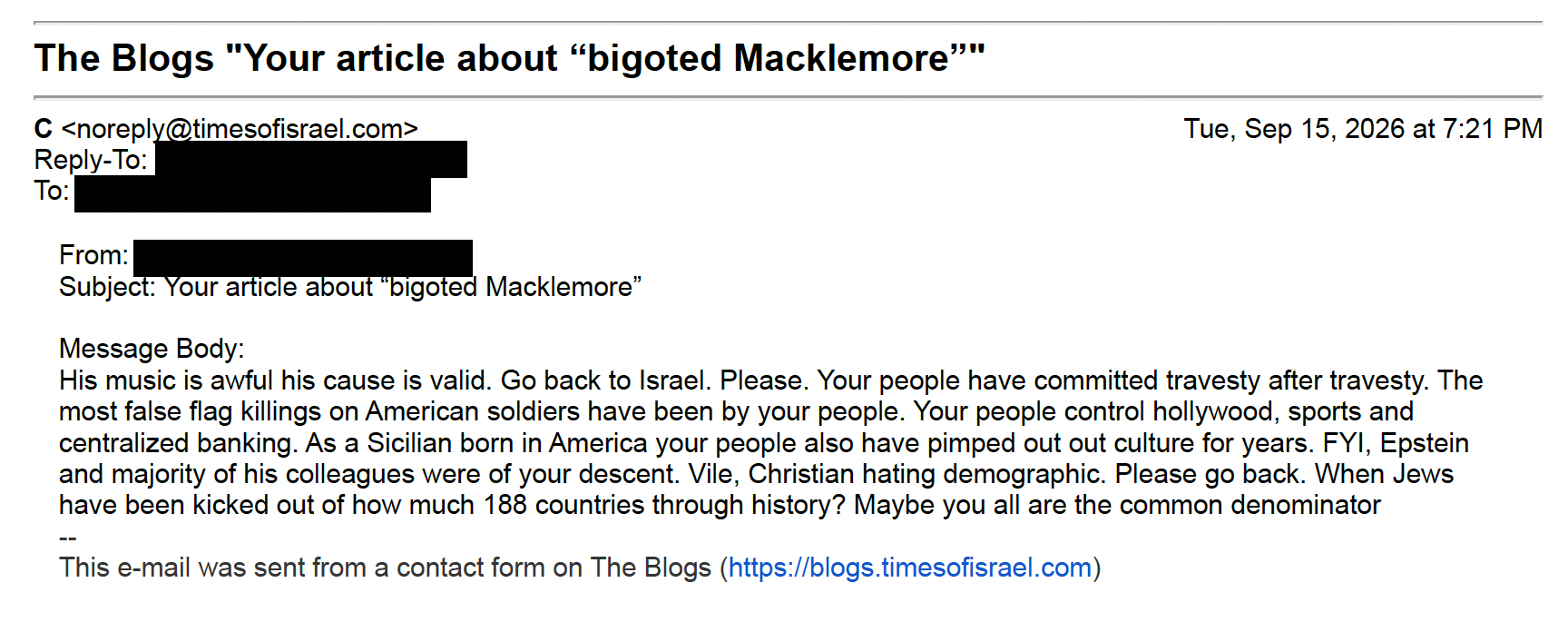
Now count the times he mentions the “Palestinian cause.” Take your time. Does he ask for aid into Gaza? A ceasefire? A border moved one inch? He does not. He calls Macklemore’s cause valid in his first sentence and spends every sentence after it on what he apparently thinks that cause is: Hollywood, the banks, Epstein, whatever happened to Sicily, and 188 countries that got it right. Read it his way and Macklemore’s cause is that Jews are the problem. Palestinians never come up, because to this man they were never the point. That makes him the most honest person who wrote to me this week. He skipped the part the rest of you lead with. He never once told me it was political.
Sure, “All Music Is Political”
That was the sentence of the week. Sheeran had plenty to say about Brexit, the argument went, so he does not get to be neutral now. Sting had the rainforest, Peter Gabriel had Biko, Bono cannot get through “Sunday Bloody Sunday” without a speech, the Beastie Boys gave a decade to Free Tibet, and nobody walked out. One reader put it to me plainly: “‘Free Tibet’ was political and it went over fine, ‘Free Palestine’ is political, that’s all.”
Fine. “All music is political.” I will bite. I have sat through more musicians’ opinions than I can count, some of them dumb, and I kept my seat, because that is the deal. But politics is a position on a question. Free Tibet meant get China out of Tibet. It never meant there should be no China. “Biko” wanted the state to answer for the man it killed. “Sunday Bloody Sunday” wanted the shooting to stop. Each one had an ask you could say out loud without anyone in the crowd wondering whether it was about them. So here is my only test. Name what “Free Palestine” wants done.
The Chant Has an Answer, and Its Authors Wrote It in Arabic
Ask the people who wrote it. In English it is “from the river to the sea, Palestine will be free.” In Arabic, at the same marches, it is “from the water to the water, Palestine is Arab.” Not a border moved. A country gone, the one Jewish state on earth replaced by an Arab one. A borrowed slogan does not get safer because the borrower never looked it up.
It may be true that most of the kids chanting it back at MetLife think it means peace and love and rainbows. It does not matter. They grabbed a hashtag because it is trendy and buys them something, and they have not spent ten minutes on what it looks like on a map. The people who wrote it have. And in America it is what the man attacking Jews shouts before he shoots them or sets them on fire. So when it comes at a Jewish family from a stage, with a flag on the screen and a keffiyeh on the man leading it, the family does not hear what the kid in row 14 meant. They hear the slogan. A threat does not get less threatening because the person repeating it never bothered to learn what it means.
If you want aid into Gaza, say aid. If you want Hamas gone, say that. If you want two states, say two states. Nobody who wants two states has ever had trouble saying so. If you want Israel dismantled, say that too, and at least I will know what I am looking at. What you do not get to do is fold them all into two words, chant them at the Jews in the seats, and then explain to us how it was not about us. We are not stupid.
They Drew the Neutral Guy With Fangs
Then Ed Sheeran spoke, and I got my second exhibit.
The promoter made the call, he said, not him. He keeps politics off his stage because “my audience includes young people, often children, of all backgrounds,” and he uses his fame “to be a place of safety and sanctuary.” The children who left his sanctuary in tears were Jewish, so I have thoughts about that sentence, and I am setting them aside, because look what it cost him. All four openers quit by Tuesday. And an account with 278,000 followers drew him.
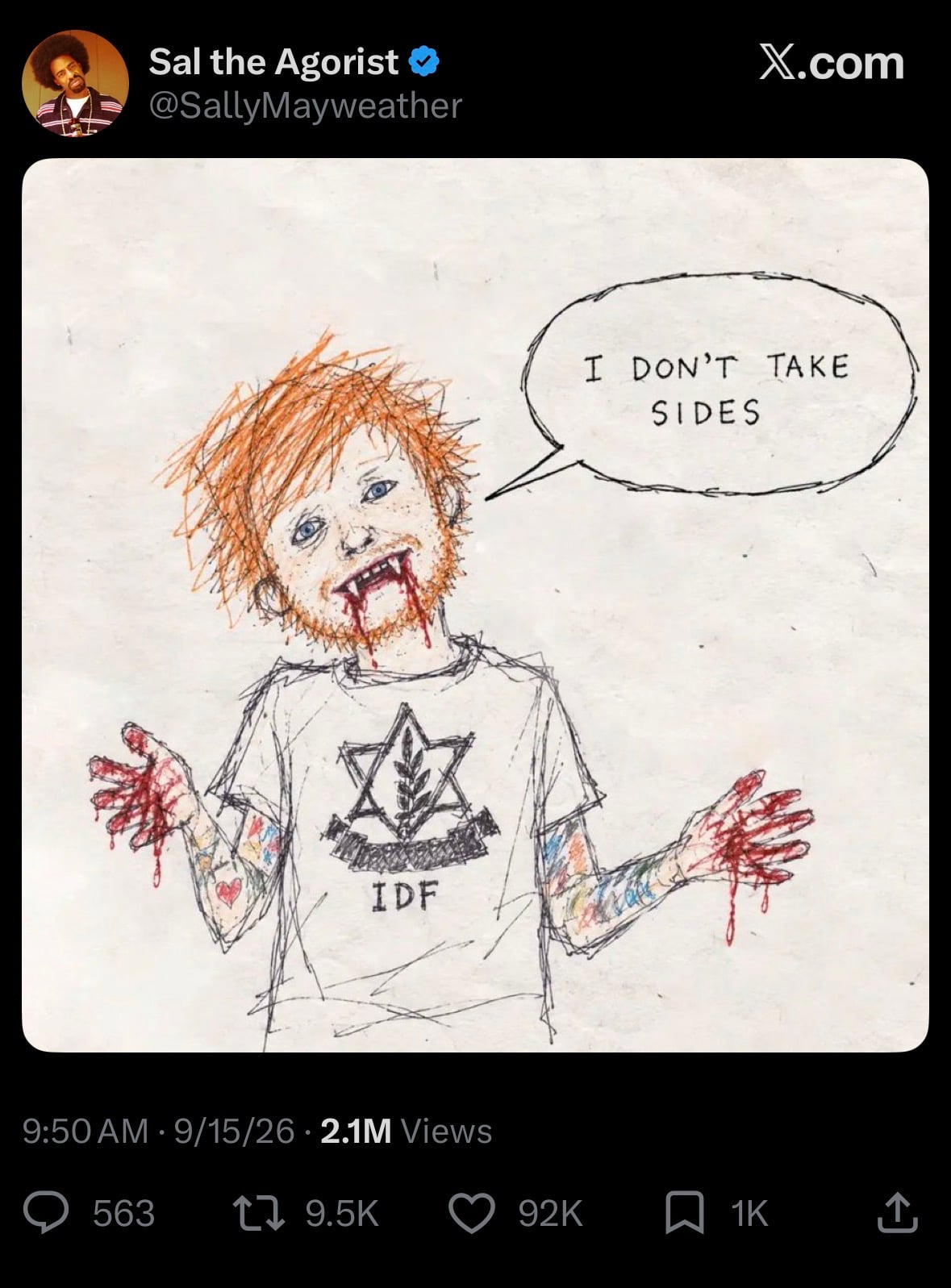
Fangs. Blood on the mouth. Blood on both hands. An IDF shirt with a Star of David on the chest, and his own line in the bubble: “I don’t take sides.” Nobody at that drawing table invented anything. The Jew who drinks blood is the oldest slander Europe has. It starts in Norwich in 1144, when a boy died and the town decided the Jews had killed him for his blood, and it got Jews killed for the next eight hundred years. The Nazis put it on the cover of Der Stürmer in 1934, Jews with knives and bowls of Christian children’s blood. Nearly a century later a crypto-anarchist in St. Petersburg, Florida, whose bio does not mention Palestine either, drew it again and put it on a pop singer who said he takes no side. In a day, 92,000 people hit the heart on it, 9,500 reposted it to their own followers, and a thousand saved it to look at later. That is not a fringe account getting ratioed. That is a crowd, and it liked what it saw. Tell me the shirt means this is about an army. Ed Sheeran is not in that army. Ed Sheeran is not Jewish. The artist did not put him in a uniform. He gave him fangs.
Two exhibits, one mechanism, and both of them show their hand. The email tells a Jew she is the root of the world’s problems and to go back to Israel. It never mentions Palestine. The cartoon takes the singer who refused to pick a side and hands him a Star of David and a mouthful of blood, a page straight out of the medieval church and the Nazi playbook. This is the cause the crowd rallied behind Macklemore for this week, and when the people who joined it got angry enough to say what they actually wanted, it was not aid, or a ceasefire, or a state. It was Jews. Politics has two sides and a question between them. This has a target, and whoever stands near it takes the hit.
“Not About Jews” Is a Soviet Talking Point From the 1960s
Macklemore, the day he was cut: “When criticizing Israel, opposing Zionism or saying ‘Free Palestine’ gets conflated with hatred of Jewish people, it doesn’t protect Jewish people. It protects Israel from accountability.”
He thinks he came up with that. He did not. None of this is original, not the chant, not the flag on the screen, not the “it was never about Jews” that follows it, and the reason it all sounds the same from every stage is that it came from the same place. In 1969 the Soviet Union gathered its friends in Cairo to launch a worldwide campaign against Zionism, and the instructions went out: call it genocide, call it racism, call it colonialism, and above all tell the world the campaign is not against Jews, only against Zionism. That was fifty-seven years ago. “Zionist colonialism” was coined in 1965, when Egypt, not Israel, occupied Gaza. The UN voted that Zionism is racism in 1975 because Moscow wanted it to. The words the kid in row 14 chanted have a file, the file has a Soviet stamp, and the disclaimer he was handed afterward is the oldest line in it.
Before the Soviets it was the Church. The playbook changes costume every few centuries. Blood, then money, then race, then Zionism. The target does not change. That is the thing about a playbook: you do not have to know you are reading from one. Naya Lekht wrote this week that anti-Zionism in America lives “a life of conviction rather than coercion.” Nobody handed that kid a pamphlet. He believes it. Propagandized people do not feel propagandized. They feel like they are standing up for the oppressed.
Okay. But not having the pattern recognition to see what you are part of does not entitle you to tell the people who do that they are imagining it. We have been reading this playbook for two thousand years. We know the moves.
So yes, when a man in a keffiyeh leads a stadium in an eliminationist chant that has, more than once, immediately preceded the murder of Jews, I assume the worst. I do not wait to find out what anyone meant by it. I start looking for the exits. Most of us are only here because somebody in the family, at some point in history, assumed the worst and left early. That is not a disorder. That is the correct reading of the last two thousand years by the people who lived them.
We are not the ones who need to calm down. We should be able to buy a ticket to hear love songs without doing a threat assessment first. Call it generational trauma if you want. It is not thin skin. It is muscle memory.
So fine. “All music is political.” But this is not about politics.