The views expressed herein are solely mine.
Post-Oct. 7, Israel’s Best Hasbara Is a White Coat
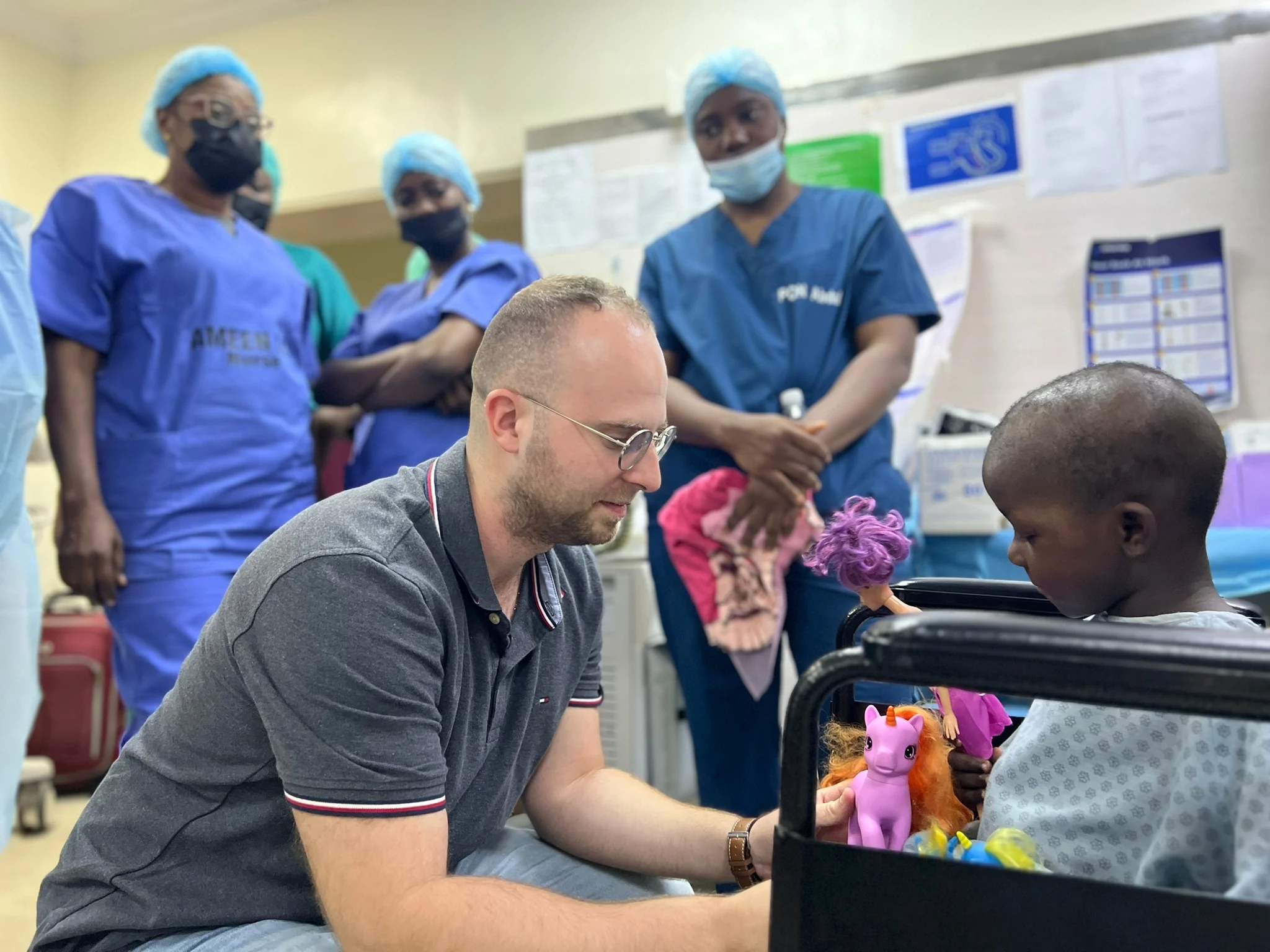
Dr. Mattan Arazi, ophthalmology resident at Sheba medical Center, consulting with a child in Nigeria as part of a humanitarian mission on January 10, 2023. (Courtesy: Sheba Medical Center).
In 1959, Liberian President William Tubman broke his glasses. Liberia had no eye doctor, while consulting one in London required a three-week wait. Tubman turned instead to Israel for help. Isaac Michaelson, chief of ophthalmology at Jerusalem’s Hadassah Medical Center, flew to Monrovia and examined the president. Within a year, Hadassah opened a 30-bed ophthalmic hospital in Monrovia and began training Liberian staff in Jerusalem. Michaelson also required Hadassah’s senior ophthalmology residents to serve for two years in Africa. Altogether, 48 Hadassah ophthalmologists built clinics in Liberia, Kenya, Malawi, and Rwanda. Michaelson estimated that these missions treated one million patients and performed 30,000 operations before African governments severed ties with Israel in 1973. A single pair of broken glasses became Israel’s unlikely gateway to Africa.
Cuban dictator Fidel Castro copied the model but inverted its purpose. During his tenure, Havana stationed 1,500 physicians in 25 countries—more doctors abroad than the World Health Organization itself fielded. Cuba sent one civilian aid worker overseas for every 625 inhabitants; Washington sent one for every 34,704. By the late 1980s, 46,000 Cuban specialists had worked in at least one other country. These medical brigades bought votes at the United Nations, exported a socialist agenda, and draped a bloody, repressive Communist dictatorship in a white coat. Although Cuba remains an economic wreck, its white coats bought Havana a generation of grotesquely undeserved prestige.
The State of Israel must learn from Cuba’s strategic success: medical diplomacy can win lasting international goodwill that no public-relations campaign can manufacture. Pew’s Spring 2026 survey found that Israel’s median unfavorable rating across 36 countries had reached 67 percent. Hostile majorities now extend across Israel’s traditional Western partners: Germany at 73 percent, Britain at 69 percent, France at 68 percent, and the United States at 60 percent. Gallup measured American favorability toward Israel at 46 percent, near the low recorded in 1989. Only 32 percent of Americans—and just 16 percent of Democrats—view the Israeli government favorably. The post–October 7 era stripped away Israel’s old diplomatic cover and exposed conventional hasbara as an expensive exercise in futility.
Jerusalem, however, still possesses a powerful alternative. Israeli medical power remains “criminally” underused. The Jewish state leads all nations outside the United States in FDA clearances for AI-enabled medical devices, securing over 80 authorizations to date. Aidoc’s platform operates in 2,000 hospitals and screens 50 million patients annually. Clalit Health Services closes more than 250,000 care gaps each month and has produced a 100-fold increase in hepatitis C detection. In August 2026, the World Health Organization named Clalit’s OPTICA framework as a leading model for integrating artificial intelligence into clinical practice. Currently, Israel spends 6.35 percent of its gross domestic product on research and development—the highest rate in the Organization for Economic Cooperation and Development—and captures 10 percent of global deep-tech medical-device investment. While Israel remains naively tethered to traditional Western markets, countries like China are currently busy leveraging its ‘Health Silk Road’ to trade hospital contracts for sovereign ports and UN votes.
The Jewish state must turn that medical advantage into a parallel arm of diplomacy, not merely charity. As a Western, democratic, and technological nation, Israel should sell what Cuba counterfeited: strategic competence that foreign governments can see and touch.
Neither Netanyahu’s failed Foreign Ministry nor the Health Ministry should bury this strategy in bureaucratic red tape. An autonomous public-private agency should instead establish a Medical AI Corps pairing clinicians from Sheba Medical Center, Hadassah, and Clalit with technology from Aidoc, Ibex, and Pulsenmore. The corps would deploy rotating diagnostic modules in partnership with health ministries across Africa, Southeast Asia, Latin America, and the Balkans. Governments that refuse Israeli spokesmen may still crave Israeli stroke-triage engines, quietly opening the door for a compromise where host governments co-brand physical clinics while Israeli firms retain backend control over data standards and software licenses. Though transactional at first, this precedent allows Jerusalem to lay the operational foundations to reshape these hostile relationships over the long term fundamentally.
Alongside this deployment, Israel must launch a sovereign Medical Cloud Initiative in partnership with India, Kenya, Ghana, Colombia, and the Czech Republic. Operating federated learning networks across anonymized hospital records allows partners to protect data sovereignty within their own borders while rapidly advancing algorithm capabilities. Embedding these joint regulatory dossiers directly into the public health infrastructure of key mid-sized democracies does not just scale innovation—it systematically undercuts regional and global anti-Israel predatory diplomacy.
Jerusalem must stop confusing superficial embassy receptions with actual statecraft; if Israel wants to outlast its adversaries, it must focus on training the next minister of health. Endowing a “Michaelson Fellowship” to bring 500 physicians and nurses from the Global South to Israel annually for artificial intelligence ophthalmological training would do exactly that. Soft power is not about diplomatic small talk; it is about institutional capture. By equipping these rising professionals with cutting-edge Israeli medical technology, the alternative ‘medical hasbara’ ensures that when these clinicians inevitably ascend to high political office, their careers will have been forged by Israeli innovation—rendering them immune to the allure of Qatari checkbook diplomacy or the trap of predatory Chinese contracts.
Cuba sold medicine to conceal a totalitarian prison and advance a socialist project. Israel must sell something better: superior medicine that showcases a free, prosperous society committed to healing. The broken glasses in Monrovia proved that this strategy works. Deploy it now.
Related Topics
Related Posts