An Aging Jewish Feminist
Power and Place in Parashat Matot-Masei
As we come to the end of the book of Bamidbar (Numbers), we are left holding multiple, often conflicting strands: We are left with both victories in war and reminders of just how conditional progress can be—especially for women.
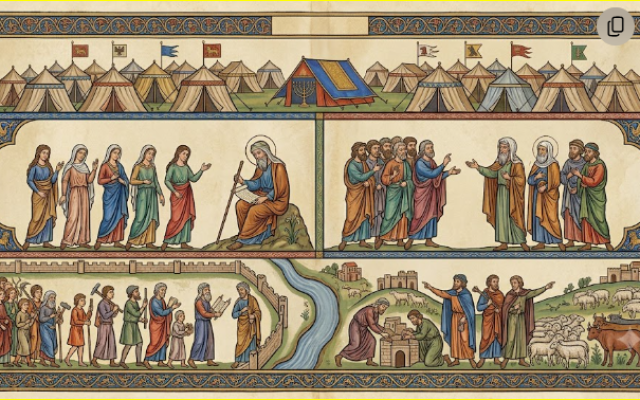
At the end of last week’s parashat Pinchas, we encountered what felt like a genuine breakthrough. The five daughters of Tzelophad —Noa, Milcha, Hogla, Tirza, and Machlah—stood before Moses to demand the right to inherit their father’s portion after his death without sons. Moses brought their case before God, who responded unequivocally: “The daughters of Tzelophehad speak rightly.” It is hard not to read this as a triumph—a moment in which women are named, heard, and granted legal standing.
Yet in this week’s double portion, Matot–Masei, that victory is immediately qualified. The leaders of the tribe of Manasseh are concerned: What if these women marry outside the tribe? The land might be given to another tribe, disrupting the balance of tribal nahalot—the land allotments. A new rule is therefore introduced: the daughters may inherit—but only if they marry within their tribe. What began as a radical expansion of women’s rights is now circumscribed They are affirmed, but ultimately reabsorbed into the system they challenged.. The law changes—but only enough to preserve the existing order. Does this sound familiar?
This ambivalence toward women’s agency runs throughout the parasha. A woman may take a vow before God, but her words are not fully her own. If her father—or later, her husband—objects, the vow is annulled and she is absolved. Only widows and divorcées possess full autonomy.
And then, without pause, the text turns to the battle against Midian. The Israelites are commanded to attack, to kill every male, and to take women and children captive. When the soldiers spare the women, Moses rebukes them and orders that all women who have known a man be killed, leaving only virgins alive. Human beings are counted among the spoils of war.
This passage is chilling. It is difficult to read at any time, but perhaps especially now, more than a 1,000 days after October 7th, when images of raped and murdered women are still raw. The Torah here does not merely permit violence against enemy women—it commands it (Numbers 31:7–18). We cannot look away from this.
Some even seem to be acting out a midrash (here) that valorizes harshness in the name of righteousness. Rabbi Shimon ben Lakish teaches:
Anyone who becomes compassionate when he should be cruel will ultimately become cruel when he should be compassionate, as it is stated: “And Nov, the city of priests, he smote by sword” (I Samuel 22:19). Should Nov not be like descendants of Amalek? The Rabbis say: Anyone who becomes compassionate when he should be cruel, ultimately, the attribute of justice will harm him, as it is stated: “Saul and his three sons died” ” (I Samuel 31:6). [Ecclesiastes Rabbah 7:16]
Yet building a just and moral society is no simple feat. Striving for an ideal world often demands difficult, even painful, choices. This would seem to be the excuse used today to continue a war which seems to have no end.
Many classical and modern commentators have struggled with this passage. Maimonides, in the Mishneh Torah, insists that even in war, one must first call out for peace: He cites a verse from Deuteronomy וְקָרָאתָ אֵלֶיהָ לְשָׁלוֹם—You shall call out to her [the enemy city] in peace, He claims that the Israelite army has to call out to its enemies in peace. Even the seven native Canaanite nations, whom God commanded to annihilate–man, woman, child, and cattle, must first be given the opportunity to surrender and accept Jewish dominion. If they refuse, only then, may they be attacked (Hilchot Melachim, 6:1,4).
Others note that the text does not explicitly state that Moses’s harshest commands were fully carried out. Still others frame the Midianite women as complicit in earlier acts of seduction and idolatry at Peor, attempting to situate the violence within a narrative of justice rather than cruelty (Numbers 25).
Then there are those modern voices who openly discuss the narrative’s ethical difficulty and suggest that the ancient Israelites, like all ancient peoples, were products of their time, with Torah laws evolving from and responding to that context. This, they argue, allows contemporary readers to confront and wrestle with such passages without justifying their literal enactment today. Some go even further to explicitly deny that the Torah ever condoned genocide, contextualizing the event within unique historical circumstances, or interpreting the text non-literally.
These apologists—however sophisticated— miss the point. A command attributed to Moses and God should disturb us. We continue to wrestle with the legacy of such texts—especially when right-wing voices in our own society invoke them to justify immoral cruelty in the name of justice.
From violence and power, the parasha turns again—to land and belonging. The tribes of Reuven and Gad, joined by half the tribe of Manasseh, request permission to settle on the eastern side of the Jordan, outside the Promised Land. Moses initially reacts with anger, recalling the sin of the spies who discouraged entry into the land. But these tribes clarify their intention: they will fight alongside the rest of Israel in the conquest, only returning to their homes afterward. On that condition, Moses agrees (Numbers 32: 32-33).
Their choice opens a different question: what does it mean to belong to a people whose center is the land, while living beyond its borders? Are they outsiders—or participants in a broader, more complex collective?
For me, this question is not theoretical. I came to Israel in 1967. My children were born here, as were my grandchildren. And yet, in recent years, my son has taken a pulpit in Los Angeles, and my youngest daughter–who was ordained as a rabbi last week–has settled in India. Both remain deeply engaged with Israel: teaching, editing, advocating, maintaining close ties. Like the tribes of Reuven, Gad and the half tribe of Menasseh, they are present and committed, but not physically here. And I wonder—are they outsiders now? Or simply part of a new diaspora, helping Israel survive in an interconnected world?
As a young woman in 1962, I argued, in Hebrew, with David Ben-Gurion that it was possible to live a full Jewish life outside the land. Decades later, I find myself returning to that position—not as theory, but as lived reality. Jews live everywhere, not only here.
Perhaps we must rethink the very language we use. The term galut—exile—no longer captures the experience of Jews living abroad. It is not exile, but extension. In an interconnected world, Jewish life flourishes in multiple centers. Indeed, Israel itself may depend on a strong and engaged diaspora, especially in moments of political isolation and moral challenge. And now that this Jewish life abroad is being attacked by antisemites, under the guise of being anti-Zionists, it is even more important to support those living abroad.
This does not diminish the significance of the land. The daughters of Tzelophehad remind us how powerful the claim to inheritance can be. But their story also teaches us something else: gains achieved from above can be limited, even reversed. Real change requires persistence—the courage to speak, to question, and to challenge again and again.
As Bamidbar closes, the text reasserts authority: “These are the commandments and judgments which the Lord commanded.” And yet, just before that final note, we heard another voice—the voices of women who dared to stand, to argue, and to imagine something different.
We end, then, not with resolution, but with tension: between authority and protest, between justice and its limits, between belonging and distance. It is within that tension that our own moral and communal lives continue to unfold.
And perhaps it is fitting to close not with law, but with a different kind of voice—one that carries these tensions forward into a lived, contemporary reality.
My daughter, Avigail Graetz’s poetry reminds me that our lives—Jewish lives—are no longer defined by one border, one identity, or one sacrifice. Her words express this in her book, Just This: Poems of Freedom (2024).
My life
A woman who fled from war to Greece, to India, to Thailand
an external rotation that will probably never stop
just like planet Earth I am grateful to visit,
just like my Jewish heritage traveling the world.
I do not want to carry the burden of
one single home,
one single identity,
one single God,
that needs constant sacrificing, constant struggle with humans,
with oneself.
Related Topics
Related Posts