Living Hi-Tech & Loving Israel
Prague Has No Jewish Quarter
Two Synagogues: Prague & Rome
We just got back from Prague. It’s our first vacation in Europe since 2014 (Rome that time).
There are lots of things to see in Prague: the castle, the Charles Bridge, the Old Town Square with its Astrological Clock. And there’s supposedly a Jewish Quarter.
Of course we went there. I was expecting a medieval-style tightly packed Jewish Quarter, the way it was described in Shadow of Night by Deborah Harkness. I was totally unprepared for what is actually there: a Paris-style late nineteenth-century quarter with wide boulevards and houses in Neo-Renaissance, Neo-Baroque or Art Nouveau styles, with a few Jewish remnants preserved in between.
What they have preserved is worth visiting.
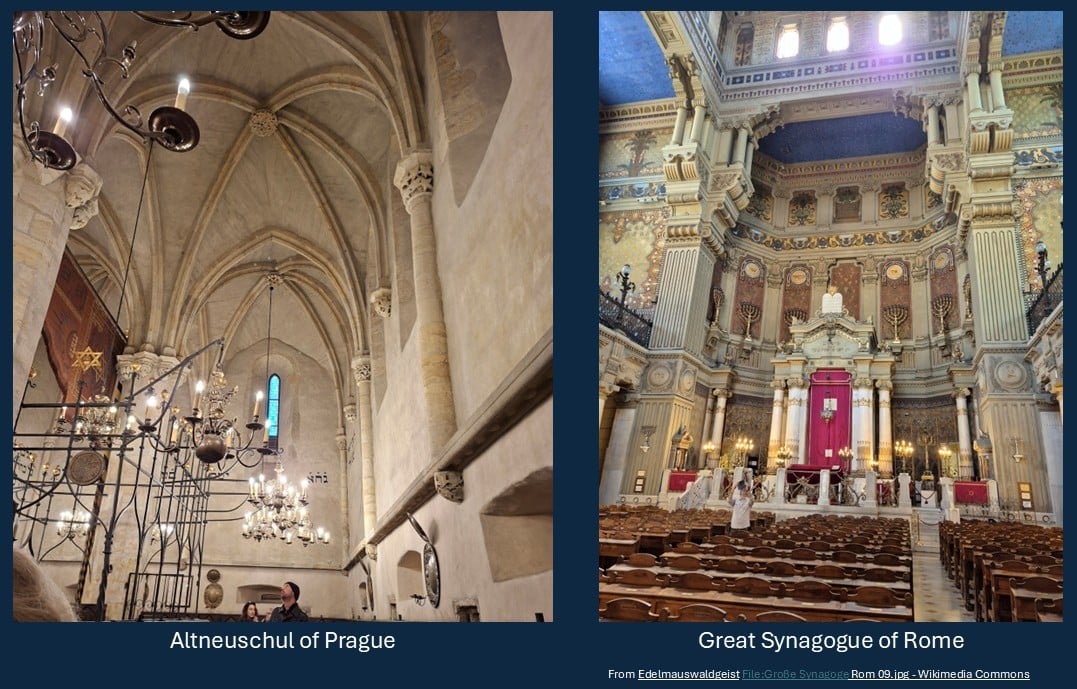
The Altneuschul (Old-New Synagogue) is the oldest still-active synagogue in Europe. It has the architecture of a Gothic cathedral, which is astounding. No nave, just two aisles divided by two central pillars so that no one can turn it into a church (a fate many synagogues have suffered). The arches over the aisles don’t have four ribs in a cross shape; a fifth simulated rib breaks that up.
The Pinkas synagogue has the names of about 77,000 Jews of Bohemia and Moravia murdered in the Holocaust engraved on its walls, and an exhibit of children’s art from Theresienstadt upstairs.
We were surrounded by hordes of tourists in large groups as we walked through the area. It’s a big business bringing tourists to Prague’s famous Jewish Quarter.
It’s painful to see this vestige of a once-thriving community. Famous Jewish sages like the Maharal (Rabbi Judah Loew ben Bezalel) and the Tosafot Yom Tov (Rabbi Yom-Tov Lipmann ben Nathan ha-Levi Heller) lived and worked here. All that is left to remember them by are a few manuscripts on display in one of the synagogues and their graves in the Old Jewish Cemetery.
Jews had been in Prague since the 10th century. Their area was a walled quarter, with its Golden Age in the 1500s when Mordechai Maisel was a wealthy court Jew and the Maharal was active. Emancipation let the Jews move outwards, including Franz Kafka who was born on the edge of the quarter and stayed nearby all his life. In the 1890s the whole quarter underwent “slum clearance,” being replaced by a Parisian-style development. Even so, in the 1930s there were still about 35,000-40,000 Jews in the city. And then there were almost none: today there are 1000-1500 Jews left.
When we were in Rome, we found a Jewish community that is still alive. The clothing store we popped into on the Largo Argentina was run by a Jewish woman, as stores in that area have been for centuries. She identified herself to me when she heard my child call me Imma. We took the synagogue tour and I remembered being there as a child myself on Rosh Hashana. It’s still an active synagogue to this day, serving a population of about 13,000 Jews. There are enough Jews left in Prague for a Friday night service in the Altneuschul but they have to move Shabbat morning services to a smaller space.
The kosher restaurants in the Jewish Ghetto area of Rome are thriving. They may serve tourists, but unlike the kosher restaurants we found in Prague, they serve tasty traditional foods in a typically Roman environment. Jews have been in Rome for over two thousand years, and they seem likely to stay.
The fate of Prague’s Jews and their overwritten quarter made our visit there more bitter than sweet. Is this to be the fate of all the Jews in Europe? How many will get away before the violence and antisemitism turn murderous? Will they instead choose (and be allowed to choose) assimilation?
Related Topics