Geopolitical Analyst: Bridging Somaliland & Israel to the world
President Irro Came Home. Somaliland Heard His Case.
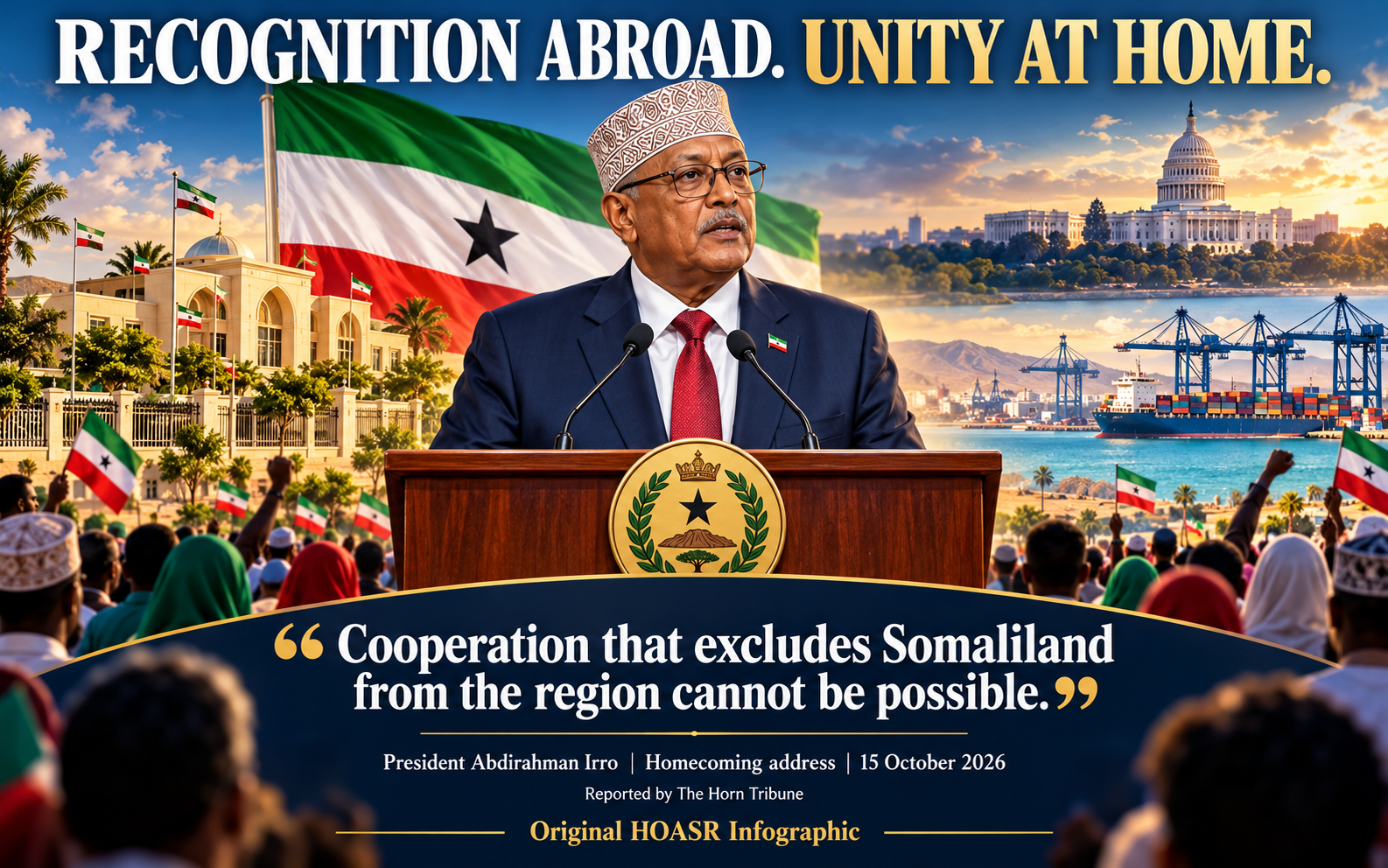
President Irro’s homecoming message connects Somaliland’s international recognition campaign with unity and national resolve. Original HOASR Infographic.
His speech connected the recognition campaign abroad with the concerns of the people waiting at home.
For weeks, Somalilanders watched President Abdirahman Mohamed Abdullahi Irro move between foreign engagements while questions grew at home. What was the long absence achieving? Was Somaliland gaining ground, or were we watching another procession of meetings and photographs? Citizens had every right to ask.
I watched his homecoming speech live on SLNTV. My assessment is that he gave a substantive answer. He described diplomatic openings, acknowledged the pressures facing families and delivered a firm message about Somaliland’s sovereignty. The account he presented deserves more serious consideration than the claim that he had simply been abroad on holiday.
A photograph tells us who stood together. It rarely tells us what they discussed. That gap had become a problem during his absence. His homecoming address finally brought the different parts of the journey into a national conversation.
Washington mattered because access matters
Irro said his visit opened important communication channels with the White House, the American defence establishment and both houses of Congress. He also described engagement with policy institutions, influential figures and foreign diplomats. For Somaliland, gaining a sustained hearing across those circles is meaningful diplomatic work.
American recognition remains the goal. Relationships built along the way can nevertheless produce practical cooperation and stronger political support. Dismissing those gains because recognition was not announced before his return sets a test that ignores how diplomacy develops.
The opposite mistake would be to declare the mission complete. Irro returned with openings that require further work. Somalilanders can recognise progress while continuing to judge its results.
Trump gave Somalilanders something they understood immediately
Irro’s thanks to President Donald Trump captured the emotional centre of the homecoming. For a people accustomed to explaining the difference between Somaliland and Somalia, hearing that distinction from an American president carried considerable weight.
It did not amount to formal recognition. Its political importance was that Somaliland’s separate identity had entered the discussion through a voice nobody in Washington could easily overlook. Somalilanders were entitled to welcome that moment.
Irro placed Trump’s remarks within his account of the diplomatic mission. Their timing strengthened his homecoming message, although it does not establish that his visit caused them. The broader point remains: Somaliland’s case had gained a prominent new reference.
His appreciation of Senator Ted Cruz also recognised the importance of sustained advocacy. Somaliland’s recognition campaign advances through people willing to raise it repeatedly, defend it publicly and keep it before those with decision-making power. Such support deserves acknowledgment.
The mission had people behind it
Irro’s praise for the Somaliland diaspora in the United States was particularly welcome. He also thanked his diplomatic representative in Washington. Those acknowledgments recognised work that often receives less attention than the president’s public appearances.
Diaspora advocacy gives Somaliland continuity between official visits. People maintain relationships, explain the country’s position and keep its concerns alive in political and public discussion. Their contribution belongs in any honest account of the trip.
His appearances before policy institutions and the media served a related purpose. They gave Somaliland opportunities to explain itself directly. Those encounters can be difficult and sometimes uncomfortable, but a recognition campaign cannot depend on speaking only to audiences already persuaded.
His warning on sovereignty deserved attention
The speech became especially firm when Irro addressed governments seeking to undermine Somaliland’s independence. He said Somaliland would defend itself and its citizens, presenting that resolve in terms of self-defence.
For Somalilanders concerned about regional pressure, this was an important assurance. A president pursuing partnerships abroad must also show that he understands the responsibility of protecting the country at home. Irro connected those duties clearly.
His commitments to modern equipment for the national army and police, together with improved salaries and benefits, gave that message practical meaning. Security depends on the people expected to maintain it. Their welfare and professional capacity belong within the national discussion.
These remain commitments whose implementation the public will judge. Their significance in the speech was the direction they expressed: diplomatic outreach would proceed alongside attention to Somaliland’s own ability to protect its citizens.
Dubai brought diplomacy closer to ordinary life
The UAE portion of Irro’s account offered something families could relate to immediately. He said Abu Dhabi had committed to four technical schools. He had requested six, one for each region, and intended to continue seeking the other two.
Somalilanders heard both what he said had been secured and what remained unfinished. The commitment is tangible because technical education can give young people skills that translate into work and greater independence.
He also spoke about the forthcoming construction of a modern hospital in Burao. For families facing limited specialist care or the expense of treatment abroad, movement on that existing project would have direct value.
Schools and healthcare help explain why foreign relationships matter beyond diplomatic ceremony. They connect international engagement to communities whose needs continue long after a delegation returns.
The family budget belongs in the recognition debate
Irro acknowledged that rising prices were hurting households. He connected those pressures to international conflicts and said his government was ready to help address the cost of essential goods.
Somalilanders do not lose their commitment to independence because they worry about food prices. They carry both concerns into the same day.
Recognition is a national aspiration. Affordable necessities, education and healthcare are daily needs. A government speaks more convincingly when it understands how closely those expectations sit together.
The promise of help will ultimately be measured through people’s experience. But the homecoming speech was stronger because it addressed the hardship awaiting the president’s attention at home.
Unity must leave room for disagreement
Irro’s central appeal was that recognition abroad required peace and unity within Somaliland. I agree with that argument. A country weakens its diplomatic position when its internal divisions threaten the stability on which its case partly rests.
His commitment to consultation with opposition groups was therefore important. Political disagreement will continue, as it should. Somalilanders can question government policy while remaining united in defending their country’s sovereignty.
The doubts raised during his absence were part of that public life. Citizens asked what their president was doing. He returned and gave an explanation. They now have a clearer basis for judging what follows.
Unity becomes more durable when people feel heard. It cannot depend on treating every criticism as disloyalty or every government announcement as beyond scrutiny.
The Scoop
My reading of Irro’s homecoming is positive. His speech gave a credible account of work undertaken for Somaliland and connected that effort to the country’s domestic concerns. The sweeping claim that the trip was merely a holiday and a photo opportunity became harder to sustain.
He returned with a message Somalilanders needed to hear: recognition, security, development and public welfare belong within the same national effort. The diplomatic campaign gains strength from the country behind it.
There is reason for encouragement, and there is work still to be judged. Somalilanders can welcome the openings Irro described while expecting the commitments to become visible. His speech answered the questions surrounding his absence. The coming months will give his account its lasting meaning
Related Topics
Related Posts