
Writing on Jewish life, relationships, trauma, and resilience
Pressure Until the Guns Stop
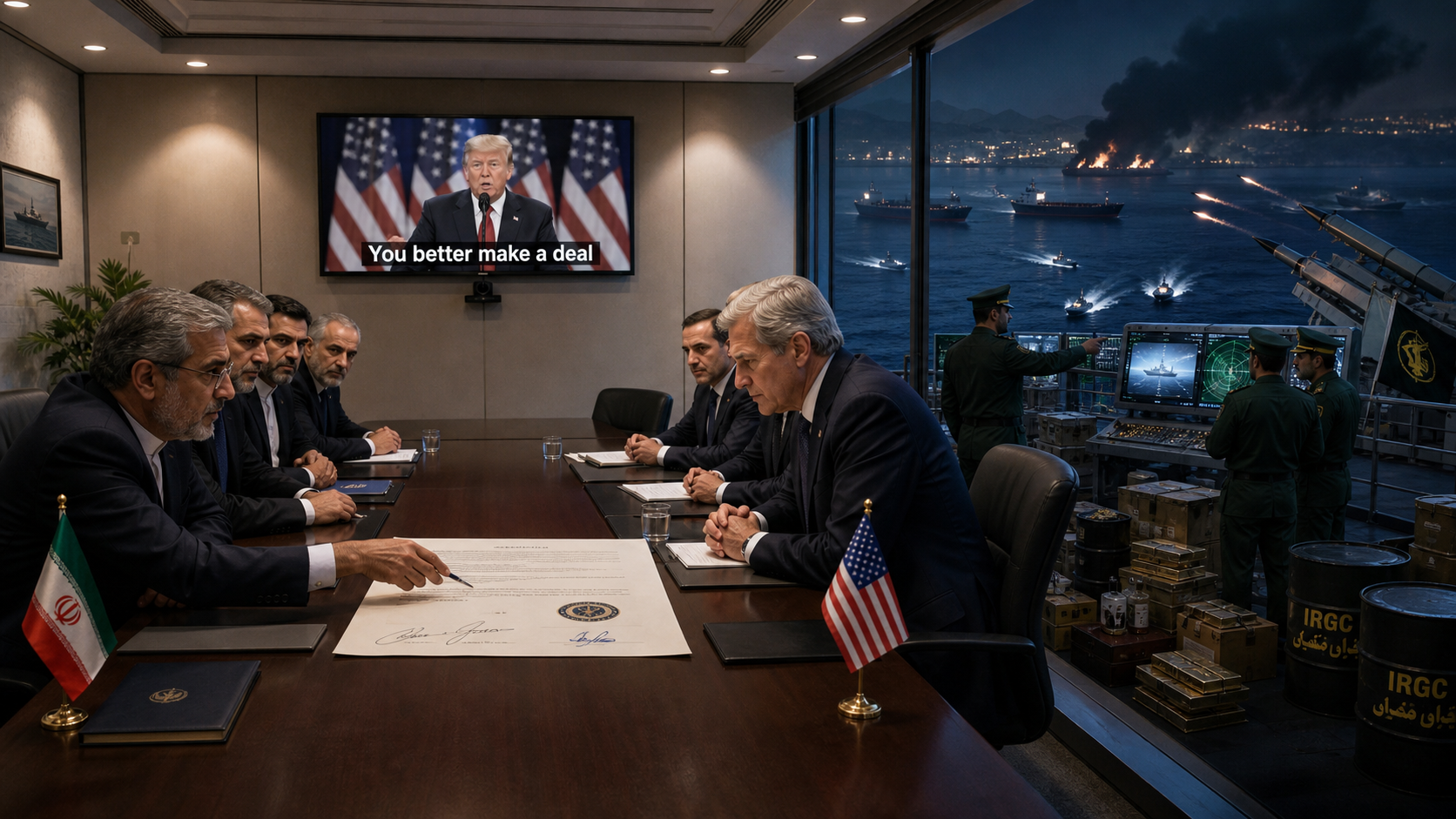
US and Iranian negotiators focus on signing a deal under Trump’s “you better make a deal” warning, while Revolutionary Guard commanders outside, insulated and armed over the Strait of Hormuz, quietly retain the real power. Illustrative AI image created by the author.
Diplomacy with Iran can produce signatures. The question is whether the men with the guns are ever forced to honor them.
Today that question sits at the center of a war over the Strait of Hormuz. President Trump has reimposed a naval blockade, threatened strikes on power plants and bridges, and warned Tehran that “you better make a deal” or “you’re not going to have anything left.” The urgency is real. What is less clear is whether his message is reaching the only audience that matters.
For years, Western publics have been offered a familiar comfort: talks are progress, memoranda are progress, and if everyone can just return to the table, the Strait will reopen and the crisis can end with signatures instead of sorties. Serious policymakers know better. Tehran has long used talks to buy time, split adversaries, probe red lines, and turn yesterday’s restraint into tomorrow’s starting point. The misleading element is not the talks; it is the story told about them, in which each broken understanding becomes a setback on the road to peace rather than evidence of how the regime converts process into pressure.
The pattern is no longer beside the point. The pattern is the argument.
Two Irans, one trigger
Twice now, Iran has attached its name to arrangements meant to calm the Strait of Hormuz. Twice, the ink was barely dry before Revolutionary Guard forces were again attacking commercial shipping. This is not the fog of war. It is the business model of a regime that has learned to weaponize a waterway.
Iran’s civilian leadership can speak the language of resolution. Its diplomats can sit in Doha, issue careful statements, and design mechanisms for monitoring violations. But it is the Revolutionary Guards who command the forces in the water and the batteries on shore, and the Guards pursue a different objective entirely. The Strait, they have discovered, is not only a chokepoint. It is a cash register. Their ambition is not simply to close it but to install themselves as the toll collectors of the world’s most important oil artery — dictating routes, protocols, permissions, and prices through waters they do not own. Whatever Iran’s diplomats intend, it is the Guards’ objective that keeps materializing as fired munitions.
Nor is the IRGC limiting itself to the water. While diplomats ask the world to believe in process, Guard-aligned networks manufacture the political climate against compromise — amplifying revenge imagery and turning threats against Trump and Netanyahu into loyalty tests, so that escalation reads as fidelity and compromise as treason. It is the same strategy in another form: diplomats harvest time, Guards harvest leverage, and the public square is trained to applaud the next violation as revolutionary resolve.
Read the sequence plainly. When Washington eased pressure to give diplomacy room, Guard forces attacked shipping. When mediators described talks as productive, Guard forces attacked shipping. There are, in effect, two Irans — one that negotiates and one that shoots — and only one of them holds the trigger. That is why every pause, every concession, every extended hand has been received not as an opening but as a confession of weakness: an invitation to harden the next demand, raise the next price, probe the next boundary. A power that treats restraint as surrender eventually leaves you only one language in which to be understood.
Why this moment matters
The Islamic Republic has rarely looked more brittle. Its supreme leader of thirty-five years is dead. His designated successor has remained conspicuously out of public view for months — a system built around supreme authority now projects absence at the very top. Its air defenses are damaged, its proxies diminished, its economy under siege, and the Strait it has weaponized now strangles its own commerce as surely as anyone else’s.
History does not often hand moments like this to the enemies of a regime, and it punishes those who waste them. A deal accepted under moderate pressure is a deal Iran can break once pressure lifts; the attacks around Hormuz are the evidence. A promise made by diplomats but unenforced on the water is not peace. It is a pause before the next test.
Every gallon of gasoline, every retirement account tied to energy markets, every family already struggling with inflation has a stake in whether Hormuz becomes a permanent instrument of coercion. This is not merely a regional dispute. It is a test of whether the world’s most important shipping lane belongs to international law or to whichever armed faction can most effectively threaten it.
Trump’s threat and the wrong audience
Into this moment, Trump’s warning lands on the airwaves: make a deal, or watch your country be dismantled piece by piece. That message will resonate in Washington, Jerusalem, and Gulf capitals. The problem is the audience in Tehran. When Trump demands that Iran “get to the table,” he is talking to negotiators and civilian officials who are not the ones ordering attacks on ships, bases, and neighboring states. His call passes over the men who matter most.
The IRGC sits behind a buffer of privilege, propaganda, and impunity. Over decades it has captured large parts of the Iranian economy, built its own businesses, smuggling networks, and patronage systems, and wrapped itself in a language of “resistance” that justifies nearly any cost to civilians. Its senior officers do not stand in bread lines or wait in hospital corridors. They are not losing children to indiscriminate fire or watching shops close under sanctions.
For the Guards, the war is an asset. Every closure of the Strait, every spike in oil prices, every new sanction is another opportunity to extract rents, expand control over commerce, and tighten their grip on the state. Civilians bear the pain — inflation, shortages, blackouts, fear — while the Guards bank the leverage.
That is why threats that Iran will “not have anything left” may sound compelling in Western capitals yet fail to translate into pressure where it counts. A faction that has already insulated itself from the collapse of ordinary life is not moved by warnings about ordinary life. If the IRGC believes it can survive, profit from, and even deepen the country’s misery while consolidating power, then destroyed bridges and darkened cities are experienced as a burden on others — not as a threat to itself.
In that sense, Trump’s message is misaddressed. A demand that Iran “make a deal” through negotiators who lack authority over the guns is a demand addressed to people who cannot deliver. Diplomacy with those who do not hold the trigger is theater.
The real target is not a signature
The goal is not Iranian humiliation. “Pressure until the guns stop” is not a demand for theatrical surrender — a white flag, a photograph for history. The capitulation that matters is operational, not symbolic. Success is not a handshake. Success means the Strait open without Iranian permission or tolls; attacks on shipping ended; nuclear concessions verified by inspection; and the IRGC made unable — or unwilling — to treat future signatures as disposable.
That is the standard by which any proposal, including any future Trump-backed deal, should be judged. Would it change the behavior of the commanders firing on ships? Would it alter the incentives of the institution that makes compromise look like betrayal? Or would it merely produce another document for diplomats to defend after the next attack? A memorandum that does not bind the men with the guns is not a settlement. It is paper awaiting its next humiliation.
Pressure, then, does not mean maximal force everywhere, bombing for its own sake, or ignoring Gulf partners’ exposure. It means sustained, escalating coercion aimed at the specific things that make agreements worthless: IRGC maritime assets, the missile and drone infrastructure threatening the Strait, the revenue streams and sanctions-evasion networks tied to coercion, the command nodes, and the political prestige of the Guards as the faction that can defy the world and survive. It means making violation costlier than compliance.
Some will argue the answer is to strengthen the “reasonable” faction instead. But hope is not a command structure — and the hope fails on either reading of Iran’s internal split. If the rift between diplomats and Guards is real, the civilians cannot deliver what they promise. If it is theater, the diplomats are buying time while the Guards keep the coercion running. Either way, agreements fail unless the armed faction violating them is forced to stop. A government that cannot bind its guns cannot bind itself.
Pressure comes with consequences
The case for pressure deserves to be taken seriously only if it tells the truth about the bill.
Escalation is likely, not merely possible. Cornered regimes do not fold on schedule. Iran retains the ability to strike Gulf states, shipping, and energy infrastructure. Israelis should expect more sirens before this ends, not fewer. Anyone promising a quick, clean victory is selling comfort, not strategy.
The economic pain will be global and sustained. Hormuz is a central artery of the world economy. Every exchange of fire will move oil prices, shipping insurance, and political patience — and America’s Gulf partners, absorbing threats and in some cases actual fire, will pay part of the price. A pressure campaign that ignores their exposure will fracture the coalition it most needs.
Regime collapse is not automatically victory. If pressure works too well, we may face not surrender but disintegration: competing armed factions, loose weapons, proxy networks answering to no one, a fractured Iran exporting chaos in every direction. We should prefer coerced compliance to a corpse — and still plan seriously for the possibility that we get the latter anyway.
Capitulation requires someone capable of capitulating. Surrender is a decision that must bind. If Iran is now governed by committee — the supreme leader’s office, the Guards, the Supreme National Security Council, an unseen or weakened leader balancing rather than commanding — then no civilian promise can be assumed to control the men firing on ships.
And there is no guaranteed endpoint. What if the guns do not stop? Then the policy risks becoming indefinite war, and democratic publics do not fund indefinite wars forever. The strategy’s greatest vulnerability may not be Iranian missiles. It may be Western impatience.
These dangers are not side notes to the argument. They are part of it.
Choosing the hard road with open eyes
So why advocate this course while cataloguing its dangers? Because the alternative’s dangers are worse and better disguised. Another ceasefire will hold exactly as long as the Guards decide it should. Another agreement will buy Tehran time to reconstitute, stabilize its new leadership, and return to Hormuz with sharper tools. The costs of pressure are visible, immediate, and painful. The costs of accommodation are deferred, compounding, and — on the evidence before us — certain.
Israel has learned this at a terrible price. Deterrence deferred is deterrence destroyed. Restraint that is read as exhaustion does not lower the cost of the next confrontation; it raises it.
None of this means diplomacy should end. It means diplomacy must be rebuilt around reality rather than theater. Trump’s insistence that Iran “better make a deal” will matter only if the deal is backed by consequences that reach the one audience that counts: the men with the guns. The question is not whether Iran can be brought to a table. It is whether the institution turning the Strait into a weapon can be made to understand that the next violation will cost more than compliance.
We should walk this road not because it is safe. It is not. We should walk it because the comfortable road leads back here in two years, against an Iran that has learned once again that our resolve has an expiration date.
Diplomacy deserves every chance to succeed. But diplomacy succeeds only when the signature reaches the hand holding the gun.
Related Topics
Related Posts