
Journalist, Commentator on Middle East Issues
The Mecca Pact: Should Israel be worried?
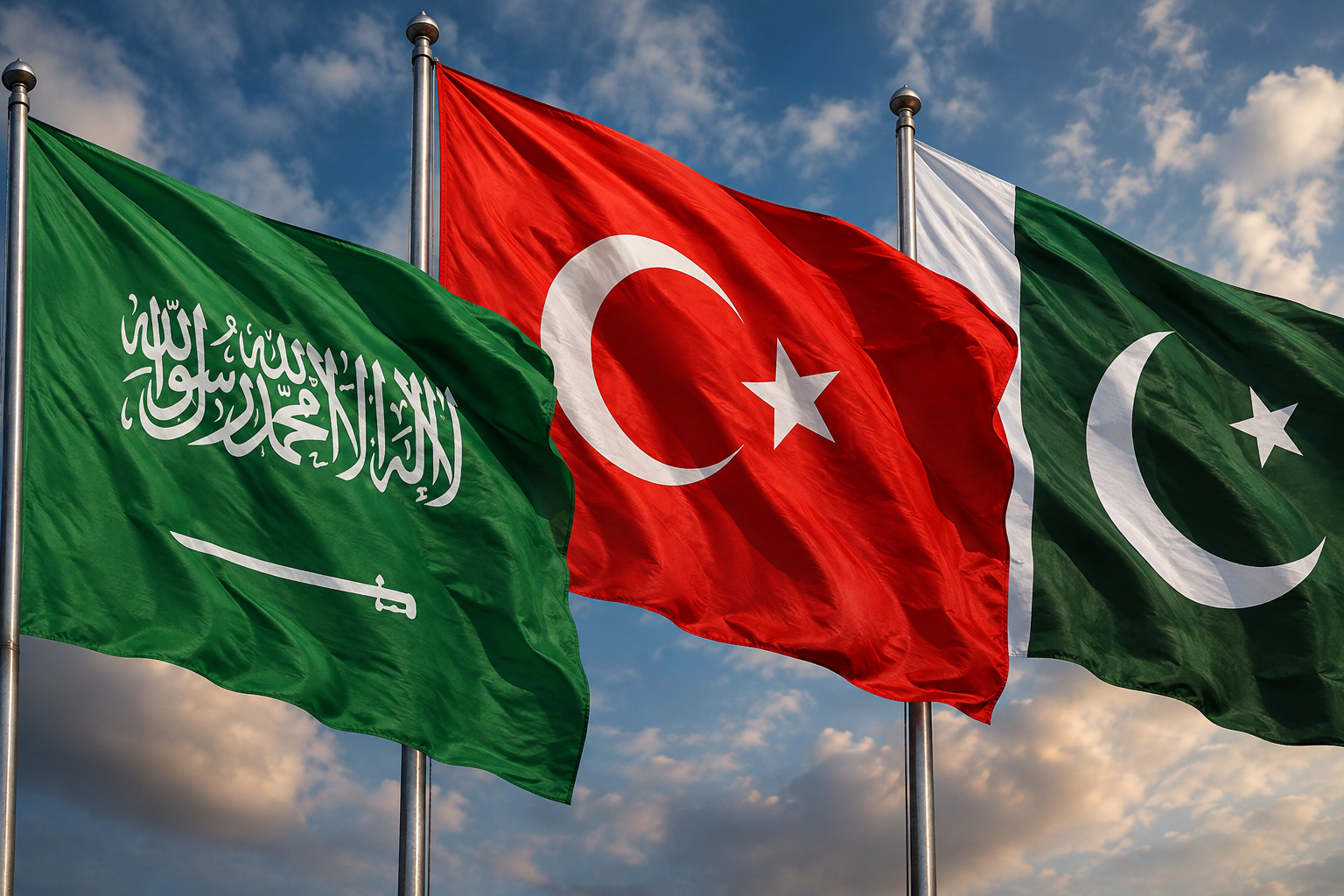
AI collage
Over the past weekend, a dramatic diplomatic ceremony unfolded at Al-Safa Palace in Mecca. Saudi Crown Prince Mohammed bin Salman, Turkish President Recep Tayyip Erdoğan, and Pakistani Prime Minister Shahbaz Sharif signed the “Mecca Joint Defense Agreement”, a trilateral military pact stipulating that an armed attack against any one of the three states will be considered an attack against all three. In the simplest sense, this is a historic agreement: it marks the first time the region’s leading Sunni powers have signed a formal military alliance of this kind.
A worrying combination of capabilities
What makes the agreement especially sensitive from Jerusalem’s perspective is the makeup of its signatories: Turkey fields the second-largest army in NATO, Pakistan is the only Muslim-majority state to possess nuclear weapons, and Saudi Arabia is one of the wealthiest and most influential powers in the Gulf. The pact effectively builds on a bilateral security agreement Riyadh and Islamabad signed back in September 2025, one that already sparked talk at the time of a Pakistani “nuclear umbrella” extending over Saudi Arabia. This time, the language was left deliberately vague: Pakistan’s defense minister insisted nuclear weapons are not part of the deal, while a senior Saudi official described it in far broader terms, as a comprehensive defense arrangement covering “all military means.” No details have been published on exactly which forces each country is obligated to commit to the others’ defense.
A theoretical threat, or an operational one?
Many analysts are urging caution. Some argue that, for now, this is primarily a strategic deterrent signal aimed at Iran rather than a fully integrated operational alliance, and that without active American backing, pacts of this kind can prove toothless in practice. It also remains unclear whether Turkey or Pakistan would actually intervene militarily if the Houthis or Iran struck Saudi Arabia directly. The real test, commentators note, will come after future incidents: will they produce visible signs of intelligence-sharing, joint deployment of defense systems, or combined exercises, or will the dramatic declaration remain, at its core, a political gesture?
The real Israeli trigger: Syria
The most concrete risk for Israel isn’t theoretical. There are reports that Turkey, Saudi Arabia, and Pakistan are working toward a gradual track that could eventually bring Syria into the pact. A NATO-style mutual defense clause could mean that any future Israeli strike on Syrian soil, even one aimed narrowly at terror targets or remnants of Iranian-backed cells, could be framed as grounds for a diplomatic, or even military, confrontation with an alliance that includes both a NATO member and a nuclear power.
Bottom line
The pact was born out of the regional war with Iran, and Saudi Arabia currently finds itself, in practice, on the same side as Israel against Tehran, a fact that carries some potential upside. But for decision-makers in Jerusalem, the combination of Saudi money, Turkish military muscle, and Pakistani nuclear capability, alongside openly stated ambitions to curb Israeli influence in the region, demands close and sustained attention , above all in determining whether this is a political statement or an alliance acquiring real operational teeth.
Related Topics