Protecting Houses of Worship and Schools from Harassment
In a 44-to-5 vote, the council took decisive action against the intimidation of Jewish — and all — worshippers and students. Advocates, lawmakers, and community voices say the moment is historic, urgent, and long overdue.
Standing inside Park East Synagogue — a building that became a flashpoint for anti-Jewish harassment just months ago — New York City Council Member Eric Dinowitz, social media activist Aliza Licht, and Speaker Julie Menin spoke with unmistakable conviction: this is not a political moment. It is a moral one.
Courtesy: Aaron Herman

The New York City Council’s passage of two bills — one protecting houses of worship and one protecting schools and educational facilities from harassment, intimidation, and physical obstruction — landed with the force of a long-delayed reckoning. The final tally: 44 votes in favor, 5 against.
The scene at Park East was charged with history. Students filled pews. Interfaith leaders stood shoulder to shoulder. And three voices — a lawmaker, an advocate, and a speaker — framed a legislative milestone as something far more personal than policy.
Courtesy: Aaron Herman
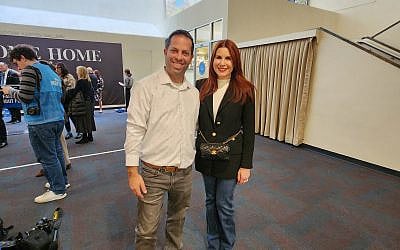
ALIZA LICHT: ‘October 7th Changed Me Forever’
Aliza Licht did not set out to become one of the most prominent Jewish voices on social media. She was a marketer and an author — someone who understood how stories are shaped and sold. But after October 7th, she said, something shifted in a way that could not be undone.
ALIZA LICHT
“In my personal life, I’m always a proud Jew. Two children that went to Jewish day school, and granddaughter of four Holocaust survivors. October 7th changed me forever.”
That transformation, she explained, led her to redirect her social media presence entirely toward advocacy for the Jewish community and Israel — a decision, she acknowledged, that does not come without cost.
ALIZA LICHT
“There’s a lot of haters out there. A lot. It’s not easy to be a voice, to come out. But being an advocate for the Jewish community has become a real priority for me.”
Licht describes her approach to advocacy as rooted in what she calls a superpower: connecting the dots. A relentless consumer of news, she has built a following not just by amplifying stories, but by interrogating the narratives around them.
“I like to point out the inaccuracies in the media and the bias in the media — what I call narrative engineering.” — Aliza Licht
ALIZA LICHT
“I see a headline and I question it. Then I look into it. And then I want to create the actual truth for the people who follow me.”
On the bills passed by the city council, Licht was direct. As a longtime member at Park East and a parent who sent her children through its day school, the November night when protesters blocked worshippers from entering was not an abstraction.
ALIZA LICHT
“That fateful night in November was shocking to everyone. I think this bill is essential. Both aspects — houses of worship and schools — need to pass. And if Mayor Mamdani doesn’t sign it, it speaks volumes.”
Courtesy: Aaron Herman
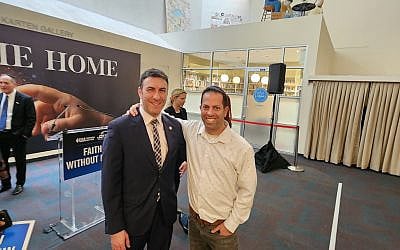
ERIC DINOWITZ: ‘We Are the Government That Stands Up’
Council Member Eric Dinowitz is the kind of lawmaker who will tell you, with a straight face and a slight smile, that he is only 25 years old — right after noting that education has been a central part of his life for the past 30 years. The joke lands. But what follows it does not.
Dinowitz was one of the driving forces behind both bills. Representing a district that includes Park East Synagogue, he watched the November protests unfold in real time and felt something crystallize.
COUNCIL MEMBER ERIC DINOWITZ
“Whether you’re going to your house of worship or you go to school, you do not deserve to be harassed and intimidated and physically obstructed. That’s not America. That is not American. Those are not our New York values.”
The bills do not restrict protest, he was careful to note. They protect access. In his framing, the legislation is as much about precedent and history as it is about any single incident.
COUNCIL MEMBER ERIC DINOWITZ
“We have seen time and time again throughout our history, thousands of years, where the Jewish communities were harassed and intimidated. That’s how it started. And then it led to violence. And all the while the government stood by and did nothing.”
“We are not the government that does nothing. We are the government that stands up.” — Council Member Eric Dinowitz
But passing the bills required votes — and votes, he acknowledged, required political courage. Some council members faced significant external pressure to vote no. Dinowitz believes much of that pressure came from people who either misread the bills, or worse, sympathized with the kind of protests that shut worshippers out of their own synagogue.
COUNCIL MEMBER ERIC DINOWITZ
Dinowitz’s ask of the community was simple, almost disarmingly so: say thank you.
“When council members take tough votes and vote the right way, we need to thank them,” he said. “We may not always be the loudest community — but we have to speak up and be heard.”
You can do it right now. Download Emissary4All on the Apple App Store or Google Play, open the Connect feature, join the Recalibration group and complete a mission to message your representative directly. Sixty seconds. That’s it.
For the children in the room — the students who came to Park East to witness the moment — Dinowitz made a different kind of promise.
“We have to fight for our kids who can’t yet vote. It’s very easy to get caught up in what is politically expedient. But sometimes we have to do what’s right. They are our future. And we have to make sure they have a bright, safe, and dignified future.”
SPEAKER JULIE MENIN: ‘We Did It, Everyone’
Speaker Julie Menin, whose remarks at Park East carried the full weight of her position and her biography, did not mince words. She is the daughter and granddaughter of Holocaust survivors. The legislation, for her, is not policy. It is inheritance.
SPEAKER JULIE MENIN
“We did it, everyone! There are people who doubted our ability to do this, but we got it past the finish line — with an overwhelming vote of support, 44 to 5.”
Menin addressed those who feared the bills infringed on free speech directly, and without hesitation.
SPEAKER JULIE MENIN
“The First Amendment right to peacefully protest is sacrosanct. It is what our country is built on. Nothing in the bills stands in that way. But you do not have the right to intimidate and harass people as they are entering their house of worship.”
The legislative package also included $1.25 million in funding for the Museum of Jewish Heritage, building on a program Menin launched to bring every 8th grade student in New York City through its Holocaust exhibition. That investment, she argued, is not separate from the bills — it is inseparable from them.
SPEAKER JULIE MENIN
“Studies show that 34% of young people believe the Holocaust is a myth or is exaggerated. 34%. The only way we’re going to combat that level of hate is through education — which is the best antidote to intolerance.”
“We have so much more in common than we do apart. And it’s by emphasizing that commonality, that kindred spirit of humanity, that we are going to get through this crisis.” — Speaker Julie Menin
Menin also paid tribute to the coalition that made the vote possible: UJA Federation of NY , JCRC, interfaith leaders, and the 44 council members who stood up. She singled out Council Members Eric Dinowitz and Lynn Shulman, co-chairs of the council’s Jewish caucus, as well as Virginia Maloney and Gail Brewer.
A CITY AT A CROSSROADS
What happened at Park East Synagogue last November — worshippers blocked, students frightened, neighbors paralyzed by the sight of their sanctuary under siege — is now etched into the history of this legislation. But the three voices gathered here were careful not to let the moment become a monument.
The bills now move to Mayor desk. Aliza Licht’s message to him was unambiguous: sign it, or the silence will say everything.
For Eric Dinowitz, the measure of success is not in the vote count — it is in whether a child can walk into a school without fear, and whether a grandmother can enter a synagogue without running a gauntlet of hatred.
And for Speaker Julie Menin, standing in a room full of students who represent the city’s next chapter, the legislation is an act of transmission: handing something essential — safety, dignity, belonging — to the generation that will have to carry it forward.
SPEAKER JULIE MENIN
“This is really about the future of New York City. You’re the next generation of leaders that will take over this city. At the end of the day, we’re fighting for you.”