
Notes from home and far away
‘Protective Parent as Alienator
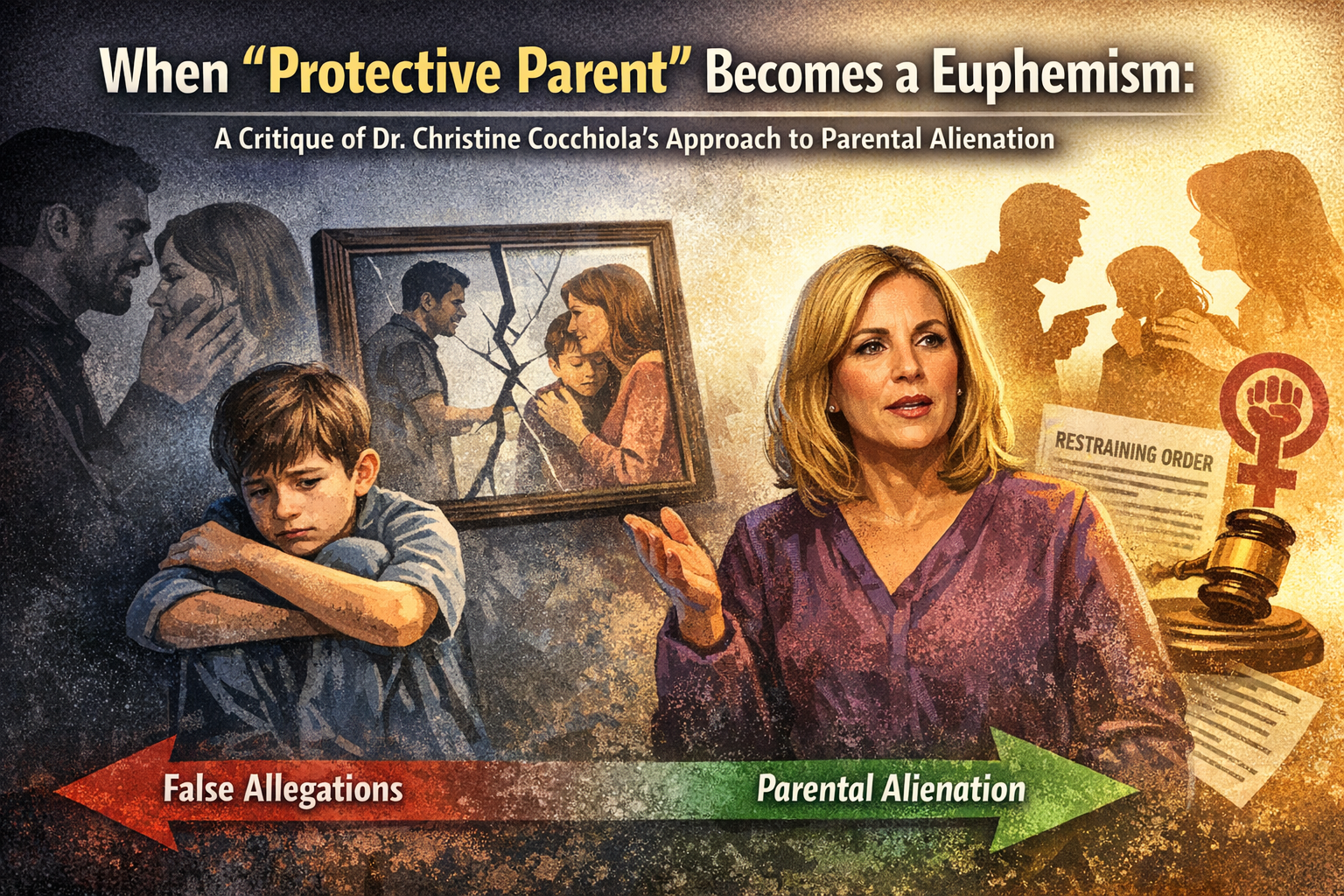
Illustration © Monique Dietvorst, 2026. Created with AI assistance
When “Protective Parent” Becomes a Euphemism: A Critique of Dr. Christine Cocchiola’s Approach to Parental Alienation
In recent years, the concept of parental alienation (PA) has become one of the most contested issues in family law and child psychology. Few clinicians illustrate this controversy more clearly than Dr. Christine Cocchiola, whose public commentary increasingly frames PA not as a child-centered relational pathology, but as a litigation tactic used by abusive fathers.
This framing is not neutral. It has consequences — especially for children.
The problem with the “protective parent” framework
Dr. Cocchiola frequently employs the term protective parent to describe parents — overwhelmingly mothers — who restrict or eliminate a child’s relationship with the other parent. In theory, this language is meant to center child safety. In practice, it often functions as a semantic shield.
When a parent is labeled “protective,” their behavior is presumed benevolent by definition. Motive is assumed. Evidence becomes secondary.
This is a serious problem in cases where:
- the child displays classic alienation symptoms (unjustified rejection, borrowed narratives, false beliefs)
- allegations are unsubstantiated or demonstrably false
- the child’s psychological functioning deteriorates in parallel with parental alignment
In these cases, protection becomes indistinguishable from coercive psychological control — yet the label prevents that behavior from being examined.
A gendered lens that obscures child abuse
Dr. Cocchiola’s work relies heavily on feminist IPV frameworks that conceptualize family violence as:
- male-perpetrated
- female-defensive
- rooted in coercive control dynamics between adults
Those frameworks have value in adult intimate partner violence contexts. They do not translate cleanly to child psychological abuse.
Parental alienation is not about adult power struggles. It is about a child’s internal world being reshaped to reject a parent without legitimate cause. That phenomenon:
- is perpetrated by both mothers and fathers
- occurs across cultures
- appears even in cases with no abuse allegations at all
- disproportionately affects fathers as the targeted parent (approximately 65–70% in multiple studies)
A framework that cannot acknowledge female-perpetrated alienation is not child-centered. It is ideology-centered.
The misuse of IPV lethality research
Dr. Cocchiola often cites research such as Sorenson & Shen (2005) on intimate partner homicide to argue that courts should default to maternal protection claims when PA is alleged.
This is a category error.
Sorenson studied:
- adult female homicide victims
- lethal violence risk during relationship dissolution
- restraining orders and timing of adult harm
Sorenson did not study:
- children
- custody dynamics
- parent–child psychological alignment
- false allegations
- long-term estrangement outcomes
As Dr. Don Dutton has pointed out, restraining orders are markers of relationship dissolution, not evidence of parental fitness or child abuse. Using adult lethality data to dismiss child psychological abuse is not evidence-based practice — it is rhetorical substitution.
Empirical Findings Show Alienating Parents, Not Targeted Parents, Are More Likely to Have Substantiated Abuse Claims.
Dr. Cocchiola will not say this about Alienating Mothers.
Research demonstrates that alienating parents — not alienated/targeted parents — were more likely to have substantiated abuse claims when abuse was confirmed. This counters the narrative that targeted parents are usually the abusive ones and that PA allegations are defensive tactics:
“Parents who were found to have alienated their children by the court… had an 81.62% greater probability of having a substantiated claim of abuse against them than parents alienated from their children.”
This suggests abuse risk aligns more with alienating behavior than with being falsely accused by targeted parents.
When belief replaces evidence
One of the most troubling aspects of the “protective parent” narrative is its reliance on belief rather than corroboration.
A parent’s conviction that they are protecting a child does not immunize their behavior from causing harm. History is full of abuse carried out in the name of protection.
Child psychology requires outcome-based analysis:
- What does the child believe?
- What behaviors are present?
- What relationships have been severed?
- What evidence supports the alleged danger?
When belief is allowed to override evidence — particularly when filtered through gender — children lose their voice.
The cost of denying female-perpetrated alienation
By refusing to seriously engage with maternal alienation, clinicians risk:
- legitimizing psychological child abuse when perpetrated by women
- reinforcing sex-based stereotypes incompatible with modern psychology
- abandoning children who are harmed by the very parent claimed to be “protective”
Parental alienation does not disappear because it is politically inconvenient. Children do not stop suffering because a theory cannot accommodate them.
A call for child-centered ethics
This critique is not an attack on feminism, nor a defense of abusive parents. It is a call for conceptual discipline.
Any framework that:
- presumes parental virtue based on sex
- treats misuse of PA claims as proof PA does not exist
- substitutes adult IPV narratives for child psychological evidence
has abandoned clinical neutrality.
Children deserve better than euphemisms.
They deserve to be seen.
Related Posts