Quintessential Sydney, the beach made us smile
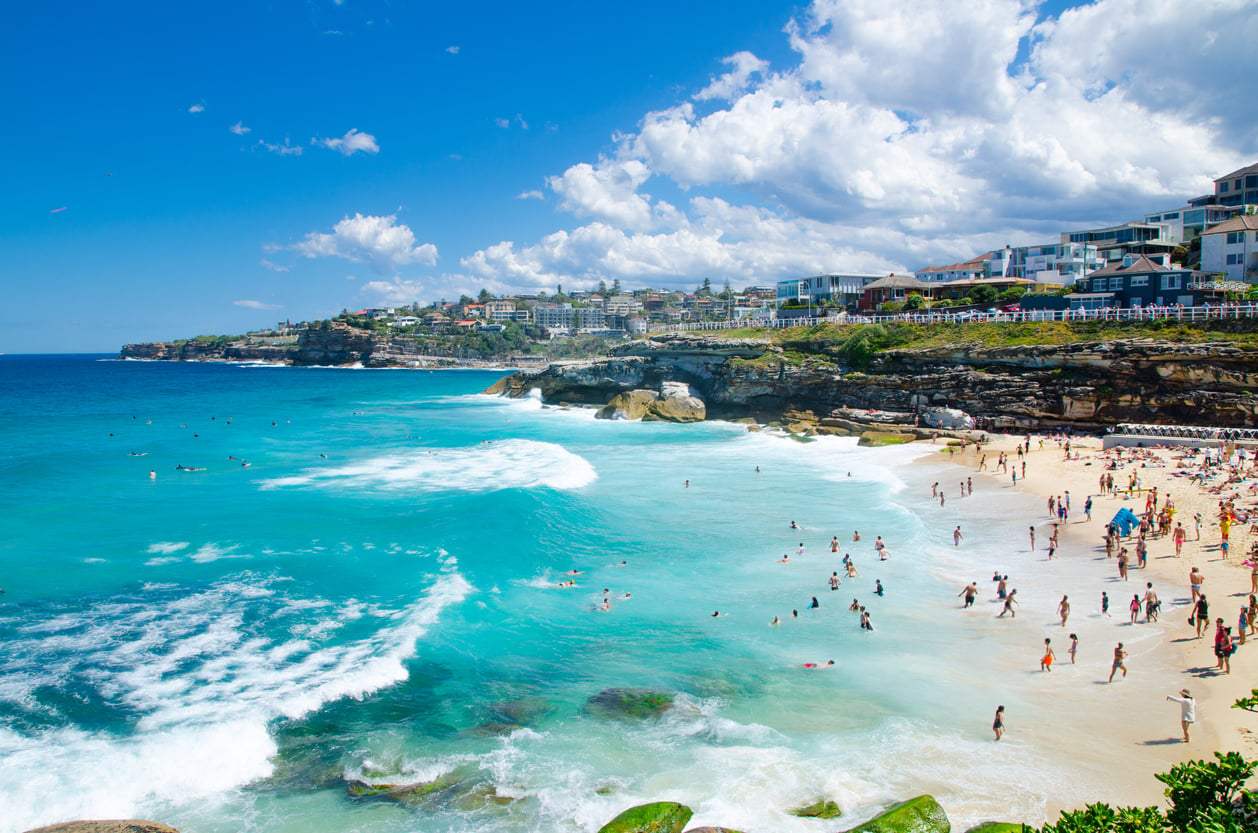
I am writing this while glued to the television, Sunday night, in Australia. Four hours ago, two gunmen targeted a Hanukkah celebration on Bondi Beach, slaughtering and injuring so many. At the time of the publication of these words, at least 15 murdered, at least 29 injured. Those numbers may rise.
I know this slice of Bondi Beach so well because I lived there for two years. My mother Mira, born in 1927 in Czechoslovakia, had been in Auschwitz when she was 17, and a fellow Jewish prisoner who helped her survive had moved to Sydney, while Mira chose Melbourne. When I was in my 20s, I accepted a job in Sydney, and Mira’s savior Edit let me live in an apartment she owned. It was situated above a kosher butcher. And it was in Bondi Beach. My mother liked the area because the Hakoah club — a Jewish community center — was only a few doors down. It was the safest place she could think of.
Most mornings, I would head to the sea, along the curvy coastal path known as the Bondi-to-Bronte walk. A few days ago, I watched Oprah Winfrey on that trail – a recommendation from actor Hugh Jackman for how to spend her time while in Australia on a speaking tour. It sparkles, that stretch of the world. The sunlight bounces off the water, and the air is filled with suntan lotion and wet dogs shaking their fur and the sounds of chatter as people walk past. It’s quintessential Sydney, including the next beach along, past Bondi: Tamarama, known as “Tamaglamour,” thanks to the itty bitty bikinis and tribal tattoos one sees en masse. It is a place to make you smile.
Today, I watched footage from Bondi Beach in horror, and it wasn’t hard to imagine I was there – whenever I texted a friend, it seemed they were. “I heard the shots from our garden and then saw hundreds of people running away from the beach, and police and so many ambulances,” wrote one. “I heard someone I know may have died; her son was injured,” wrote another. “My son was swimming in the water near the shooting but got away. Safe but shaken,” said a third. So much terror in those tiny messages.
It was an unimaginable turn of events, in many ways. Australia isn’t a place of mass shootings; not since the Port Arthur massacre, which prompted our then prime minister John Howard to revise the gun laws almost 30 years ago. This is the biggest shooting since then. Yet if you are Jewish in Australia, you always knew this was a possibility. Today, only hours before the Bondi Beach massacre, I reposted a social media Hanukkah message from our Prime Minister Anthony Albanese, with words of my own. “If you’re wondering if Australia has a problem with antisemitism, just scroll through the comments,” I wrote. They were vile, as they always are. The people who spew hate do so with impunity. After the shooting, I commented on the massacre. “Why don’t you just leave, if you feel unsafe?” asked one poster. I’m paraphrasing, because I blocked him. I’ve blocked so many like him, in the last two years.
But I can’t be silenced; I owe that much to my late mother Mira, a Holocaust survivor. I wrote a book about her life – not only that she endured four concentration camps, but that she managed to live with so much joy afterwards. That is not the full story. Mira knew that the beating heart of antisemitism still echoed beneath the ground, even if it was faint and so very hidden in Australia, a place she nevertheless saw as a sanctuary. She made sure I wasn’t fearful, but she didn’t want me to be ignorant, either. Under her watch, I was not allowed to be complacent.
It was unthinkable that today’s events would have taken place in Australia, but Mira would have known they were possible. She had learned the lessons first hand: that if hate speech becomes the norm, violent actions follow. That if you segregate a group of people and label them appalling in some way, they become obvious targets for aggression and hate. That human beings are capable of so much – sometimes great generosity and love and empathy, and sometimes great cruelty and barbarism and viciousness. Wherever humanity exists, inhumanity does as well.
How does it stop? I don’t have an answer. I do the only thing I know how to do: I pick up a pen and I write. Perhaps I can change one heart; perhaps I can change 10. Perhaps the non-Jewish people who tell me how awful it is that our synagogues have to be guarded by armed security will take that one step further, and not just complain to me. Change doesn’t start as a collective; it begins with the individual.
Tonight, I commemorated Hanukkah by lighting the first candle on my menorah – on three menorahs, in fact, because it felt that more light was needed. As I sang “Ma’oz Tzur,” a line translated into English, rang out: “There is no end to days of evil.” However, this is not what Hanukkah is really about. It is a holiday about miracles, about good prevailing over evil, about standing up for what is right, no matter how daunting. And on Hanukkah, the most important lesson of all: the smallest amount of light can be stretched for the greatest of lengths. My mother Mira believed that no matter how unfathomable the darkness, one had to look for the light beneath. And if it couldn’t be found, it was incumbent to light the way forward with your own essence. That’s what she did. And, being my mother’s daughter, I have no choice but to follow.