NAnews - Nikk.Agency Israel News
Racism – or Anger at Russia Backing Israel’s Enemies? The Dolev Cohen Scandal
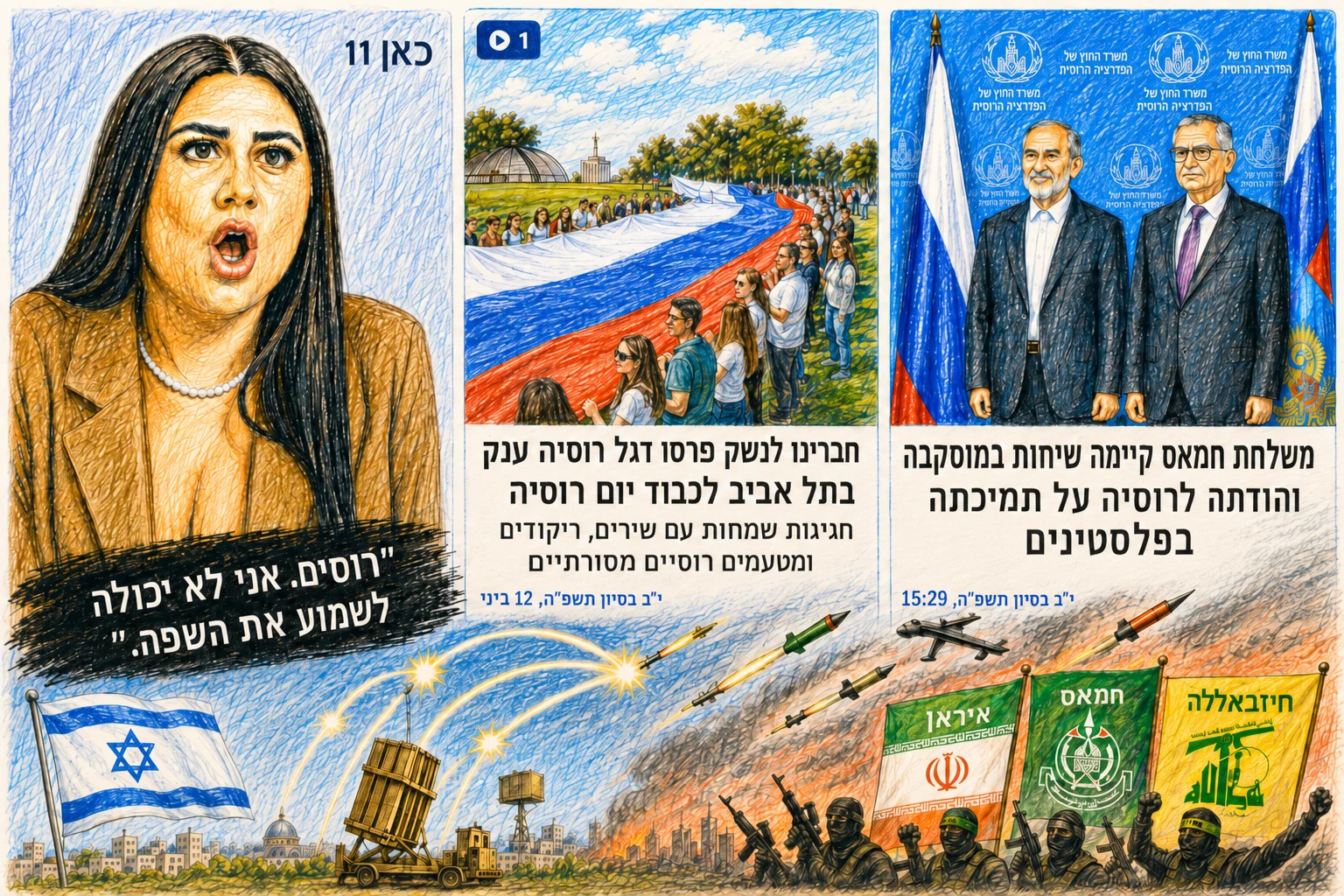
Racism - or Anger at Russia Backing Israel’s Enemies? The Dolev Cohen Scandal. Their image was created using AI.
“I Can’t Stand Hearing Russian”: The Dolev Cohen Scandal and the Russia Problem Israel Keeps Compartmentalizing
How does it look from Jerusalem?
“רוסים. אני לא יכולה לשמוע את השפה” — “Russians. I can’t stand hearing Russian.”
A few seconds from a reality-show promo were enough to ignite a political controversy in Israel.
On August 21, 2026, 27-year-old Dolev Cohen from Ramla appeared in a promotional clip for the new season of Kan 11’s Four Weddings. Speaking to the camera, she said:
“Russians. I can’t stand hearing the language. I can’t stand hearing it. I walk through the supermarket and other places, and it seeps into my head.”
In the same remark, she made a similar comment about Amharic.
The reaction was immediate.
Avigdor Liberman called the clip racist and said racism should not be turned into prime-time entertainment. Yesh Atid MK Vladimir Beliak demanded that Cohen be removed from the screen. Yisrael Beytenu MK Evgeny Sova formally wrote to Israel Public Broadcasting Corporation CEO Golan Yochpaz, asking how such a promo had passed editorial review and demanding that it be removed.
Kan 11’s response is important. The broadcaster said it opposes racist statements and explained that the promo comes from a longer humorous sequence in which Cohen criticizes not only others but also herself, her family and her own wedding. According to Kan, in the full segment the program’s presenter clearly criticizes the way Cohen expresses herself.
Fair enough.
But that creates another question.
If the full segment provides the critical context, why did Kan itself choose a fragment without that context to promote the new season?
The controversy was not created only by what Cohen said. It was also shaped by an editorial decision to turn those words into advertising.
Then, on August 22, the story took another turn.
According to a message published by Israeli journalist Daniel Amram, Cohen’s brother Matan defended her. He said people had blown the issue out of proportion: his sister, he argued, is not racist and loves everyone; she simply dislikes certain languages. He compared it with his own reaction to hearing Arabic, which he said gives him flashbacks from Gaza.
That is his explanation.
It is not Dolev Cohen’s explanation.
And that distinction matters.
We do not know why Dolev Cohen reacts this way to Russian
There is a tempting political explanation.
Russia invaded Ukraine. Russia has moved steadily closer to Iran. Iran directly attacks Israel and supports forces that fight Israel. Hamas officials travel to Moscow. Russian-made weapons have been captured from Hezbollah.
Perhaps a young Israeli sees this news year after year and eventually starts associating the word “Russian” with something hostile.
That is psychologically possible.
But Dolev Cohen did not say any of that.
She did not mention Vladimir Putin. She did not mention Ukraine, Iran, Hamas, Hezbollah or Russian foreign policy.
She talked about hearing Russian in supermarkets and other public places.
So I do not want to play the same game in reverse: first convict her of racism on the basis of a few seconds, then acquit her by inventing a geopolitical motivation she never expressed.
Maybe she dislikes the sound of Russian.
Maybe there is some personal experience behind it.
Maybe politics has nothing to do with her reaction at all.
Until Cohen explains it herself, we do not know.
But there is another question that does not require us to guess what is happening inside Dolev Cohen’s head:
What does an ordinary Israeli now see when Russia appears in the news?
That question is much easier to answer.
No classified Mossad briefing is required.
You only need to read the headlines.
Hamas in Moscow, Russian weapons in Hezbollah hands, Iran beside Russia
On June 10, 2026, Russian Deputy Foreign Minister Georgy Borisenko received senior Hamas official Mousa Abu Marzouk in Moscow.
According to the Russian Foreign Ministry, they discussed Gaza, a sustainable ceasefire, humanitarian assistance and a broader Palestinian political settlement. Abu Marzouk also publicly thanked Russia for its diplomatic efforts and its support for the Palestinians.
For Moscow, this can be described as diplomacy.
For an Israeli after October 7, the picture looks somewhat different.
Hamas murdered Israelis, abducted Israelis and held Israeli hostages. Israel has spent almost three years fighting the organization.
And a senior Hamas figure can still sit down for an official meeting at the Russian Foreign Ministry.
Now move from Gaza to Lebanon.
In December 2024, the IDF invited journalists to view a massive collection of weapons and equipment captured from Hezbollah in southern Lebanon.
Among roughly 6,840 RPG rounds and anti-tank missiles on display were 340 Russian-made Kornet anti-tank missiles, along with their launchers. Israeli military sources told The Times of Israel that Hezbollah’s arsenal was sourced largely from Russia and Iran, with some weapons produced locally.
Here we need to be precise.
Those Kornets do not prove that the Kremlin directly delivered those specific missiles to Hezbollah.
A Wall Street Journal report cited by The Times of Israel found that many Russian weapons discovered by the IDF had previously belonged to the Syrian military, which Russia had supplied for years. Exactly how individual weapons moved from Syrian stocks into Hezbollah’s hands remains unclear.
That distinction is important.
But it does not erase the image an Israeli soldier sees on the ground: Russian-made anti-tank weapons sitting inside Hezbollah positions.
Then there is Iran.
On January 17, 2025, Russia and Iran signed a 20-year comprehensive strategic partnership treaty. It deepened cooperation in security and defense, including military exercises and closer intelligence ties, although it stopped short of creating a NATO-style mutual-defense obligation.
By 2026, the relationship was raising much more immediate questions for Israel.
In July, Reuters reported that US and Western officials were examining whether Russia had supplied Iran with targeting information or technology that helped increase the precision of Iranian drone attacks. Investigators were also looking at Russian-enhanced Shahed drones and navigation technology. Reuters stressed that definitive conclusions had not been reached about Russia’s role in particular strikes.
That caveat matters too.
But look at the direction of travel.
Iran supplied Russia with Shahed drones for its war against Ukraine.
Russia developed and expanded its own drone capabilities.
Now Western intelligence officials are investigating whether Russian technology and information are feeding back into Iran’s military capabilities.
For Israelis, the wars in Ukraine and the Middle East no longer sit comfortably on separate pages.
The same relationship increasingly runs through both.
Hamas in Moscow on Tuesday, a 600-square-meter Russian flag in Tel Aviv on Thursday
Then came one of those coincidences that does not prove anything by itself — but produces a powerful image when the two events are placed side by side.
June 10: Abu Marzouk of Hamas meets the Russian Foreign Ministry in Moscow.
June 12: Russia Day.
In a Tel Aviv park, dozens of participants unfurled a Russian tricolor covering 600 square meters. Russian state news agency RIA Novosti described those present as Israelis and Russian-speaking “compatriots.”
I wrote about precisely this juxtaposition in this blog in June: Hamas in Moscow, followed almost immediately by a giant Russian state flag in Tel Aviv.
Nothing about a Russian flag makes a person responsible for Hamas.
Nothing about speaking Russian makes someone a supporter of Putin.
And the millions of people around the world who speak Russian are obviously not one political community.
But this is exactly where the problem of perception begins.
Most people do not read their news like diplomats.
They scroll.
One story: Hamas in Moscow.
Another: Russian-made Kornets captured from Hezbollah.
Another: Russia and Iran deepening their strategic relationship.
Another: possible Russian technical assistance to Iran.
Then: a huge Russian state flag in Tel Aviv and the language of Russian-speaking “compatriots.”
These are different stories.
Legally, politically and morally, they belong in different boxes.
But the person holding a phone on the bus sees one feed.
And then he hears Russian at the supermarket.
Israel speaks very clearly about Iran. Russia remains in another box
There is another element in this story, and I think it matters.
Israel’s government has no difficulty telling Israelis what it thinks about Iran.
The language is explicit.
Iran is a strategic threat. Its nuclear program must be stopped. Its missiles and drones threaten Israel. Its proxy network has to be weakened.
When the subject is Russia, the vocabulary changes.
For years there were obvious operational reasons for Israeli caution. Russia maintained major military assets in Syria, while Israel needed freedom of action against Iranian weapons transfers and military infrastructure there.
That argument was not invented.
It was a real Israeli security consideration.
But Syria has changed dramatically. Russia’s regional position has changed. And Russia’s relationship with Iran has become much deeper.
Yet the special political language around Moscow remains.
On December 8, 2025, Prime Minister Benjamin Netanyahu told the Knesset that he spoke with Putin “on a regular basis” and that their long personal relationship served Israel’s “vital interests.”
Seven months later, The Times of Israel’s diplomatic correspondent Lazar Berman described Israel and Ukraine as countries fighting actors on the same Iran-Russia axis, while noting that Jerusalem still showed little appetite for a major recalibration of its relationship with Moscow or Kyiv.
I have seen no evidence of some secret instruction from Netanyahu ordering ministers not to criticize Russia.
I would not present such a claim as fact.
The observable situation is simpler.
Israel talks about Tehran as an enemy. It talks about Moscow with considerably more caution — even when Moscow’s relationship with Tehran increasingly affects Israeli security.
Diplomats can maintain that distinction.
I am no longer sure ordinary people will.
When “Russia” becomes “Russian”
This brings me back to Dolev Cohen’s supermarket.
Russia is far away.
The Kremlin is far away.
A 20-year strategic agreement is a document most Israelis will never read.
Satellite navigation systems, intelligence cooperation, Syrian weapons depots and diplomatic channels are complicated.
A person speaking Russian next to you at the supermarket checkout is not complicated.
And political anger has a habit of taking shortcuts.
The shortcut looks something like this:
The Kremlin → Russian policy → the Russian state → the Russian language → a Russian-speaking person.
The last step is false.
There is no political passport hidden inside a language.
The person speaking Russian next to Dolev Cohen may have been born in Kyiv.
Or Odesa.
Or Kharkiv.
Or Riga.
Or Chisinau.
They may have left Russia precisely because they wanted nothing to do with Putin’s regime. They may serve in the IDF. They may raise money for Ukraine. They may have relatives living under Russian missile attacks.
A Ukrainian whose home was destroyed by Russia may still speak Russian to his children.
An Israeli who has lived here for thirty years may still speak Russian to his mother.
The Russian language tells you neither a person’s citizenship nor their politics nor their loyalty to Israel.
This should be particularly easy to understand in Israel.
We are a country of immigrants, inherited languages and identities that rarely fit neatly inside the borders of a single state.
At the same time, nobody needs to invent irrational reasons for hostility toward Kremlin policy.
Bucha happened.
Mariupol happened.
Russia’s invasion of Ukraine continues.
Hamas officials really do go to Moscow.
Russian-made weapons really were captured from Hezbollah.
Russia really has built a strategic relationship with Iran.
Those are legitimate subjects for political anger.
The problem begins when anger at the Kremlin moves to the Russian language — and from the language to whichever stranger happens to speak it.
At that point, the original political logic has disappeared.
Maybe the real warning is not Dolev Cohen
I still do not know why Dolev Cohen said what she said.
And I do not want to finish this column by handing down a verdict on a 27-year-old reality-show participant based on several seconds of promotional footage.
Maybe she really cannot stand the sound of Russian.
Maybe there is some personal history behind it.
Maybe the news from Moscow has nothing to do with her reaction.
Until she says otherwise, anything beyond that is speculation.
But the scandal may have accidentally exposed a much larger problem.
For part of Israeli society, the word “Russian” may be beginning to mean more than a language.
Israelis see Hamas in Moscow.
They see Russian-made weapons in Hezbollah arsenals.
They see an increasingly close Russia-Iran relationship.
They see Russian state symbolism inside Israel.
And at the same time they see their own government continuing to place Russia in a different diplomatic category from Iran.
Perhaps this contradiction is precisely the kind of environment in which foreign-policy anger begins leaking into ordinary life.
Not necessarily in Dolev Cohen’s case.
But potentially in Israeli society.
And if that is beginning to happen, the real problem is no longer a few seconds from Four Weddings.
The problem is that the bill for Kremlin policy may eventually be handed to someone whose only connection to the Kremlin is that they happen to speak Russian at an Israeli supermarket.
That would not be Israel defeating Russian influence.
It would be one more consequence of Russian influence.
Related Topics
Related Posts