
From Kibbutz to the global stage
Ramat Rachel’s Mysterious Waterworks: Two Discoveries in Jerusalem in Six Months
Ramat Rachel’s Water Mystery: Why Two Major Discoveries in Six Months Call for a Systemic Engineering Approach
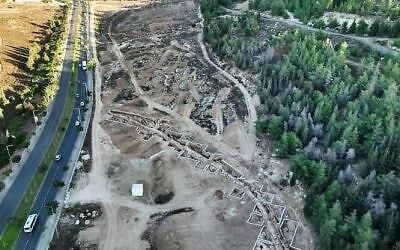
This week, the discovery of a roughly 2,000-year-old aqueduct south of Kibbutz Ramat Rachel, within Jerusalem’s municipal boundaries, was announced.
The approximately 300-meter section of the ancient, plaster-lined aqueduct was uncovered during a salvage excavation ahead of the construction of a new neighborhood near the kibbutz. According to the excavators, the aqueduct, attributed to the Hasmonean period, carried water approximately 21 kilometers from Solomon’s Pools to Jerusalem and remained in use until about a century ago. The exposed section is expected to be incorporated into the new neighborhood south of the kibbutz. The Israel Antiquities Authority is also promoting a park along the aqueduct’s route toward the Old City.
This discovery follows the dramatic announcement in May 2026 of a large, mysterious tunnel hewn into the rock near Ramat Rachel—a discovery I discussed extensively in connection with Section 46 of the Copper Scroll.
Salvage excavations necessarily focus on particular sites and construction areas. Yet the questions raised by these discoveries extend beyond the boundaries of any individual excavation. I propose examining the surrounding remains as potential components of a planned, integrated water system.
The proximity of the two discoveries—the mysterious tunnel revealed in May and the plaster-lined aqueduct revealed in October, approximately 500 meters apart as the crow flies—deserves closer investigation. They also join the approximately 300-meter section of the Upper Aqueduct uncovered at Givat Hamatos in August 2023, across the main road from Ramat Rachel.
Taken together, these discoveries highlight four issues:
A concentration of engineering infrastructure. The area around the Ramat Rachel ridge may have been more than a corridor through which water passed on its way to Jerusalem. It may have accommodated a planned network combining channels, underground spaces, shafts, and structures for managing water flow.
The expanding scope of salvage excavations. Rapid development of new neighborhoods, including projects initiated by the Israel Land Authority, has prompted extensive archaeological excavation. These investigations are revealing structures that remained buried for centuries or millennia.
An opportunity to test a systemic model. The discovery of substantial structures within the same topographic setting provides an opportunity to investigate whether they were separate installations or parts of an integrated system connecting different elevations. Establishing such a relationship requires evidence of physical connections, compatible dates, and hydraulic feasibility.
Possible disruption by modern infrastructure. Road construction and changes to the terrain through cutting and filling may have interrupted the original topographic continuity between Givat Hamatos and Ramat Rachel. Reconstructing the landscape before these works could help determine whether ancient connections were severed or obscured.
The hypothesis I presented in my article of August 17, 2026, proposes an engineered connection involving a ring-like network around the hill, through which water could have been conveyed to supply the palace and ancient settlement at Ramat Rachel.
A central question is how such a system could have delivered water to the required elevation. A perimeter network alone would not explain this. The hypothesis must therefore be tested against the elevations of the water sources and receiving installations, the gradients of the channels, and any evidence for structures capable of maintaining hydraulic head or lifting water.
The possibility of drainage and reuse of surplus water also merits investigation. Residents of Kibbutz Ramat Rachel report the remains of a covered underground passage descending southward from the hilltop archaeological site toward the swimming pool parking area and the slope below. These accounts offer a lead for a field survey, although the passage’s date, function, and connection to other installations remain to be established.
The excavators have suggested that the mysterious tunnel may have served as a quarry. That explanation must be considered alongside any proposed hydraulic function. Investigation could also examine whether a structure originally excavated for one purpose was subsequently adapted for another.
What would it take to test the proposed system and resolve Ramat Rachel’s water mystery?
First, the discoveries should be mapped and examined within a single hydraulic framework. A coordinated survey should record elevations, gradients, possible connections, and construction phases, while reconstructing the terrain before modern development.
Second, laboratory analysis should characterize the plaster and associated deposits, followed by an assessment of suitable samples for radiocarbon and optically stimulated luminescence (OSL) dating. The choice of method must reflect the materials available and their archaeological context.
Third, further controlled excavation of the sediment and debris within the large tunnel could help establish its original form and determine whether it has an underground or other connection toward the southern part of the hill.
The relationship I have proposed between the tunnel and Section 46 of the Copper Scroll remains a separate interpretive hypothesis. Its evaluation would benefit from a clearer understanding of the tunnel’s date, dimensions, and function.
The new aqueduct discovery does not, by itself, establish the existence of an integrated system supplying Ramat Rachel. It does, however, make a coordinated engineering investigation more timely. We now have an opportunity to move from a collection of intriguing discoveries to a testable model of how water may have been conveyed, stored, distributed, and reused around the ancient settlement.
For my earlier discussion, see: Does Copper Scroll Section 46 Describe the Ramat Rachel Mystery Tunnel ? See link in the comments.
Related Topics
Related Posts