
Space Science Researcher
Iran’s Water Crisis Under the Islamic Regime Could Force Millions to Flee
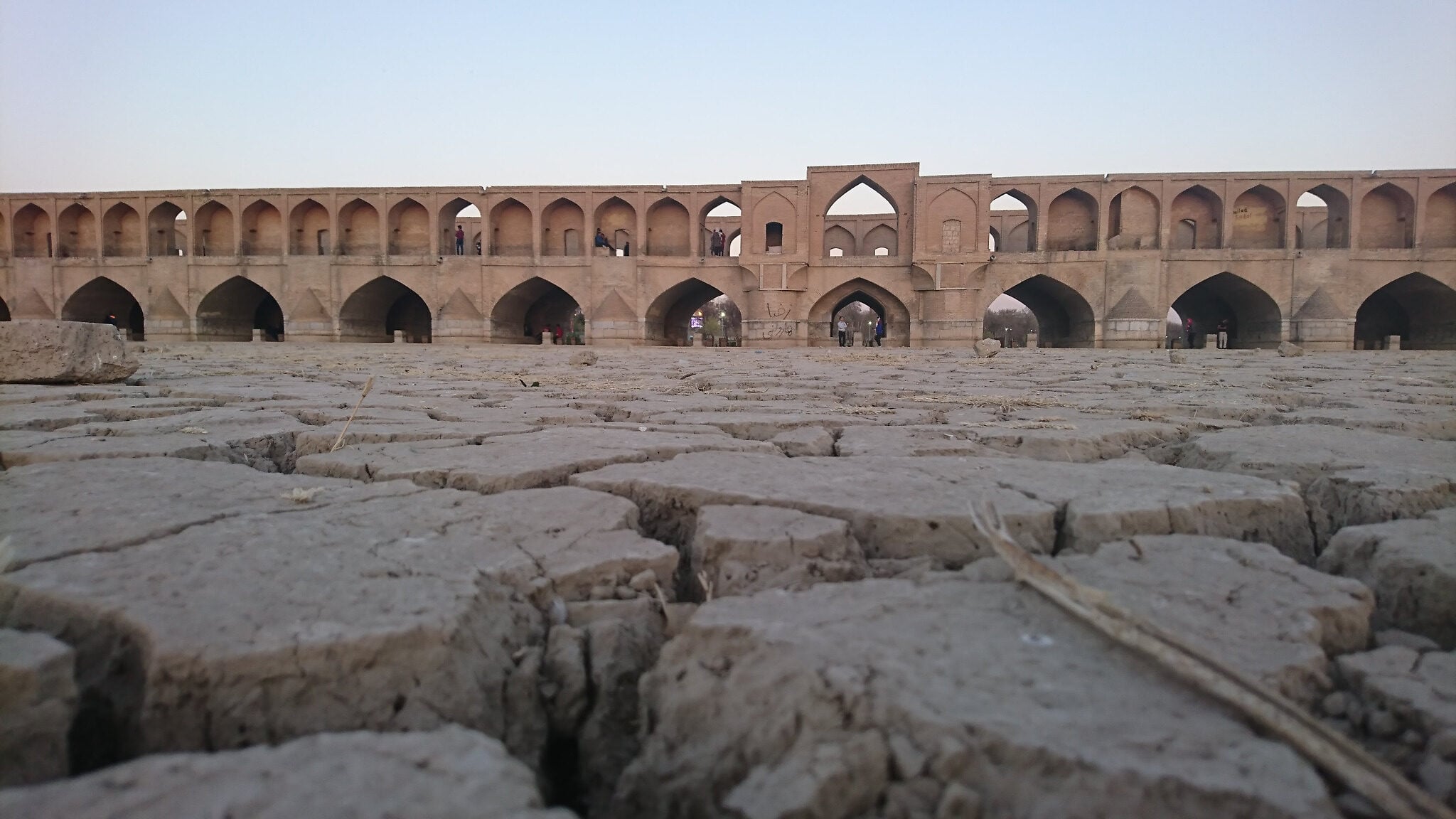
The dried Zayandeh Rud riverbed in Isfahan, Iran. (Photo: Romain Bréget / CC BY-SA 4.0)
For millennia, communities across Iran’s arid regions have adapted to scarce rainfall through ingenuity and careful water management, learning to coexist with the challenges of a dry climate. Around 3,000 years ago, Iranians began developing qanat irrigation technology, an engineering masterpiece that enabled generations to access groundwater, sustaining agriculture, gardens, and communities in landscapes where surface water was limited. This hydraulic breakthrough laid the groundwork for the Persian garden, a sophisticated form of landscape architecture exemplified by the Chahar Bagh. By channeling qanat water through carefully designed gardens, Iranians created self-sustaining landscapes that maintained cool microclimates, turning barren stretches of desert into flourishing oases.
The city of Kashan lies on the western edge of Iran’s central desert, the Kavir Desert, and is home to some of the country’s most impressive qanat systems. Notably, the ancient Soleymaniyeh Qanat remains fully operational today, feeding the Fin Garden as a living testament to advanced qanat engineering and Persian landsacpe architecture. Beyond Fin Garden, qanats supply about 75 percent of the Kashan region’s water needs. Nationwide, figures attributed to the Islamic regime’s Ministry of Agriculture Jihad put the number of qanats at more than 37,000. Such dependence on groundwater makes effective water management vital to sustaining agriculture across many regions of Iran. Excessive groundwater extraction lowers the water table, causing qanats to dry up and threatening the livelihoods that depend on them.
During the Pahlavi era, Iran took steps to protect its groundwater reserves, prevent water pollution, and conserve wetlands. The1966 Groundwater Resources Protection Law authorized restrictions on drilling where water tables were falling and provided for groundwater monitoring. The 1968Water Nationalization Law established responsibilities for safeguarding water resources and included provisions to prevent pollution. In 1971, Iran hosted the international conference at which the Ramsar Convention on Wetlands was adopted, helping establish a global framework for wetland conservation. After the Islamic regime came to power in 1979, it failed to enforce many of these safeguards. Over time, its mismanagement of Iran’s water resources contributed to the depletion of groundwater reserves and the loss of many qanats. A study reported that more than 14,000 qanats across Iran dried up between 1980 and 2000 as groundwater pumping lowered water tables.

The Islamic regime has consistently attempted to excuse Iran’s water crisis by pointing to natural forces and climate change. While over 80 percent of Iran’s land area is arid or semi-arid, climate data undercut the regime’s attempt to pin the crisis on climate change alone. A six-decade hydroclimatological study analyzed high-resolution gridded aridity index data across Iran’s diverse climate zones. The researchers checked those data against observations from nine synoptic stations, including Tehran, Esfahan, Mashhad, Kerman, Urmia (Oroomieh), and Zahedan. They found no statistically significant trend in aridity across most of the country from 1954 to 2013.
The scale of Iran’s water crisis is visible in national figures. In 2022, Iran’s renewable internal freshwater resources were estimated at 1,435 m³ per person per year, down about 59 percent from 3,461m³ in 1978, during the Pahlavi era. A separate study estimated that Iran lost 211 km³ of total terrestrial water storage between 2003 and 2019 and that groundwater levels fell by about 28 cm per year from 2003 to 2016. The Islamic regime’s expansion of military infrastructure near vital water sources, including underground missile cities, has put additional pressure on Iran’s water supplies. Taken together, the evidence shows how water mismanagement under the Islamic regime, compounded by this military expansion, has contributed to Iran’s water crisis.
Over nearly five decades in power, the Islamic regime has failed to reform the policies that drove Iran’s water crisis, despite repeated warnings from its own officials. In 2015, Issa Kalantari, then an adviser on water affairs to the regime’s first vice president, said Iran was using 97 percent of its surface water, effectively drying up its rivers and leaving virtually no water in the natural environment. He warned that if this pattern continued, about 50 million Iranians would be forced to leave the country to survive. More than a decade after that stark warning from one of its own advisers, the Islamic regime has yet to take meaningful action to address the crisis. The water crisis has left communities more vulnerable to drought, flooding, and sand and dust storms, while accelerating land degradation. In 2021 alone, sandstorms, drought, floods, and other environmental hazards triggered about 41,000 internal displacements across Iran, according to figures from the Internal Displacement Monitoring Centre.

Iran’s water crisis could have consequences far beyond its borders. The displacement caused by Syria’s civil war offers a sense of what a crisis on that scale could mean for Europe. In 2015 and 2016, the European Union received nearly 2.5 million first-time asylum applications from all countries combined, with Syrians making up the largest group in both years. If worsening water shortages force millions of Iranians to leave their country, Europe could face a humanitarian challenge greater than the one it faced during the Syrian refugee crisis. Most Syrian refugees found safety in countries near Syria, yet the number who reached Europe still placed significant pressure on its asylum and reception systems. Even if only a fraction of displaced Iranians sought refuge in Europe, the consequences could be substantial.
The risk of mass displacement gives Europe a direct stake in Iran’s future. European leaders should consider the cost of standing aside and support Iranians in their efforts to end the Islamic regime and build a government capable of addressing the water crisis. On January 8 and 9, 2026, millions of Iranians answered Crown Prince Reza Pahlavi’s call to take to the streets and demand an end to the Islamic regime. Weeks later, on February 28, U.S. and Israeli strikes killed the regime’s supreme leader, Ali Khamenei. These events have weakened the Islamic regime and opened a rare opportunity for world leaders, especially in Europe, to stand with Iranians as they seek to replace it with a government accountable to its people. European leaders can start by engaging directly with Crown Prince Reza Pahlavi and helping Iranian experts prepare for the work of rebuilding through initiatives such as the Iran Prosperity Project.

A free Iran should make environmental rehabilitation, grounded in environmental history, a priority from the outset. That means safeguarding groundwater, preserving the qanats that still sustain rural communities, and restoring lakes, rivers, wetlands, and forests. The work begins with a basic goal: giving both the next generation of Iranians and returning diaspora specialists the opportunity to build a future in the places they call home.
–
Co-authored by Shabnam Nikbakhsh and Soma Alikhani
Related Topics
Related Posts