Real vs. Fake ‘Achdus’
Achdus, “unity,” is something that we all want and need. But what does it actually mean? It’s not what people often claim. It doesn’t mean singing and dancing with other types of Jews, or professing one’s love for them. Nor does it mean abstaining from harshly criticizing them.
People can have very different ideas about profoundly significant issues. One person might feel that a Palestinian state is essential for Israel’s long-term survival; another person may feel that it is suicidal for Israel. Each may well think that the other is crazy, but they should be able to recognize that they are both are motivated by the same desire, for Israel’s well-being and security.
The same goes for many divisive issues. One person may feel that extensive judicial reform is necessary, another may feel that it’s disastrous. But both should recognize that both are concerned for the country’s welfare and dedicated to it.
We saw the greatest demonstration of such unity in the aftermath of October 7th. People on all sides of such political issues put them aside and engaged in tremendous self-sacrifice on behalf of everyone else. This is what unity is about – caring for other people’s welfare despite one’s profound disagreements with them.
Genuine achdus is about caring for each other, which translates into mutual responsibility. The Midrash Tanna d’Bei Eliyahu says that the Jews in Egypt made a covenant to become an aguda achas, a unified group, and always do chesed for one another. The concept of achdus is perfectly expressed in Moshe Rabbeinu’s warning to the tribes of Reuven and Gad against not participating in the war – “Shall your brothers come to war, and you remain here?” When one regards other people as brothers, one helps them out in times of need.
And this brings us to those who unfortunately fall outside of such unity.
There is a painful truth that some are understandably reluctant to admit, but which we must face up to. The charedi community is not part of any genuine unity with the rest of the Jewish People.
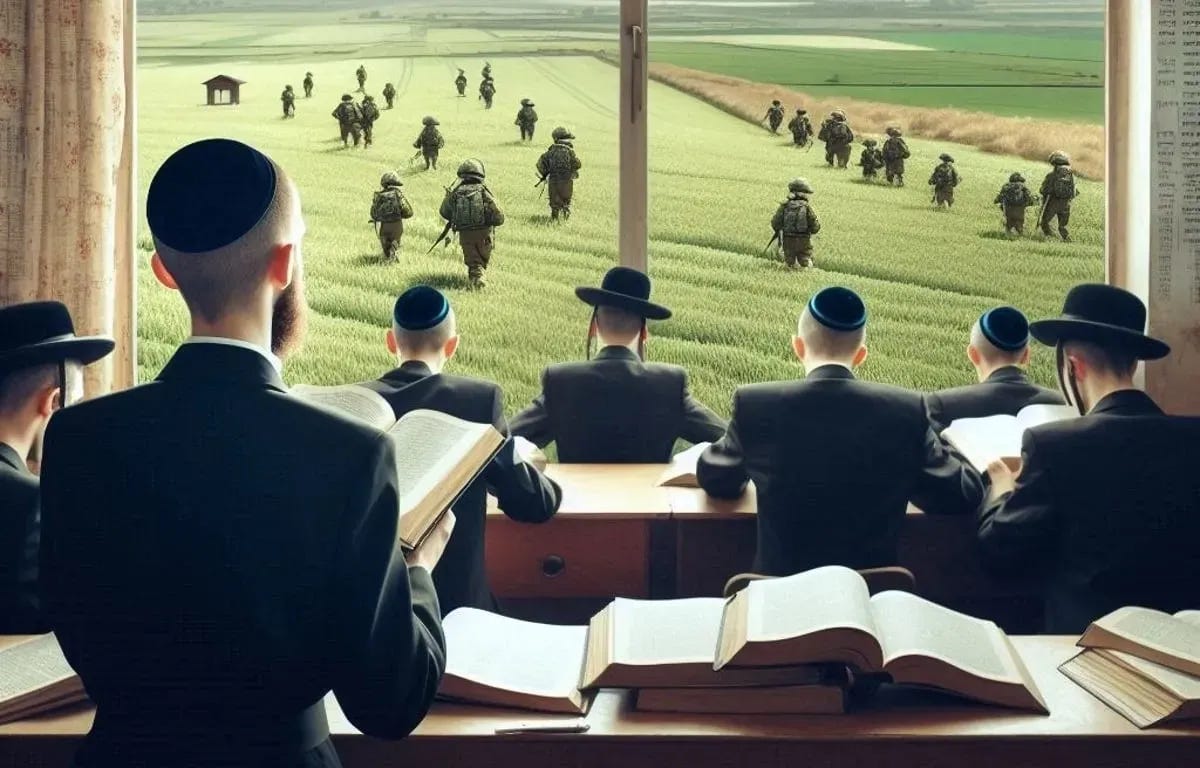
There are countless examples of this. Of course, far and away the most significant is how the rabbinic and political leadership, along with the vast majority of the charedi community, are opposed to helping relieve the crushing burden of army service on the reservists. The charedi refusal to serve has caused hundreds of thousands of families to suffer as reservists are called up again and again and again, sacrificing their studies, their careers and livelihood, their family life, their marriages, their mental and emotional and physical health, and sometimes even their very lives. (It also risks the destruction of the entire country, in the eventuality of a future much larger war with the Palestinians in which many more soldiers would be needed.) All this could be alleviated if even a quarter of the 80,000 charedi young men would help. But they haven’t, and the community has made it very clear over the past two years that that they are not interested in helping.
But it’s not only that the charedi community doesn’t help their brethren in our hour of need; for the most part, they don’t even care. With some notable exceptions such as the amazing Shai Graucher, the vast majority of the charedi community not only does not enlist in the IDF, but does not even help out those who do. Indeed, Rabbi Dov Landau, leader of the Lithuanian charedi community, stated that charedim should not visit injured soldiers or attend funerals, and condemned Shai Graucher. There weren’t masses of charedim helping out on farms; a small number provided assistance for families of soldiers, but it was always far below the assistance provided by everyone else.
Why does this lack of unity exist? Because it’s foundational to charedi identity. Being charedi is precisely about being separate from everyone else. It may have started as an admirable way to protect their community against the vices of the modern world, but it has come at the terrible price of what Jonathan Rosenblum has called “diminished Klal Yisrael consciousness.” This is why the majority of charedi synagogues will at most recite Tehillim for “the matzav” affecting all Israel but will not explicitly pray for the soldiers of the IDF, and why charedi yeshivos do not talk about the sacrifices made by those who serve.
Feeling connected to others risks undermining the isolationism that is at the heart of charedi identity. Instead, they perform PR and assuage their conscience by professing to believe that learning Torah replaces material effort by providing supernatural protection for others from military attacks. This is even though there is absolutely no basis for such a belief in classical Judaism, and charedim are not interested in researching the parameters of this alleged protection, and they certainly don’t rely on such supernatural forces for medical or political matters, and they are largely not interested in helping in the myriad of other ways that could be done without compromising yeshiva studies.
There is no achdus with those who do not care to help out the rest of the nation in its hour of desperate need. And pointing out this lack of achdus is therefore not harming achdus. On the contrary; it is crucial to point it out., for the sake of achdus. Problems are not solved unless they are acknowledged.
In this case, acknowledging that there is no achdus with the charedi community, and that moreover that the leadership are by design not interested in fostering mutual responsibility and civic values, helps us understand why years of attempted bridge-building have failed. The only solution is to force change by removing the billions of shekels in grants and benefits that incentivizes the charedi community to maintain their lifestyle (which is also an existential threat to Israel due to being a path to economic catastrophe), and to impose various sanctions that are practical and effective.
Governments in general (and the current government in particular) are not so interested in doing this, because of the valuable political support that charedim offer in exchange for army exemptions and money. And thus change will only happen if there is widespread public demand for it. The charedi community has tragically created a situation whereby it is necessary for Israel’s well-being and very survival that everyone strongly protests their lack of achdus.