
An Aging Jewish Feminist
Rebekah’s Agency in Chayei Sarah: Vulnerability and the Fate of Women

The expression “There, but for the grace of God, go I” is traditionally attributed to the sixteenth-century English preacher John Bradford, who supposedly uttered it upon seeing prisoners being led to execution. It expresses an uncomfortable recognition: another person’s misfortune could easily have been our own. Family, circumstances, environment, and sheer luck often determine whether we escape danger or become its victims. Recognizing this should make us more compassionate toward others. We should never assume that our own good fortune is entirely our doing.
This thought has been on my mind as I read Parshat Chayei Sarah and consider the story of Rebekah. She is a woman who leaves her home, travels with a strange man to an unknown destination, and eventually becomes one of the matriarchs of Israel. Her journey has a happy ending. But another biblical woman, the unnamed concubine in Judges 19, also leaves home and travels with a man. Her journey ends in rape, murder, and the dismemberment of her body. Juxtaposing these two stories raises disturbing questions about women’s agency, vulnerability, hospitality, and the ways in which biblical and rabbinic literature portray women.
Almost every sermon on Chayei Sarah begins by observing that the parsha is not really about Sarah’s life, but, about her death. After Abraham purchases a burial place for her, the narrative turns toward the future: finding a wife for Isaac. Much of the parsha is devoted to the lengthy account of Abraham’s servant’s journey to find Rebekah.
Yet one important part of that journey is strangely absent: the trip back to Canaan. We are told:
Then Rebekah and her maids arose, mounted the camels, and followed the man. So the servant took Rebekah and went his way. (Genesis 24:61)
The next thing we know, Isaac sees the approaching camels in the distance. There is no description of the long journey, the conversations, or what might have happened between Rebekah and the servant during their travels.
Perhaps the rabbis were uncomfortable with this omission. One midrash, in Pirkei de-Rabbi Eliezer, chapter 16, explains that the journey was miraculously shortened. The servant left at midday and arrived in Hebron three hours later, just in time for Isaac’s afternoon prayer. The explanation is that the journey was shortened so that the servant would not be alone with the young woman at night. The rabbis were evidently concerned about the propriety of a man traveling with an unmarried woman.
There is another biblical journey with which Rebekah’s story can be compared, although it is much more disturbing: the story of the concubine in Judges 19.
This woman, like Rebekah, leaves her home and travels with a man. But the circumstances are very different. The concubine has apparently left her husband and returned to her father’s house. The Levite, her husband, comes to retrieve her. Her father welcomes him warmly, and the two men spend several days eating, drinking, and enjoying each other’s company. The woman herself virtually disappears from the narrative.
Eventually the Levite insists on leaving, despite his father-in-law’s attempts to delay him. They set out late in the day, reach Gibeah, and find no one willing to offer them hospitality. An old man finally takes them in. During the night, the townsmen surround the house and demand that the Levite be handed over. Instead, the old man offers his own virgin daughter and the Levite’s concubine. The Levite pushes the concubine outside. She is raped throughout the night and collapses at the entrance to the house. In the morning, her husband discovers her body and cuts it into twelve pieces, sending them throughout Israel (Judges 19:1–29).
The contrast with Rebekah is extraordinary. Both women undertake journeys with men. Both encounter questions of hospitality and protection. But Rebekah is welcomed, protected, and eventually loved by her husband. The concubine is abandoned, violated, and dismembered.
I cannot help wondering whether the two narratives are deliberately meant to be read against each other. Their similarities in language and plot are too numerous to ignore.
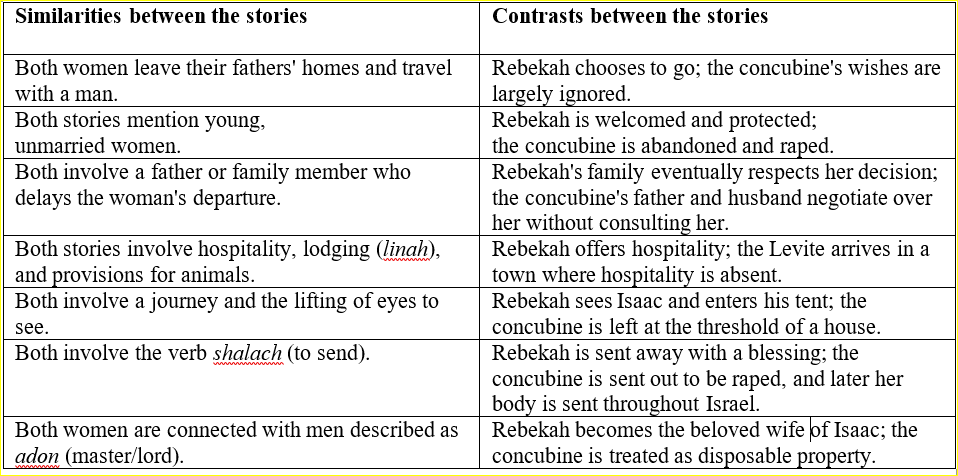 There is an especially chilling connection involving the word ma’achelet, the knife or cleaver. This is the instrument Abraham intended to use to slaughter Isaac at the Akedah (Genesis 22:6, 10). He is stopped at the last moment. In Judges 19, the Levite uses a knife to cut up the concubine’s body into twelve pieces. Had Abraham completed the sacrifice, there would have been no Isaac, no marriage to Rebekah, and no future generations through her. The instrument that almost ended the promise in Genesis becomes the instrument of a woman’s destruction in Judges.
The hospitality theme is equally significant. In Genesis, Rebekah runs to provide water for Abraham’s servant and his camels. Her brother Laban welcomes the stranger into the family home and provides water, straw and feed for the animals. Hospitality is part of the family’s tradition, established earlier by Abraham and Sarah when they welcomed their visitors.
In Judges, the opposite is true. No one in Gibeah initially offers the Levite and his companions a place to stay. Only an old man eventually takes them in. Here too there is straw and feed (teven ve-mispoh) for the animals. These words only appear in Judges 19 and our parsha. But his hospitality is grotesquely distorted: he offers his virgin daughter and the concubine to the mob to protect his male guest. Hospitality becomes a justification for sacrificing women. The social commentary is devastating. The narrator’s famous refrain, that there was no king in Israel and everyone did what was right in his own eyes (Judges 21:25), frames the story as a portrait of social and moral collapse. The concubine’s body becomes the evidence of a society that has lost its humanity.
Rebekah’s story, by contrast, is a story of beginnings. She is the light at the end of a history marked by the destruction of Sodom and the near-sacrifice of Isaac. She will become the mother of Jacob and Esau and the grandmother of the twelve tribes. The two stories offer radically different visions of women’s fate: one opens the way to a future; the other leads toward civil war and devastation. What makes Rebekah particularly remarkable is her agency. When her family asks whether she is willing to leave home with Abraham’s servant, she answers without hesitation:
And they called Rebekah and said to her, “Will you go with this man?” And she said, “I will.” (Genesis 24:58)
The Hebrew is simply elekh—I will go.
Unlike Abraham, who is commanded by God, lekh lekha, Rebekah is asked whether she wants to go. She makes her own decision. She is not simply handed over by her family; at least in this moment, her consent matters.
It is worth noticing a difference in the narrative. When Bethuel, her father, is present, he declares:
“Here is Rebekah before you; take her and go” (Genesis 24:51).
But when her mother and brother are present, they suggest a delay and eventually agree to ask Rebekah herself. Her mother, whose name we never learn, is part of the decision-making process. Is she perhaps the feminist of the story?
The rabbis, however, seem uncomfortable with Rebekah’s independence. They are particularly puzzled by the sudden disappearance of her father from the narrative. In Genesis Rabbah 60:12, they explain that Bethuel wanted to prevent the marriage and was struck down overnight. The midrash interprets Proverbs 11:5, “The righteousness of the honest will straighten his way,” as referring to Isaac and Eliezer, while the wicked Bethuel is rejected.
Other versions elaborate. In Midrash Aggadah on Genesis 24:53, an angel switches a poisoned dish intended for Eliezer, giving it to Bethuel instead. Another explanation suggests that Bethuel intended to have sexual relations with Rebekah before her marriage, as he supposedly did with other local women, and that the angel intervened to protect her. Still another version says that the townspeople killed Bethuel because they were tired of his sexual exploitation of their daughters. These stories are disturbing in themselves, but what is even more striking is the rabbis’ preoccupation with Rebekah’s virginity.
One midrash, found in Yalkut Shimoni on Torah 109, imagines that when Rebekah falls off her camel upon seeing Isaac, her hymen is torn. The angel Gabriel is sent to preserve the blood as evidence of her virginity, so that she can later prove that neither Eliezer nor anyone else had violated her. The discussion becomes almost forensic in its attention to her sexual purity. Why do the sages need to construct such elaborate explanations? Is their concern really for Rebekah’s safety, or is it a way of controlling the meaning of her story? The biblical Rebekah is energetic, decisive, and strong. She runs, draws water for ten camels, offers hospitality, and makes her own decision to leave home. Later, when she suffers during pregnancy, she goes directly to inquire of God (Genesis 25:22). She does not wait passively for someone to explain her suffering.
Yet the rabbis even reduce her age to three years in some interpretations, making her extraordinary independence harder to imagine. It is tempting to ask whether the sages simply did not know what to do with a woman who was so capable of making her own decisions. My beloved late sister, Menorah Rotenberg, in her article “The Devolution of a Matriarch into a Patriarch” (Conservative Judaism, 2002), explores the ways in which Rebekah’s character is transformed in the interpretive tradition. The question is not merely how the rabbis understood her, but how their interpretations could diminish the very qualities that make her remarkable.
I am reminded of Marge Piercy’s poem “For Strong Women.” Piercy describes women who struggle against the expectations imposed upon them, who are determined to do what others would prefer they not do, and who are strong not because they lack fear or vulnerability but because they persist despite them. Her memorable conclusion is that strength is something we make together.
Rebekah embodies this kind of strength. She is not without vulnerability, but she acts. She chooses, questions, and eventually shapes the future of the family. We should be careful not to turn her into a flawless heroine: her later manipulation of Isaac to secure Jacob’s blessing raises its own moral questions. But her strength and independence deserve recognition rather than diminution.
There is another aspect of Rebekah’s story that deserves attention: the way women are treated as objects to be transferred between men. The Tanakh contains numerous examples of women being given away, whether to protect a husband, secure an alliance, or establish a marriage. In Chayei Sarah, the long account of Rebekah’s selection is conducted largely through Abraham’s servant. Isaac himself is not involved in the search. Rebekah is chosen on behalf of a man she has never met.
There is an intriguing detail in the way the servant is described. When Rebekah first encounters him, the text calls him an ish, a man. In the formal negotiations with her family, however, he is Abraham’s eved, servant (Genesis 24:21–33, 34–52, 61). This distinction raises an interesting question. Rebekah meets a man at the well, not simply a servant on official business. She is impressed enough to offer him water and to water his camels. The well, after all, is a familiar biblical setting for encounters between future couples, as in the stories of Jacob and Moses. What might Rebekah have thought of this stranger? Did she imagine that he was the man destined for her? Did they develop a relationship during the journey? And what happened when she discovered that he was not the bridegroom but merely the intermediary?
There is also something to consider about Eliezer’s position. According to Genesis 15:2, Abraham’s servant could potentially have been his heir if Abraham had no son. Finding a wife for Isaac was therefore not necessarily in Eliezer’s own interests. Yet he undertakes the mission faithfully. The rabbis, perhaps suspicious of the intimacy that might develop between him and Rebekah, explain the miraculous shortening of the journey as a way of preventing impropriety.
When Rebekah finally sees Isaac, the text tells us:
Rebekah also looked up and saw Isaac. She fell down from her camel and asked the servant, “Who is that man in the field coming to meet us?” “He is my master,” the servant answered. So she took her veil and covered herself. (Genesis 24:64–65)
Why does she fall from her camel? Is it awe, embarrassment, or disappointment? Perhaps she suddenly understands that the man she has been traveling with is not the man she is going to marry. Whatever the explanation, she immediately covers herself with a veil. The woman who was so active and visible at the well now becomes modest and concealed. The text concludes that Isaac took her into his mother’s tent, married her, and loved her. Rebekah becomes his wife, and he is comforted after Sarah’s death (Genesis 24:67). But what happened to Rebekah’s feelings? We are not told. The narrative is concerned with the continuation of Abraham’s family and the fulfillment of God’s promise, not with the emotional experience of the young woman who has left everything behind.
The haftarah for Chayei Sarah, 1 Kings 1, offers another interesting comparison. It begins with the aging King David, just as the parsha begins with the aging Abraham. Both narratives are concerned with succession and the future of a dynasty. The haftarah introduces Abishag the Shunammite, a beautiful young virgin brought to David to keep him warm. The text emphasizes that David was not intimate with her (1 Kings 1:1–4). Later, Bathsheba, with the support of Nathan the prophet, works to secure the succession of her son Solomon.
The parallels are revealing. Rebekah and Bathsheba are both determined women who intervene in the future of their families. Abishag, by contrast, is brought into the king’s bedchamber as an attendant, her purpose defined by the needs of an aging man. In the following chapter, Adonijah’s request to marry Abishag becomes the reason for his execution (1 Kings 2:13–25). Once again, a woman’s position in the royal household becomes part of a struggle among men over power and succession.
These biblical stories may be ancient, but the underlying questions are hardly obsolete. Women continue to be treated as instruments in political, religious, and family arrangements. Their bodies, choices, and futures are often discussed by others as though they were possessions rather than persons. Even when women exercise power, as Rebekah and Bathsheba do, their actions are frequently judged more harshly than those of the men around them. This is particularly relevant today, when debates about women’s rights, bodily autonomy, sexual violence, and political representation remain urgent. The contrast between Rebekah and the concubine is not simply a contrast between two ancient narratives. It forces us to ask what kind of society allows women to exercise agency and what kind of society sacrifices them to protect male interests.
I have never considered Rebekah one of my favorite biblical characters. I admire her strength, even when I question the choices she makes. But I find it particularly unfortunate that some rabbinic interpretations seem determined to diminish her independence, turning her into a young girl whose virtue must be protected by supernatural intervention.
Perhaps, however, we can imagine Rebekah herself looking back on her journey and recognizing how easily things could have turned out differently. She traveled a long distance with a strange man, leaving her family and everything familiar behind. She could have become another victim, like the concubine in Judges 19. Instead, she arrived safely, met Isaac, and became the mother of a new generation.
This does not mean that Rebekah was merely lucky or that her strength depended on divine intervention. She had the courage to leave, the confidence to choose, and the determination to make her own way. But recognizing how vulnerable she could have been may also have given her a deeper understanding of the fragility of other women’s lives.
Perhaps that is the most important lesson of these stories. We should admire Rebekah not because she escaped becoming a victim, but because she had the opportunity to shape her own destiny. And we should remember the concubine not simply as a tragic figure in an ancient story, but as a reminder of what happens when a woman’s life is treated as expendable. The challenge, then and now, is to create a world in which women’s safety does not depend on luck, divine intervention, or the goodwill of men. It should depend on a society that recognizes their humanity, respects their choices, and protects their right to live with dignity. Rebekah’s strength is not that she was invulnerable. It is that she was able to act. And perhaps the greatest tribute we can pay her is to make sure that other women have the same opportunity.
Related Topics
Related Posts