
Where Objectivity Meets Reality
Recognizing ‘Palestine’: Opening Pandora’s Box
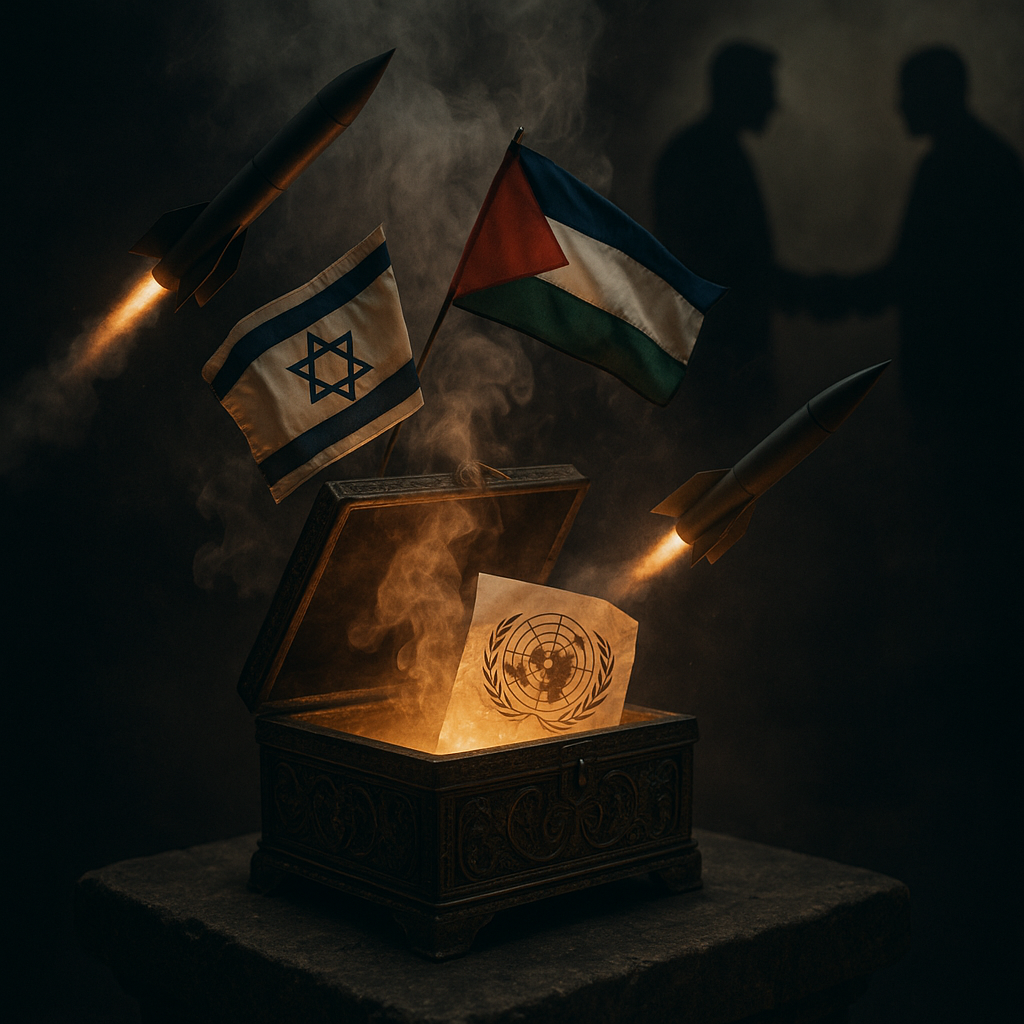
Recognizing ‘Palestine’: Opening Pandora’s Box
Why Recognizing ‘Palestine’ as a State Changes Nothing — and May Make Everything Worse
Once again, European countries are opting for the symbolic recognition of a “Palestinian state.” After Sweden in 2014, now Ireland, Spain, and Norway are following suit, with Malta and Slovenia waiting in the wings. These states claim to promote peace in the Israeli-Palestinian conflict. But behind this well-meaning gesture lies a dangerous naivety. Not only does such recognition change nothing on the ground—it adds legal and military confusion, undermines international norms, and perpetuates misleading narratives that only push real peace further out of reach.
Legal: A State Without the Elements of Statehood?
According to international law, there are three minimum criteria for statehood, as outlined in the Montevideo Convention (1933): a permanent population, defined territory, and a government exercising authority over that territory. The entity that calls itself “Palestine” currently fulfills none of these.
The Palestinian Authority (PA) has no control over Gaza—since 2007 that territory has been under the rule of Hamas, which violently ousted the PA. Hamas is not just a political rival but is classified by the EU as a terrorist organization. The PA also lacks sovereignty over East Jerusalem and large parts of the West Bank, where Israel retains security control as agreed in the Oslo Accords. There is no unified government, no control over borders, airspace, ports, or internal security. In short: no functioning state.
Recognizing a “State of Palestine” is therefore legally meaningless—a recognition of something that does not meet the definition of a state, undermining the credibility of recognition under international law.
Political: Diplomacy as a Moral Gesture
What Spain, Ireland, and Malta are doing is essentially symbolic diplomacy. Instead of applying pressure on both parties to negotiate, they take the side of one party that does not meet the prerequisites for statehood, but has mastered the role of victim. This is not a step toward peace, but a unilateral political reward—without reciprocal concessions. Why should the Palestinian leadership negotiate borders, security, or recognition of Israel, if they are already internationally recognized as a “state”?
Recognition becomes a tool of political pressure—not on the Palestinians, but on Israel. And that is where the damage lies.
Symbolic: A State Without Peace
The symbolic weight of state recognition is often underestimated. Recognizing a country is not merely administrative. It is a powerful diplomatic act: “We consider you a legitimate actor among the nations.” Granting that status to an entity that condones or tolerates terrorism (as Hamas does in Gaza), or that exhibits deep internal division and democratic deficits (as the PA does in the West Bank), is a dangerous precedent.
This is not about solidarity with the Palestinian people but about a moral equivalence between a stable democracy like Israel and an internally fragmented entity with no constitutional order, no regular elections, and open incitement against the Jewish state.
Military: Recognition Turns Terrorism into War
A recognized state does not engage in “armed resistance”—it wages war. Every rocket fired from Gaza into Israel would then constitute an act of aggression by a recognized state. This reclassifies the conflict: no longer a domestic or asymmetrical security issue, but an international armed conflict between states, with significant implications.
Would the EU then invoke Article 51 of the UN Charter, affirming Israel’s right to self-defense against a fellow state? Or would it continue to treat Israel as an occupying power facing a stateless people, even after formal recognition of Palestinian statehood?
The double standard would be glaring: recognizing Palestine as a state while continuing to portray Israel as a colonial power.
Practical: Which Borders, Which Government?
Are they recognizing “Palestine” within the 1967 lines? These were ceasefire lines, never sovereign international borders. They also include areas where Israel has lived, built, and protected for over fifty years, including Jewish neighborhoods in East Jerusalem.
Does recognition include both Gaza and the West Bank—even though no single authority governs both?
Who speaks for Palestine? Abbas, who hasn’t held elections in 18 years? Hamas, which calls for Israel’s destruction? Or some future technocratic government supervised by Qatar and the EU?
Until these questions are resolved, recognition is not just premature—it is counterproductive. It rewards ambiguity and disorder.
Final Thought
Recognizing a Palestinian state is not a step toward peace, but a dangerous shortcut that weakens international law, confuses diplomacy, legitimizes violence, and undermines future negotiations. Real peace demands realism, mutual recognition, security arrangements, and clear borders—not hollow symbols that ignore facts on the ground.
—
Bibliography
- Montevideo Convention on the Rights and Duties of States (1933), Article 1.
- UN Charter, Article 51 (Right of Self-Defense).
- Oslo Accords (1993-1995), including the Interim Agreement on the West Bank and Gaza Strip.
- European Union list of terrorist organizations (latest status of Hamas).
- ICJ Advisory Opinion on the Legal Consequences of the Construction of a Wall in the Occupied Palestinian Territory (2004).
- Cedric Vloemans, “The False Claim of Occupation by the Palestinian State”, Joods Actueel, May 19, 2021.
- Efraim Karsh, Palestine Betrayed, Yale University Press, 2010.
- Dore Gold, The Fight for Jerusalem: Radical Islam, the West, and the Future of the Holy City, Regnery, 2007.
- Eugene Kontorovich, “The Legal Case for Israel,” in Israel’s Rights as a Nation-State in International Diplomacy, Jerusalem Center for Public Affairs, 2011.
Related Topics
Related Posts