Reconciliation in the land of the Bible, then and now
The violence of brothers hating each other and even killing one another –which we are witnessing in Israel and Palestine in recent decades — is not new to the land of the Bible, the land of Israel. The book of Genesis—which we are now reading in our synagogues once again– is full of such stories. Yet, stories about reconciliation between brothers are rare in the Bible, which is why this week’s Torah portion is such an unusual occurrence.
In the Torah portion which Jews in Israel and around the world will ready in our synagogues on this coming Shabbat, known as Va’Yishlach (Genesis chapters 32:4-37:0), we find an inspiring story of reconciliation between brothers. At the beginning of chapter 33, Jacob sees Esau coming, accompanied by 400 men! So, he is naturally afraid. He divides the children among his wives, Leah and Rachel, and prepares for the worst. Then he goes to greet Esau and bows 7 times, out of fear or out of respect. And then, all of a sudden, we are surprised by the big moment of the encounter between them:
Esau ran to greet him. He embraced him, and falling on his neck, he kissed him; and they wept.
In the Torah scroll, from which we read in our synagogues, the Hebrew word for “he kissed him” is marked with four asterisks on the parchment. This has led classical commentators to offer various interpretations of this puzzling text.
Was Esau’s kiss genuine? Did he mean it? Was his purpose in coming to meet his estranged brother to repair their relationship after so many years?
According to the great Jewish medieval commentator, known as Rashi:
There is a difference of opinion in this matter. Some interpret the asterisks to mean that he (Esau) did not kiss him wholeheartedly. (But there is another opinion). Rabbi Shimon Ben Yohai said: It is well known that Esau hated Jacob; however, his compassion was moved at the moment and he kisses him wholeheartedly.
Another classic commentary, Bereishit Rabbah agrees that Esau’s motives were not pure and does so by using a pun on the Hebrew word “to kiss”. Instead of coming to kiss him, the Midrash argues, Esau came to bite him, since Esau is essentially an evil person, a rasha, and therefore cannot be trusted.
Another famous Midrash, Avot D’ Rabbi Natan, takes issue with the interpretation of Bereishit Rabbah and says:
Everything Esau ever did was motivated by hatred, except for this one occasion which was motivated by love.
Amazing. Here is a Jewish commentator saying that Esau was motivated by love in this instance. This goes against the conventional wisdom of rabbinic thinking which viewed Esau as motivated only by evil intentions.
So, were the embrace and the kiss genuine or not? Was this a real moment of brotherly reconciliation? Could it have led to a totally new relationship between the two estranged brothers?
According to the great 19th century German rabbi, Shimshon Raphael Hirsch, who authored his own fascinating commentary to the Torah:
This kiss and these tears show us that Esau was also a descendant of Abraham. In Esau, there must have been something more than just the wild hunter. Otherwise, how could he have had the ability to domineer the whole development of humankind (which the Romans actually did)?
And Hirsch adds an amazing commentary about Esau which is rich in contemporary meaning:
The sword alone, simply raw force, is not able to do that. But Esau, also, gradually lays the sword aside, turns gradually more and more towards humaneness, and how the principle of humaneness begins to affect him. When the strong respect the rights of the strong it may well be wisdom. It is only when the strong, as here Esau, fall around the necks of the weak and cast the sword of violence far away, only then does it show that right and humaneness have made a conquest.
What remarkable words from a very famous Modern Orthodox rabbi, one of the pioneers of this movement in Jewish history. I wish that more Modern Orthodox rabbis in Israel today would follow Rabbi Hirsch’s wisdom!
Then and Now
We contemporary readers of the Biblical story can only wonder: Was reconciliation between Jacob and Esau only a momentary event? Could it have worked for the long haul?
And, in our contemporary situation, who is Jacob? And who is Esau? Who is the strong? And who is the weak? Or maybe we are both strong and weak at the same time or at different times
In the Biblical story, the brothers go their separate ways. Separation becomes the operational modality. Peace is not achieved but an armistice is reached.
Some people today might call this “coexistence”. Each group lives separately. As long as you don’t shoot missiles at us, you can live over there in Gaza, or in the West Bank, or wherever. We can each live our separate lives.
Or within Israel, the Arab minority and the Jewish majority generally live separately. Integration is not the normative model in this country, as it is in other Western countries. Separate but not very equal seems to be the prevalent model.
Nevertheless, in our contemporary context, we have witnessed some remarkable processes of reconciliation!
The most important one is the great reconciliation between the Jewish People (the people of Israel, formerly Jacob) and the Christian world (in Jewish Tradition, Esau became Edom who symbolized Christianity), especially with the Catholic Church. This is one of the great reconciliations in human history.
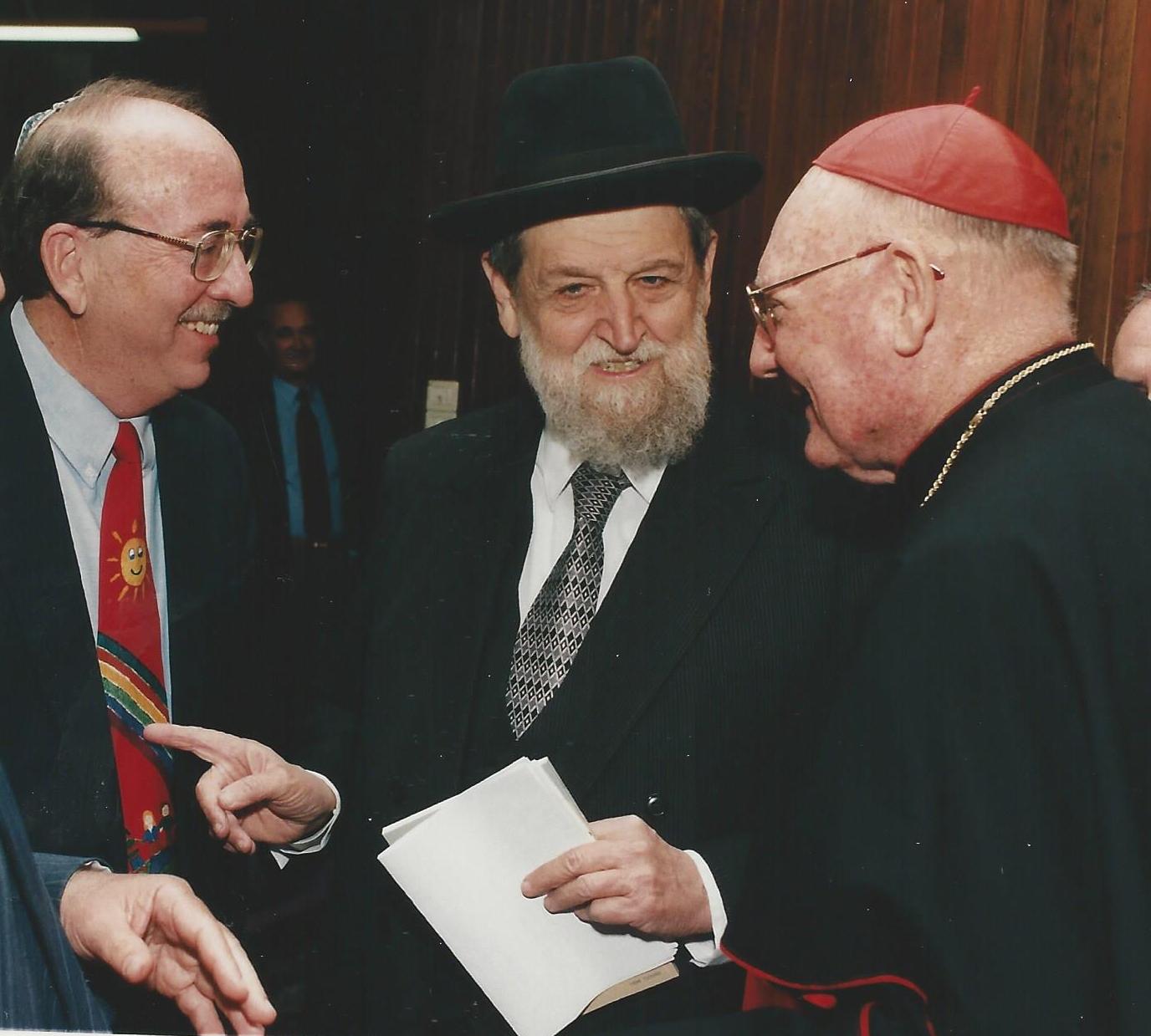
The religious leaders of Christianity and Judaism actually embraced each other at Vatican II in the 1960s and have been in genuine dialogue in a spirit of trust and mutual respect for the past 60 years. It is the most significant act of reconciliation between religious communities in the modern world that I know of. This is why Jews and Catholics around the world recently commemorated the anniversary of “Nostra Aetate”, the Vatican document of October 28th, 1965, which led to this new era of Dialogue, with many conferences and special seminars in October and November of this year. (I participated in four such gatherings.)
The second great act of reconciliation in our time was the visit of President Anwar Sadat to Jerusalem in 1977, with his speech in the Knesset, and his initiative to establish peace with Israel. This led to the signing of a peace agreement with Egypt in 1979. This peace, even if it is very cold, has lasted for all these years.
The third one could have been the handshake (not an embrace or a kiss!!) between Yasser Arafat and Yitzhak Rabin z”l, at the famous signing of the Oslo Accords on the White House lawn, on September 13, 1993. The intentions were honorable, but the reconciliation process has faded from sight, diminished greatly, and almost disappeared during the subsequent 32 years.
Nevertheless, I believe that we must still hope that reconciliation between Israeli Jews and Palestinian Arabs will still be possible in the future, even if this does not look possible at the present moment. After all, we finally have a cease-fire in the war between Israel and Hamas in Gaza, and we even have a “peace plan”, even if it is full of problems and challenges. We must never give up on the chances for peace and reconciliation.