(Re)Creating a World
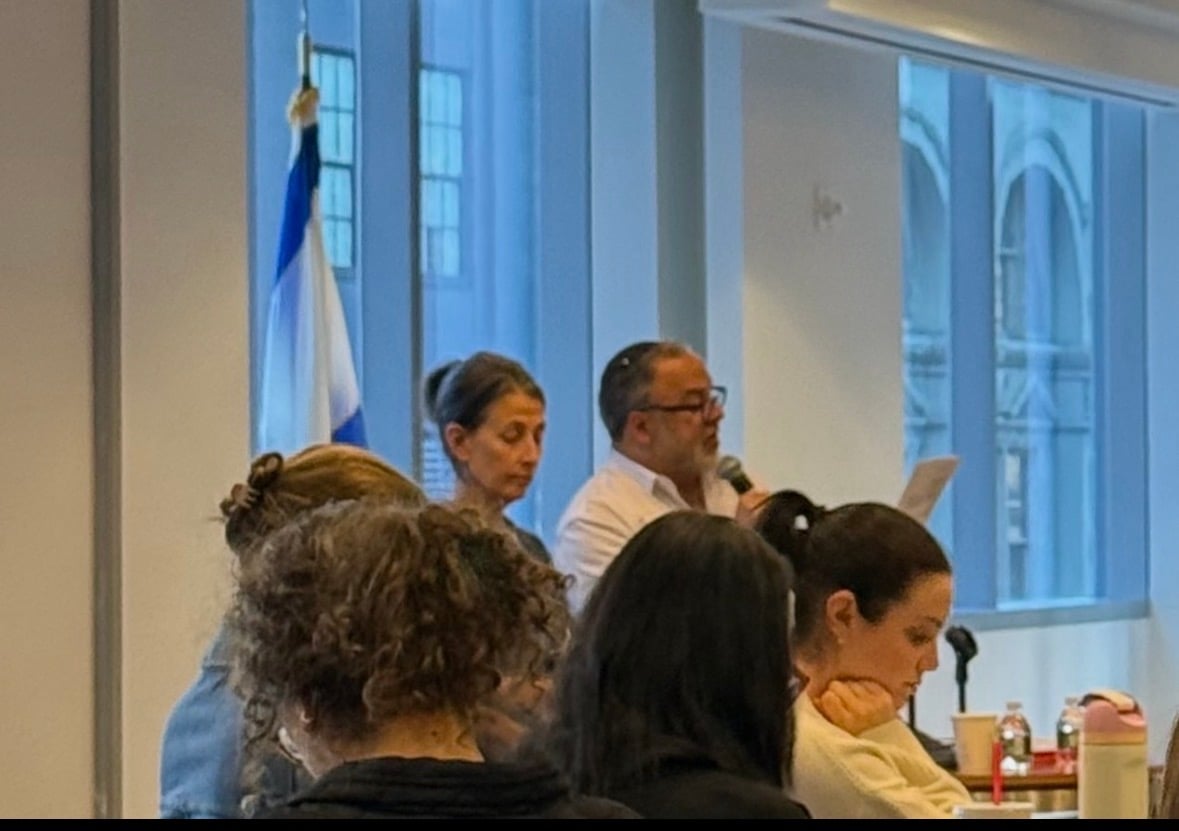
Yesterday, on the third anniversary of October 7, I had the sacred privilege of teaching Torah alongside Rachel Goldberg-Polin before nearly 200 UJA-Federation of New York colleagues. On a work-from-home day, they came: to learn, to grieve, to be together, and to listen. The room carried the gravity of a day that changed us all.
We began with creation. Genesis does not open with a peaceful, finished world, but with tohu va-vohu: chaos and emptiness, darkness over the face of the deep. Before light, before names, before anything we could recognize as ordered life, there was a world that could not yet hold us.
That is not an abstraction. It is, in some measure, the world we have inhabited since October 7.
The Torah’s first movement is not to explain chaos. God does not offer a theory of why darkness is dark. God creates in the face of it. Light is called forth. The primordial waters are separated. Boundaries are established. A world becomes habitable.
That image becomes even more piercing when we turn to the Flood during the days of Noach. The Torah tells us that “all the fountains of the great deep burst apart, and the floodgates of the sky broke open.” The waters above and the waters below, the very waters God had divided so that life might be possible, break through their boundaries. Creation itself is reversed. Darkness returns.
There are moments when that is how catastrophe feels: not simply as pain, though it is pain; not simply as loss, though it is unbearable loss; but as the collapse of the structures that made the world feel coherent. Something breaches. The ground of ordinary life shifts. We discover that the world we thought we knew was far more fragile than we had understood.
The rabbis, millennia later, imagine the sage Ben Zoma contemplating the space between the upper and lower waters of the Creation story. The firmament, he worries, is frighteningly thin, just three fingerbreadths wide. His colleague, Rabbi Yehoshua, finds him so consumed by that realization that he is unable to respond to the world around him. Yehoshua turns to his students and says, “Ben Zoma is still outside.”
There is wisdom in Ben Zoma’s seeing. We must not deny the thinness of the boundaries that protect us. We have learned too much about the fragility of life, of safety, and of the social order to pretend otherwise. But Rabbi Yehoshua teaches that we cannot live there. A life permanently fixed upon the breach, permanently scanning the heavens and the deep for their collapse, is not sustainable. We must remain awake to danger without surrendering our capacity to be present, to love, to build, and to answer one another.
And, while discussing together these deep and penetrating texts, Rachel’s voice filled the room – and our hearts.
I have been privileged to hear Rachel Goldberg-Polin teach and testify before. But yesterday, sitting beside her, teaching alongside her, I was overwhelmed by her sheer presence. Rachel is a giant of our people, a source of moral clarity, fierce love, unflinching truth, and meaning unlike any other. And incredibly funny. Charming. Good to be near. She has lived through a devastation no parent should ever know. And yet she has refused every temptation to become smaller in love, compassion, courage, or in her insistence that every human being is infinitely more than a number.
To teach with Rachel is to encounter not a theory of hope, but hope embodied. Not naive optimism, for she has never trafficked in false assurances, but the disciplined, costly, holy decision not to surrender to despair. Rachel is a faithful, very human human.
The sources we studied led us toward responsibility. The covenant is not a guarantee that evil will not occur. It is the refusal to let evil have the final word.
That is also the work of UJA. We cannot hold back every flood. We cannot restore every life or erase every absence. But we can become agents of shelter. We can create places of safety where fear threatens to overflow. We can laugh. We can build networks of care where loneliness threatens. We can honor the humanity of those whose names the world some refuse to appropriately acknowledge and others have begun to forget.
I looked around the room yesterday and felt profound gratitude. Nearly 200 UJA colleagues chose learning over isolation, presence over distraction, and one another over retreat. Together, we allowed ancient words of Torah to meet the shattered places of our present. And, perhaps most importantly, we learned and stood with a matriarch of Am Yisrael.
The world is still being made. Love insists that we dig deep and work hard to help make it whole.