Reflections on The Plot Against America and Mephisto
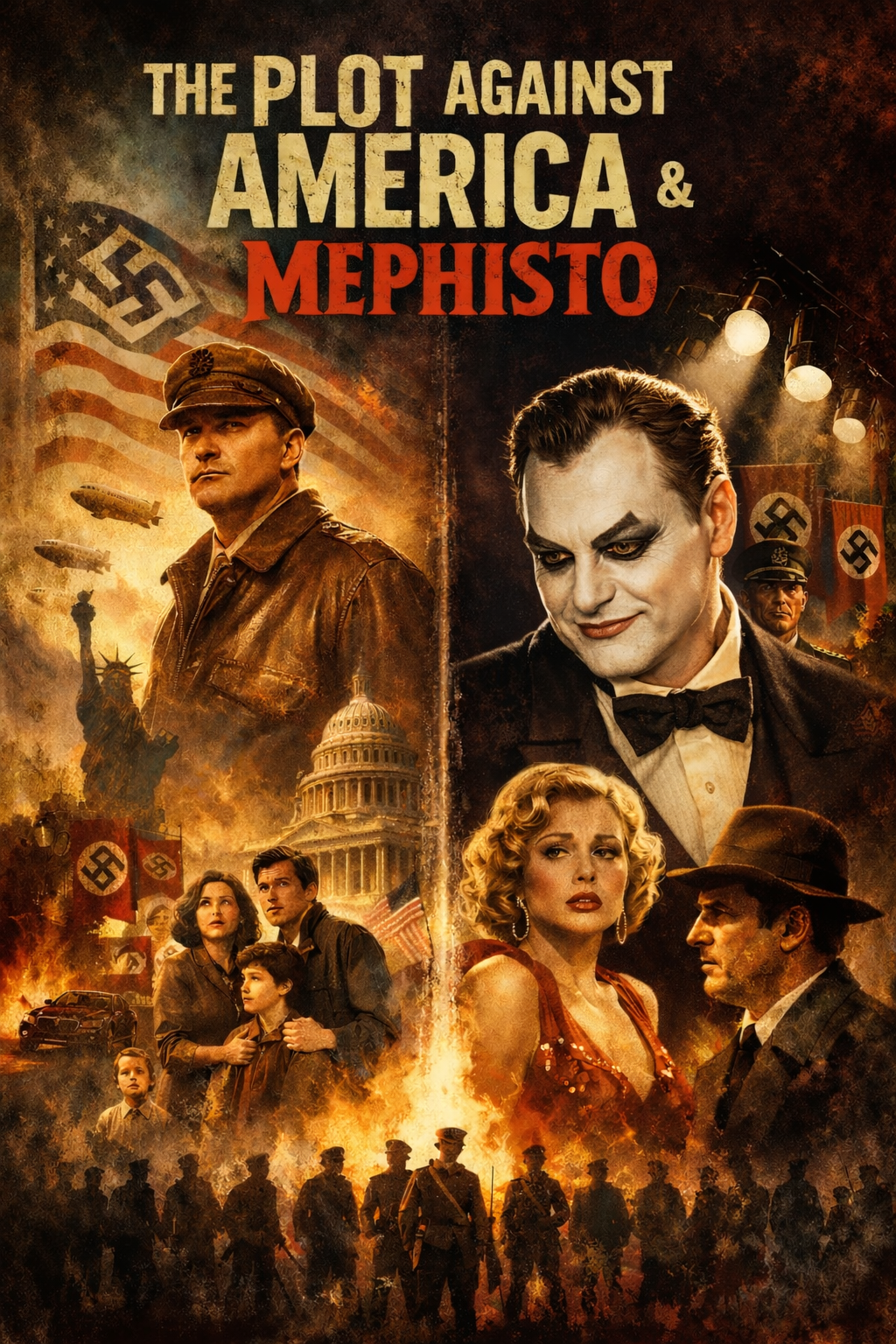
When does a country change?
Not when tanks roll down the boulevard. Not when a constitution is ceremonially torn apart. Those moments come later, if they come at all. The change I’m thinking of is quieter. It arrives without announcement. It settles into habits, into tone, into the background noise of daily life — the things we stop remarking on because they no longer feel new.
I didn’t plan to write about this. But after watching HBO’s The Plot Against America, I found it difficult to return to whatever I had been doing before. The story lingered in a way that felt physical. I kept replaying scenes while doing other things — washing dishes, answering emails — as if some unresolved question had been left open and refused to close.
Several times I paused the episode. I was binge-watching, but I stood up anyway — not because I needed anything, but because sitting still had become uncomfortable.
What unsettled me wasn’t fear exactly. It was familiarity.
I watched the series as a Swedish immigrant living in the United States, someone who grew up with Europe’s twentieth-century lessons woven into school curricula and dinner-table conversations. I know, at least in outline, how authoritarianism takes hold. But seeing it unfold so patiently, so plausibly, unsettled me in a way I hadn’t anticipated. The unease didn’t come from spectacle. It came from how ordinary everything felt.
At some point, another story surfaced — Klaus Mann’s Mephisto, and István Szabó’s film adaptation. Different country. Different decade. The same slow corrosion.
Together, these works kept circling a question I couldn’t quite set aside: how does a free society talk itself into not noticing what is happening?
I’m not writing to predict catastrophe, nor to insist that history is repeating itself. I’m writing out of a quieter concern — about how the unthinkable becomes tolerable, and how decent people adjust without ever deciding to.
The Seduction of Normalcy
The Plot Against America imagines a United States that doesn’t collapse through violence, but drifts through choice. Charles Lindbergh — a beloved aviator, a national hero, and an admirer of Nazi Germany — defeats Franklin D. Roosevelt in 1940 under the reassuring banner of “America First.” He promises peace. He promises stability. Above all, he promises to keep America out of Europe’s wars.
Many Americans are relieved. It’s an understandable response. War is terrifying. Lindbergh smiles easily. He sounds measured. He speaks in a register that suggests moderation rather than threat.
The series follows a Jewish family in Newark, New Jersey, as the atmosphere around them begins to shift — not dramatically, but just enough to register. Neighbors grow more candid. Jokes sharpen. Old assumptions stop holding. Nothing collapses; it tilts.
What makes the story unsettling is its restraint. There are no jackboots on day one. No mass arrests. Instead, there are programs with friendly names and good intentions. One of them, “Just Folks,” sends Jewish boys to live with rural American families — supposedly to broaden their horizons, to make them more “American.”
From a distance, it sounds wholesome. Up close, it feels vaguely wrong.
A teenage boy named Sandy returns from his farm stay transformed — enthusiastic about country life, dismissive of his parents’ fears, subtly estranged from his own community. The program never announces its purpose. It doesn’t need to. Its effects speak quietly for themselves.
That’s when the pattern becomes harder to ignore: nothing that feels quite serious enough to resist, yet everything adding up to something unmistakable.
How Democracies Actually Unravel
This fictional America kept pulling me back to a real European past.
In 1928, Germany was still a democracy — fragile, battered, but intact. The Nazi Party hovered at the margins, polling in the low single digits. Adolf Hitler was widely dismissed as a vulgar agitator, more nuisance than threat.
Five years later, he was chancellor.
The Weimar Republic didn’t fall in a single dramatic moment. It eroded through elections, legal maneuvers, emergency decrees, and strategic compromises. Each step was framed as necessary. Temporary. Corrective. Civil liberties were curtailed in the name of order. Institutions were repurposed rather than dismantled.
Many Germans were uneasy. Many others were relieved. After years of economic collapse and political chaos, someone finally seemed to be restoring control.
By the mid-1930s, new realities had settled in. Critics disappeared. Jewish citizens were stripped of rights. Former neighbors became untouchable. And yet, for most non-Jewish Germans, daily life continued. Children went to school. Shops opened. Trams ran on time.
Normalcy proved remarkably durable — even as the moral ground beneath it gave way.
It wasn’t until Kristallnacht in November 1938, when synagogues burned and Jewish homes were smashed in plain sight, that the illusion finally collapsed. By then, habits of silence were firmly in place.
Looking back, the question lingers: how many moments of quiet accommodation made that night possible?
The Comfort of “Just Doing My Job”
Klaus Mann’s Mephisto brings these abstractions down to the scale of one life.
Hendrik Höfgen is not a monster. He is an actor — ambitious, gifted, politically alert, and deeply invested in his own success. When the Nazis come to power, he faces a choice: leave Germany and risk obscurity, or stay and adapt.
He stays.
At first, he tells himself he is apolitical. An artist. A professional. Someone whose work exists above ideology. The regime rewards him. His career flourishes. He becomes indispensable.
Around him, others disappear.
A friend is imprisoned and tortured. A former lover — a Black woman — is forced to flee. Hendrik feels discomfort, even sorrow, but he does nothing. Each compromise is small. Each silence defensible. Each step easier than the last.
At the novel’s climax, he protests his own innocence: What do they want from me? I’m just an actor.
Mann’s point is not subtle, but it is precise. Evil doesn’t require universal hatred. It only requires enough people to persuade themselves that responsibility lies elsewhere.
Mephisto dismantles the fantasy of moral neutrality. To do nothing is not to stand aside — it is to remain in place while the machinery moves through you.
Denial as a Civic Habit
I didn’t notice it at first, but the same pattern kept resurfacing — in Roth, in Mann, in history itself.
In The Plot Against America, many citizens don’t want to believe their smiling president means what he says. Each troubling development is explained away. Each incident treated as an exception. Admitting the truth would require moral courage — and risk.
In early 1930s Germany, similar rationalizations abounded. Hitler would moderate. The rhetoric was exaggerated. The system would restrain him.
Denial is rarely stupidity. More often, it’s self-protection.
Complicity rarely begins with cruelty. It begins with fatigue, fear, and the desire to preserve one’s own small sphere of safety. The civil servant enforces a law he dislikes. The neighbor avoids eye contact. The professional tells himself that survival requires accommodation.
I recognize these impulses in myself. That recognition is what makes these stories uncomfortable. The danger isn’t that “bad people” will take over. It’s that ordinary people — people like us — will adjust.
An Immigrant’s Unease
When I moved from Sweden to the United States, I carried a genuine admiration for American democracy. I still do. But I also carry a European memory shaped by what happens when societies underestimate their own fragility.
Sweden escaped the worst of the Second World War, but not without moral compromise. Neutrality has its costs. Silence always does.
To be clear: the United States today is not Nazi Germany. History doesn’t repeat itself mechanically. But it does rhyme — and it rhymes most clearly early on, when everything still feels negotiable.
I write as a non-Jew with humility, aware that I will never fully grasp what it means to live as a targeted minority. But I share a fear that cuts across identity: the fear of losing a society that protects human dignity by default rather than by exception.
Vigilance Without Panic
The value of these stories isn’t alarmism. It’s attentiveness. They train us to notice language, norms, and moral shortcuts before they harden into structure.
They force questions we’d rather postpone:
When does loyalty to a leader eclipse loyalty to principles?
When does silence become endorsement?
At what point does adaptation become surrender?
These aren’t abstract questions. They’re civic ones.
I find cautious hope here. Authoritarianism isn’t inevitable — and neither is complacency. History also records those who resisted early, quietly, and at great personal risk. We remember them because they refused the comforts of denial.
We, unlike them, possess hindsight.
If “Never Again” is to mean anything, it has to apply not only to the final horrors, but to the early accommodations that make them possible.
I remain watchful not because I expect the worst, but because I care deeply about the country I now call home. Democracy doesn’t survive on autopilot. It survives because enough people decide, again and again, not to look away.
Whether enough of us are willing to pay that price — and in time — is the question I still can’t quite put down.