
A writer interested in yesterday today and tomorrow
Reflections on Trafalgar
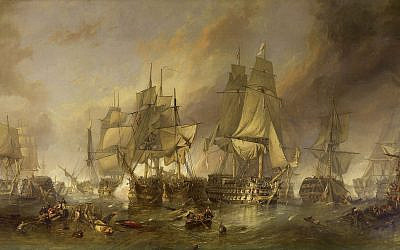
In 1805 twenty-seven British warships commanded by Admiral Horatio Nelson engaged a combined French and Spanish fleet of thirty-three off the coast of southwestern Spain near Cape Trafalgar. I just read a fascinating book based on eye witness accounts recorded in situ by participants in the battle. They tell of a mammoth naval action where huge battleships under sail, some equipped with over one hundred guns bombard each other at point blank range, sailors and soldiers being ripped to pieces by cannon and musket balls, terrible injuries, and many deaths. Nelson, was one of the casualties, he died of his wounds at the height of the battle.
Nelson won a resounding victory, only eleven French and Spanish ships from the original fleet of thirty-three were left intact at the end of the battle.
In the midst of the mayhem the narrators also told some positive heartwarming stories, when individuals desperately trying to survive in the worst of situations were still capable of displaying compassion and a strong sense of decency and morality.
One story really touched me, it was about Jeanette, a young woman in her twenties. a crew member on a Spanish battleship Santísima Trinidad. Supplying gunners with gunpowder was a critical activity during a naval battle and Jeanette was a “powder monkey”. The largest warship of its era, the Trinidad was a major target for the British and after suffering major damage to its superstructure fire erupted on its upper deck. Trapped on a lower deck Jeanette was desperately trying to find an escape route when the upper deck planks started collapsing and the ship’s guns on that level began crashing down around her. She had two choices, being crushed by a cannon or take her chances in the water. Tearing off her clothing she jumped naked into the sea where she thrashed around until a fellow crew member swam to her with a large plank and placed it under her arms to provide the support required to keep afloat.
She was in the water for over two hours until the occupants of a French lifeboat dragged her aboard more dead than alive. Seeing her nakedness the men immediately removed their own garments to cover her and protect her dignity. When they were eventually brought on board a British ship and the officer in charge realized one captive was a woman, he immediately arranged for a screened berth to be built and gave Jeanette access to his own cabin when privacy was required.
This story deeply impressed me, in the middle of a bloody conflict when no quarter was asked for or given, victor and vanquished exhibited compassion and a moral conscience. Jeanette’s story and others from both past and present support a belief that there is hope for the future; that humanity does possess an inherent ethic, we choose what is right not what is wrong, and, most important, society holds to account those who attempt to reverse that choice.
And so, I asked myself this question, in this inverted world we now live in, where good has become evil and evil has become good, is it still reasonable to hope that there will be a reckoning, that the standards of ethical behavior and morality western civilization fought to uphold will ultimately prevail? Let me juxtapose Jeanette’s story against three cases from the present day and after reading them ask yourself that question.
In a front-page story July 2025 about the humanitarian crisis in Gaza, the New York Times inserted a photo of an emaciated Gazan youngster purportedly suffering from either starvation or malnutrition. The unambiguous message it conveyed was, “look what the Israelis are doing to the children of Gaza”. The real story, the child had a rare genetic condition affecting muscle development and appearance!! Not published by the paper was a photo of the child’s older brother who appeared to be healthy and well-nourished.
On April 7, 2023, Palestinian terrorists opened fire on a vehicle in the Jordan Valley murdering two sisters Maia and Rina Dee. Their mother, Lucy, died of her injuries three days later. Unarmed civilians, the three were going on a family holiday during the Passover holiday. Three days later on April 10 during an interview with Palestinian Authority Prime Minister, CNN’s Amanpour referred to the incident as a “shootout,” implying an exchange of gunfire between combatants not the murder of innocent civilians.
Before the last USA presidential elections, the BBC spliced together two unconnected 2021 recordings of Trump’s comments about the Capitol Hill riots. The fabrication the BBC put together was this, “we’re going to walk down to the Capitol and I’ll be there with you, and we fight, we fight like hell”. This was broadcast on the Panorama program which at times has an audience of two million.
Compare this to the actual speech Trump said “we’re gonna walk down to the Capitol and I’ll be with you”, followed by other remarks including, “march over to the Capitol building to peacefully and patriotically make your voices heard”. Then later “we fight like hell, and if you don’t fight like hell, you’re not going to have a country anymore.”
So, is it appropriate to juxtapose the story of Jeanette with these three cases? Is it valid to derive moral equivalents from that juxtaposition? A strong argument says no but nevertheless I have, and here is my conclusion.
We allowed an ethic of moral bankruptcy to infiltrate our western democracies. The three cases cited are about morally bankrupt journalists and editors who do not subscribe to the ethical foundations on which those democracies were built. They are the Winston Smiths in Orwell’s dystopian vision of the future he called Nineteen Eighty-Four. Smith was a clerk who spent his days in the “Ministry of Truth” altering reality to fulfill the agenda of an invisible Big Brother. Orwell’s fiction has become reality, how prophetic!
The story of Jeanette was uplifting; it encourages hope for the future. The three cases cited are reprehensible and if they represent the now accepted benchmark of moral standards how is it possible to believe there is hope for the future?
Related Topics