Reimagining How Hebrew Reading Can Be Taught and Who Can Learn It
For decades, many Jewish educational settings operated under a quiet but devastating assumption: that children who couldn’t access Hebrew language simply couldn’t participate.
The cost of that assumption has been enormous. Children who struggle to read Hebrew often disengage entirely, leaving Hebrew school, feeling alienated at camp, withdrawing from day school, opting out of b’nei mitzvah, and ultimately drifting away from Jewish communal life. Many carry that loss into adulthood. We hear from them regularly: adults who wish, decades later, that someone had given them the tools to participate fully.
At Gateways: Access to Jewish Education, we refused to accept that outcome. Twenty years ago, Gateways’ Marion Green pioneered a new approach to Hebrew decoding, which is the ability to translate written words into sounds and spoken language. This Hebrew Decoding Program was built to be accessible for diverse learners.
We’ve found that educators don’t necessarily know how to teach certain kids Hebrew—those with dyslexia, ADHD, autism, intellectual and developmental disabilities, or other learning differences—so those kids are often gently excused; that door, closed. Today, we are giving educators the tools to change that by making our approach more readily available than ever before.
What Makes the Gateways Method Different
Written Hebrew is not inherently difficult to learn. But there are certain stumbling blocks that can feel insurmountable for some children. Many letters look strikingly similar—resh and daled, caf and bet, vav and zayin—and the vowel system is subtle and easy to mix up.
The Gateways Hebrew Decoding Program addresses these obstacles directly. We sequence instruction out of alphabetical order to deliberately separate letters that are easily mistaken for one another. Each letter is paired with a mnemonic that links its shape to its sound, and students engage with that mnemonic across multiple sensory channels: a visual image, an auditory phrase, a physical movement, and verbal expression. Encoding the information through these different pathways strengthens learning and memory in ways that more traditional approaches do not.
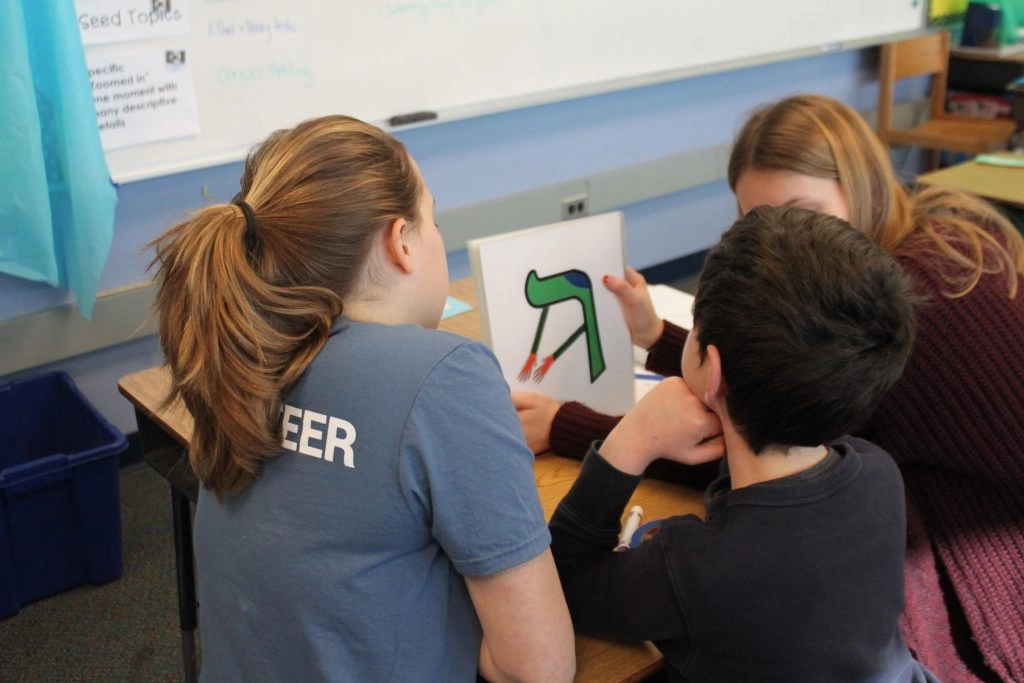
Take the letter gimmel: students learn the “g” sound of gimmel through the mnemonic phrase “Going for the Goal.” They color in a flashcard that illustrates this phrase, depicting the bottom of the gimmel as a foot kicking a soccer ball. When students go to practice the sound of gimmel, they may also be prompted to kick a ball as they repeat the phrase. These multisensory touchpoints give the child different ways to access their recall, like multiple roads to the same destination. For a lot of students, that really clicks.
The students who have found success using the Gateways Hebrew Decoding program are not a narrow subset. They include children with language-based learning disabilities, ADHD, autism, and intellectual and developmental disabilities, as well as neurotypical students who may have struggled through other methods. What they share is the experience of finally having instruction that meets them where they are.
Two Decades of Impact in Boston and Beyond
Gateways was founded on a simple but radical premise: that every Jewish child, regardless of disability or learning difference, deserves access to Jewish education. From our base in Boston we have spent more than two decades making that premise a reality: providing direct services to students and families, running an accessible Hebrew school and B’nei Mitzvah Program, partnering with Jewish day schools, training educators, and building the field-wide infrastructure for inclusive Jewish learning.
Our Hebrew Decoding Program has been a cornerstone of that mission. Teen madrichim at our own Accessible Hebrew School have been using it with their students successfully for over 20 years. When we began training other educators to use the system in their own classrooms, the number of students successfully decoding Hebrew grew dramatically. Teachers from supplementary schools, day schools, and tutoring programs across the Boston area and beyond have brought the Gateways method into their work and the results have followed.
Why We’re Taking It National
Despite the program’s proven track record, our training model had a structural limitation: the economics of live, in-person professional development require groups of multiple educators at a time. That requirement, while sensible, made it cost-prohibitive and logistically impossible for individual Hebrew tutors, teachers at small congregational schools, or educators in communities far from Boston to participate.
We saw those barriers. And then we built a solution.
We are proud to announce the launch of “Foundations of the Gateways Hebrew Decoding Program,” a self-paced online course available to any Hebrew educator, anywhere, at any time. Created by experienced Gateways instructor Rebecca Redner, the 2.5-hour course prepares educators to implement the full Gateways method—and at $75, it represents roughly 8% of the cost of a traditional live training.
That number means a solo Hebrew tutor in Cleveland can access the same methodology we have spent twenty years refining in Boston. It means a part-time teacher at a rural congregational school no longer has to wait for a cohort to form. It means geography and expense are no longer obstacles keeping Hebrew educators from reaching all of their students.
The Broader Movement, the Bigger Stakes
There is a growing consensus in the Jewish communal world that we must do more to engage and retain the next generation. We invest significantly in Jewish camps, Israel experiences, day school subsidies, and engagement initiatives. All of that is important. But we will undermine those investments if we continue to allow a foundational barrier, the inability to access Hebrew, to push children with learning differences out of Jewish life before any of those other interventions even have a chance to reach them.
Hebrew is not merely a language skill. It is at the core of modern Judaism; an essential part of the rhythm of Jewish life and community. When a child can decode Hebrew, they can learn to read it. They can participate in services. They can begin to access texts that have sustained our people for millennia. The confidence that comes from that access is, for many families we serve, transformative.
That is why we are not doing this work alone. The past several years have seen a broader movement take shape in the field of Jewish education to make Hebrew acquisition more accessible. Pritzat Derech: Hebrew for All is a multifaceted, research-driven initiative to improve Hebrew literacy for students with dyslexia and other language-based learning disabilities, who have been historically underserved. Led by Hebrew at the Center, the group of experts that form the initiative’s core includes Gateways, Scott Goldberg Consulting (MaDYK/Even Kriah), Prizmah, and The Shefa Center. All of these groups have been leaders in this emerging movement in their own ways.
Most recently, in May 2026, Hebrew at the Center partnered with Gateways to convene a landmark session for Hebrew teachers. In a four-hour workshop conducted entirely in Hebrew, educators from across the Greater Boston area came together to learn more about teaching students with language-based learning disabilities.
This work could not take place in a vacuum because disability inclusion in Jewish education is not a niche concern. Roughly one in five children has a learning difference of some kind. That means in any Hebrew school classroom, any day school, any b’nei mitzvah cohort, there are children whose needs our traditional instruction has not been designed to meet. The question is not whether those children are in our communities. They are. The question is whether we are willing to meet them where they are.
An Invitation to the Field
The launch of this online course is an invitation to individual educators, to synagogue education directors, to Jewish day school administrators, to federation professionals, and to philanthropic partners who care about the vitality and inclusivity of the Jewish community. The tools exist. The program works. The access is now unprecedented.
We know what happens when a child who has struggled finally decodes a Hebrew word and looks up with that particular light in their eyes. We have seen it hundreds of times in our direct programs. We have seen it in classrooms across Boston where trained educators have brought this method to their students. Now we want to see it everywhere.
Every Jewish child deserves to access their heritage. Every Jewish educator deserves the tools to make that possible. And every Jewish community deserves to be enriched by the full participation of all its members.The gateway is open. Walk through it.
About Gateways: Gateways: Access to Jewish Education provides high quality special education services, expertise and support to enable students with diverse learning needs to succeed in Jewish educational settings and participate meaningfully in Jewish life.