Replacing my fear with pride: A Haredi mom and her 2 IDF sons
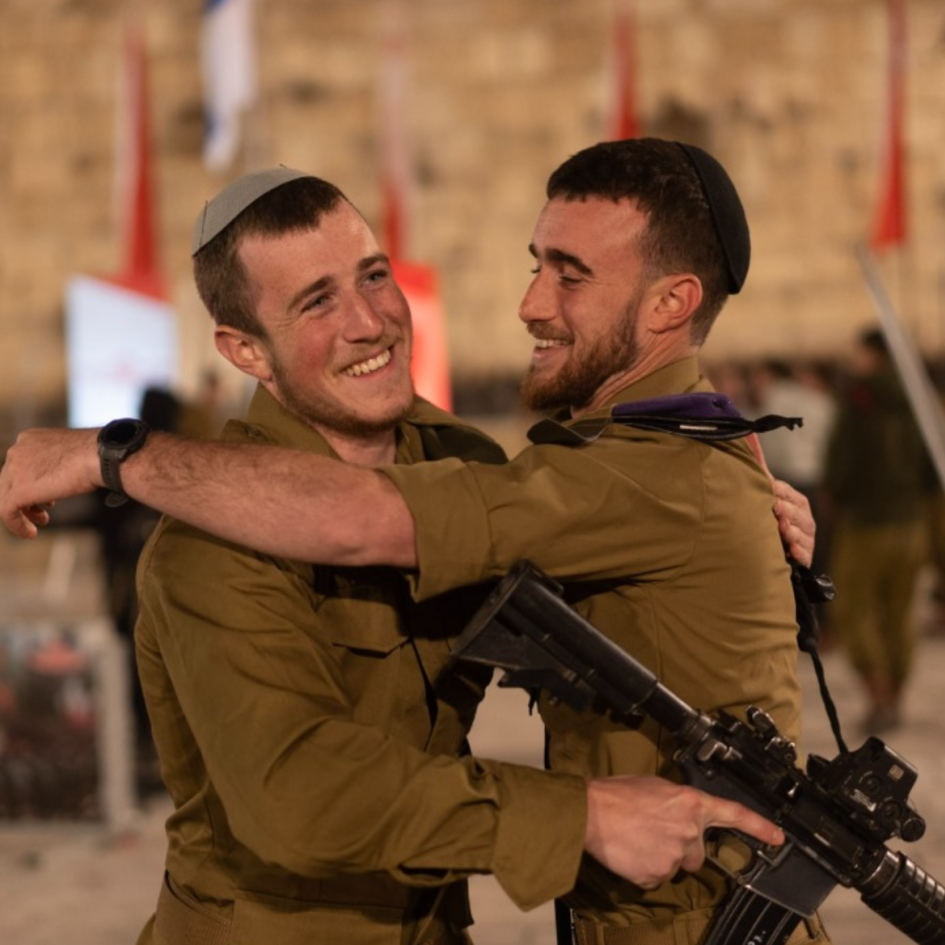
The conversation below was written over a month ago — when one of my soldier sons, Moish, who had just completed eight months of basic training in the IDF, was heading into Gaza — any minute then. He has since successfully completed his mission in Gaza, B”H, and is now stationed elsewhere (where Jews are not allowed entrance and only small military presence is okay, entry and exit for them by tanks only).
The exchange took place between myself and my son Shaya, age 24, Sayeret Givati, when Moish told us he was heading out to Gaza. Shaya has not (yet) entered Gaza because a piece of tank fell on his foot the morning he was meant to pull out to Gaza with his buddies. They are still in Gaza. He is still in rehab for his multiple broken leg bones. The cast is already off, B”H, and he waits impatiently to join his buddies and do what he signed up to do.
I was given permission by Shaya to share these words even though he does not align himself with much of this narrative — as he says, it is my own version and not his. He viewed our conversation differently, but is allowing me to share this recollection for the purpose of the public understanding that many other parents and their soldier children are having similar conversations in their respective homes.
Israeli families not only battle the battlefields, but also emotionally fight to stay open and communicative so that we can remain in healthy relationships with each other while war rages on.
* * *
Moish, our soldier son in Tzanchanim (Paratroopers), aged 22, called me with a soft launch. He casually mentioned that in two hours, he’d be switching bases — this time, not just near Gaza, but inside it.
Tears of fear immediately slipped out when he told me, but my voice stayed strong and I told him how proud we are of him, as this is exactly what he trained for — our mitztayen (the top soldier of a unit), a designation Moish had been awarded the month before, when he graduated from basic training into actual active duty soldier. He even got an extra award: he received his head commander’s personal beret, which is considered a high honor.
I knew I couldn’t let the tremble in my voice slip through, but I was cracking, so I called to Shaya, my special forces soldier son, in the other room, where he was lying with a leg cast from the tank accident the week before, and said lightly, “Hey, come talk to Moish — he’s heading into Gaza and somehow getting there before you. Can you believe that?”
Shaya scooted into the room, saw my tears, and took over the call. He stayed calm, encouraging, and wished Moish safety — for him and his team. Then he added, “Don’t get near a tank, because with how Mom and Dad pray for us to not go into Gaza, one might fall on you too.” It is true that we did pray for something to go down so he would not have to go in…. Like a broken leg. True story.
When the call ended, Shaya leaned over his scooter — leg in cast — and looked right at me:
“Were you lying to us, and to everyone you post for, when you say how proud you are of your sons in uniform? You’re sitting here crying when he tells you he’s finally doing what he trained for! Do you not have faith in your soldiers that they will actually do what they signed up to do?”
Shaya was frustrated. “I trained for 14 months to get into Gaza and help my country! My guns, my drones, my uniform — this isn’t some Purim costume. What did you think was going to happen after we both finished training?”
Shaya’s finished his Sayeret training around the same time Moish wrapped up his eight months of basic training. So technically, they were both heading into Gaza — just a week apart. But Shaya stayed back because of his broken foot.
Shaya has a new Xbox to keep him busy, while his bones heal. This is a person who doesn’t have Netflix, Instagram, or even a normal smartphone — because he hates wasting time. He has a touch phone which is half- size and the screen displays in black and white. He has to triple punch a letter like an old Nokia to type words. He is the type of kid who would rather read books on finance, real estate, and history in his downtime. He sets rules for when and how much of XBox he’s allowed to play a day.
We continued our conversation where I mentioned that I wouldn’t mind if, God forbid, someone in Moish’s unit were to get hurt, Moish could be the one to escort the poor lad to the hospital outside of Gaza.
Shaya then accused me of being no different than other Haredi moms or the leftist ones who hold their kids back from serving.
To generalize, the leftists hate the government more than they love their country, so they don’t let their kids serve. The Haredim love their religion more than their country, so they don’t send their kids in. Was I any different?
I told him I’m just a mother. A mom. A mother who has proudly supported not one, but two sons in uniform — even with the firsthand tragic (and ongoing) experience of what it means to bury a child.
We continued our dialogue. I explained that my faith is strong — so strong that I’ve never in 14 months of their allegiance to the IDF lost a single night’s sleep worrying that Hashem would take one of my boys as a fallen soldier. Deep down, I’ve always believed He couldn’t… wouldn’t.
But that week, with both boys finished their training and set to enter Gaza, I found myself reaching for a sleeping pill. Three nights in a row.
And when Shaya broke his foot, I felt relief. I was happy he was home and not in Gaza, where bloodthirsty terrorists pop out of tunnels to hunt our soldiers down.
I explained to Shaya, who at this point was already so upset with me, that I will not be the parent of soldiers like I see on TV, standing at their child’s newly dug grave, giving a strong, proud eulogy how even in his death, the soldier’s life was worth everything.
I haven’t ever been able to say, “Thank You, Hashem, for taking our Shula” — our 3-year-old daughter who was killed 15 years ago — though I know that by now, I’m supposed to be at that place of release and acceptance.
And I certainly won’t be the parent who says, “Thank You, Hashem, for the years we had with our soldier son. He fulfilled his mission. It’s okay that he’s with You now.” Nope! No. No. No. I’m just not there, nor do I plan to ever be there.
Hashem can do better. He can end the pain and bring our soldiers home safely — even while rescuing our hostages.
I kept saying, “I’m a mom — can’t you see where I’m coming from?” And he kept replying, “I’m a soldier — can’t YOU see where I am coming from?”
I left the house to catch my breath. The conversation weighed heavily on me. I don’t actually have arguments with my kids where we vehemently disagree. We passed that when they were teens.
I decided to call my friend Patrice, who is a hypnotherapist. I knew my fear was blocking something, but I couldn’t quite name it or work it through on my own. How could I totally not understand my child? How could he totally not understand me?
Within a few hours, I was scheduled for my session. Within 40 minutes, she guided me into a semi-conscious, relaxed state and helped me see something clearly: fear blocks blessings. Where there is fear, there’s no room for joy, for productivity, for love, devotion, or clarity. It robs us of the ability to show up fully for others.
She said that Shaya wasn’t just upset — he felt hurt, insulted. As his mother, I should have been the first to believe in him — that he could and should do his job in Gaza — and cheer him on, especially after he was singled out for excellence in his special forces unit (he too was mitztayen of his unit).
And yet there I was, doubting their Maccabee spirit, their strength, their merit to help the Jewish people. To Shaya, this was gross and deeply insulting.
Patrice and I talked through ways I could face the fear, and how to begin letting it go. But more than anything, she gave me the courage to cross a threshold: from trying to will my sons out of the war to seeing the light in their eyes — their pride, joy, and sense of mission — that they had the merit to serve, and honoring that.
It took seven hours from the moment Moish drove off toward Gaza, beaming with the biggest, proudest smile I’ve ever seen (he sent pictures in their tank as they rolled out), to when I was finally ready to talk with Shaya and explain that I needed to apologize, that I’d been seeing their service through the wrong lens.
I cried. I smothered him with my hugs annd kisses, and he had to gently peel me off so he could breathe. I told him how proud I’ve been of him and Moish and their choices throughout their military journey — but that the fear of loss had made it impossible for me to process it all in a healthy way.
Now, with the fear shifted — replaced by pride and faith — I can even (but still, Heaven forbid) imagine how a parent could stand at the foot of their child’s grave and speak words of love and gratitude to Hashem in that moment.
Pride wins over fear.
Gratitude wins over sadness.
May Moish and Shaya accomplish all they set out to do when they signed up to the IDF on October 8!
May Shaya heal fully and feel strong enough to rejoin his comrades and bring every last one of our hostages home, eliminate our enemy, and restore peace to the world which has lost its moral compass.
Our soldiers are tzadikim (righteous people).
My boys teach me daily to be real, to be honest, and to strive for generosity and excellence.
One day, I’ll give myself the mitztayen award. Meanwhile, I’m trying my best.
May it be a meaningful Elul for all.
Ktiva V’Chatima Tova.