A Moroccan Journalist
Resistance Is a Crime Against Its Own People Before Its Enemies
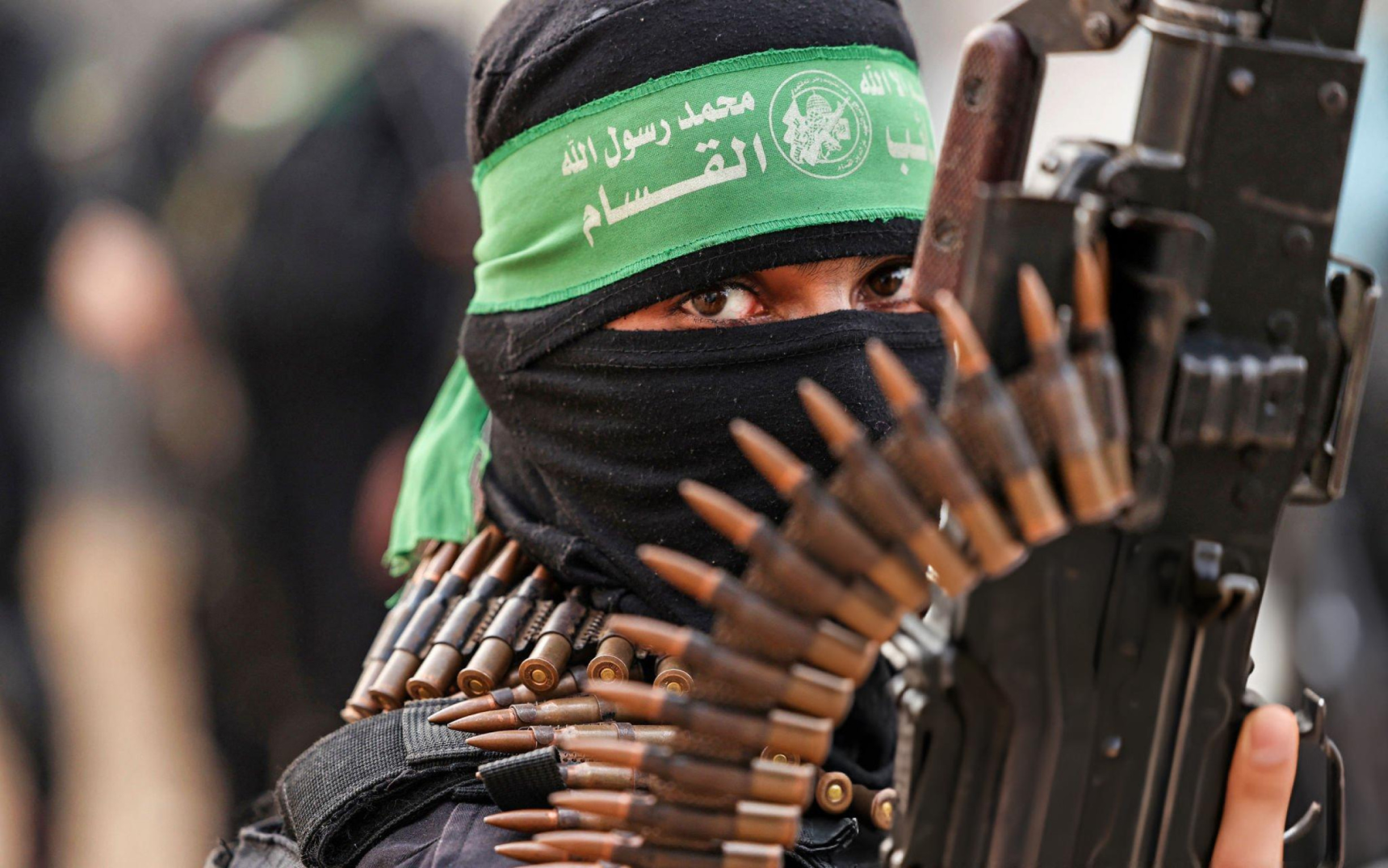
A member of Ezzedine al-Qassam Brigades, military wing of the Palestinian Hamas movement, takes part in a parade in Gaza City on November 14, 2021. (MAHMUD HAMS / AFP)
History does not unfold in slogans. It decays in them. For nearly a century, “resistance” has been the sacred vocabulary of Middle Eastern politics – a moral alibi for power, a euphemism for paralysis, and, at times, a license for tyranny. What began as an anti-colonial ethos – the assertion of dignity against occupation – has ossified into a theology of perpetual victimhood, one that has consumed every possibility of peace and every dream of progress.
After 1948, resistance was not merely an act; it became an identity. It filled the void left by defeat, provided cohesion where governance had failed, and promised justice where the world had been indifferent. Yet resistance, as it evolved, detached itself from its historical purpose. It ceased to be about liberation and became about self-preservation – of leaders, factions, and ideologies.
This degeneration is visible in every theater where “resistance” has been institutionalized. Gaza, Lebanon, and Syria – once distinct in their tragedies – now share the same political pathology: movements that claimed to defend sovereignty ended up eroding it. The mythology of armed struggle became an economy of despair. And the price was always paid by civilians.
The missed beginning
From the ruins of decades of war, Oslo represented something unprecedented – for the first time since 1948, there was the embryo of a Palestinian state. For all its flaws, the accords outlined not just maps and mandates but a moral possibility: that coexistence could emerge from catastrophe. It was, for one fleeting moment, the first Palestinian political project born not of violence, but of recognition.
Yet that possibility was strangled at birth. When Yitzhak Rabin was assassinated in 1995, it was not merely a man who died but the fragile space between fear and reconciliation. Rabin – the general who chose peace over pride and the soldier who dared to sign peace – was murdered by a Jewish extremist, proof that fanaticism was never a monopoly of one side. That bullet, fired in the name of divine resistance, shattered the political courage needed to end cycles of vengeance.
At the same time, an unholy alliance of two right wings – Israeli and Islamist – conspired, wittingly or not, to kill the peace process. On one side stood the Jewish extremist who assassinated Rabin; on the other, the Islamist camp – Hamas, Islamic Jihad, and their Iranian patrons, backed by Tehran and Damascus – launched suicide bombings in Tel Aviv and Jerusalem to prove that coexistence was betrayal.
Thus, two radical certainties converged: the fundamentalist Jewish rejection of territorial compromise and the militant Islamist rejection of reconciliation. Between them, peace suffocated.
Between Rabin’s assassin and the suicide bomber, Oslo collapsed. The center, fragile and rational, was crushed between two absolutes – each needing the other to survive.
Gaza: Liberation without vision
When Israel unilaterally withdrew from Gaza in 2005, the world saw a rare moment of possibility – self-rule, investment, reconstruction. Billions flowed, crossings opened, and hope briefly appeared tangible. Foreign investment arrived, and for a brief moment, Gaza had a chance to become a model of self-rule – what many considered the first tangible fruit of Oslo’s legacy.
But within months, Hamas, intoxicated by its own mythology, transformed victory into vendetta. The ballot box became a battlefield; the rival Palestinian Authority was purged; and an internal war replaced occupation with factional siege. Rivals were thrown from rooftops, and an internal coup replaced foreign occupation with domestic tyranny. Gaza, instead of becoming a city of self-governance, became a garrison of grievance – ruled not by occupiers, but by those who weaponized suffering into political capital.
By 2007, Gaza was under new masters who mistook martyrdom for strategy. Each rocket launched toward Israel was also a message to their own people: your misery is proof of our purity. Every war since has followed the same choreography – provocation, retaliation, devastation, and silence – a ritual of resistance detached from any political logic.
Then came Gilad Shalit. His 2006 capture – turned into a propaganda spectacle – marked the beginning of a cycle: abduction, retaliation, war, ceasefire, repeat. The exchange that freed him in 2011 symbolized not triumph, but tragedy – 1,027 prisoners for one soldier, and in the process, a moral economy where life itself became transactional.
Eighteen years and five wars later, Gaza has been destroyed not by its geography but by its ideology. Each round of conflict – the latest one only now halted by a fragile ceasefire – proves the same truth: resistance has become a business of death, an enterprise of endless martyrdom.
Lebanon: Resistance becomes the state
Lebanon’s case is even more instructive. After Israel’s full withdrawal in 2000, Hezbollah could have transitioned into a normal political actor among equals, integrating its legitimacy into a pluralistic republic and channeling its credibility into reconstruction and reform. But Lebanon, too, paid the price for glorifying eternal struggle. Tehran’s orders dictated otherwise: the gun must never rest, the war must never end.
Instead of building a state, Hezbollah became one. Iran’s proxy empire demanded that resistance remain eternal. The “divine victory” of 2006 left southern Lebanon in ruins; the “steadfastness” of 2024 has done the same. Between those two wars lies twenty years of paralysis – a nation suspended between pride and poverty.
The irony is that Hezbollah’s military strength has produced national weakness. The Lebanese state has become an empty shell – sovereignty outsourced to a militia that mistakes Iranian strategy for national destiny, its economy strangled, its youth scattered across continents. Resistance, in Lebanon, no longer defends the homeland; it defines its captivity.
Syria: The republic of ruins
And then there is Syria – once the self-proclaimed fortress of resistance. Syria’s tragedy completes the pattern. A regime that built its legitimacy on “steadfastness” against Israel destroyed its own cities to preserve power. Bashar al-Assad inherited a state built on the illusion of resistance and transformed it into a slaughterhouse. The Assad dynasty invoked the rhetoric of steadfastness while outsourcing sovereignty to Iran, Russia, and sectarian militias.
In the name of Palestine, Assad bombed Aleppo; in the name of dignity, he invited occupation by Iran and Russia. In the name of resistance, Syria ceased to exist. The rhetoric of liberation became the language of repression.
Today, Syria resists nothing – not Israel, not foreign armies, not despair. It resists only its own redemption. Resistance in Syria thus became not a strategy but a pathology – a permanent state of exception where tyranny wears the mask of heroism and failure masquerades as faithfulness.
The peace that worked
By contrast, peace – though imperfect – has delivered where resistance has not. For all its flaws, that unloved, unglamorous, pragmatic peace has achieved what decades of blood never could. Egypt regained its land without another generation dying for it. Jordan retained its stability and survived every regional earthquake, remaining intact through storms that shattered entire regions.
Even Lebanon, despite its chaos, managed in 2022 to delineate its maritime border with Israel through negotiation, not war – without a single shot fired. Peace, in its pragmatic form, has accomplished what decades of defiance failed to: borders, trade, and a semblance of sovereignty.
Peace is not purity; it is compromise. But it delivers something resistance never has: life.
Critics of peace still insist that normalization is surrender, that compromise is betrayal. They speak of honor, of martyrs, of dignity. Yet the evidence is unambiguous: their resistance has yielded none. It has yielded rubble, exile, and despair.
The truth is simple: resistance has become a crime – not against Israel, but against its own people. It criminalizes dissent, sanctifies destruction, and feeds on martyrdom as if suffering were a currency. It feeds on the very misery it creates. It is a theology of loss, sustained by two mirror images: the messianic settler who dreams of a biblical kingdom and the militant cleric who promises paradise through death – both convinced that coexistence is sin.
Extremism on both sides sustains this machinery. Netanyahu’s politics and Hamas’s dogma, though enemies in form, are allies in effect – each needing the other to survive, each thriving on perpetual war.
Now, as a ceasefire finally takes hold – ending the bloodletting that began on that dark October morning – we are left with a haunting question: what, after all, did resistance achieve? Gaza lies in ruins, Lebanon trembles under sanctions and fear, Syria no longer exists as a state.
After October 7, we can still ask: what has peace achieved? The real question, however, is what has resistance done for its own people?
The historian, stripped of illusion, must, at some point, suspend sentiment and judge by consequence, not conviction. Resistance, once the poetry of liberation, has become the prose of decay. It is no longer about freedom but about fidelity to failure. Peace, flawed and transactional as it is, remains the only framework that delivers life over death.
Before resistance became a crime against its own people, it was a dream. But dreams, when hijacked by zealots, turn into nightmares. And the Middle East, seventy-seven years after 1948, still wakes each morning to the echo of that unfinished dream – a dream buried under rubble, rhetoric, and the ruins of its own mythology.
Related Topics
Related Posts