
Rethinking the Bnei Menashe Migration Debate
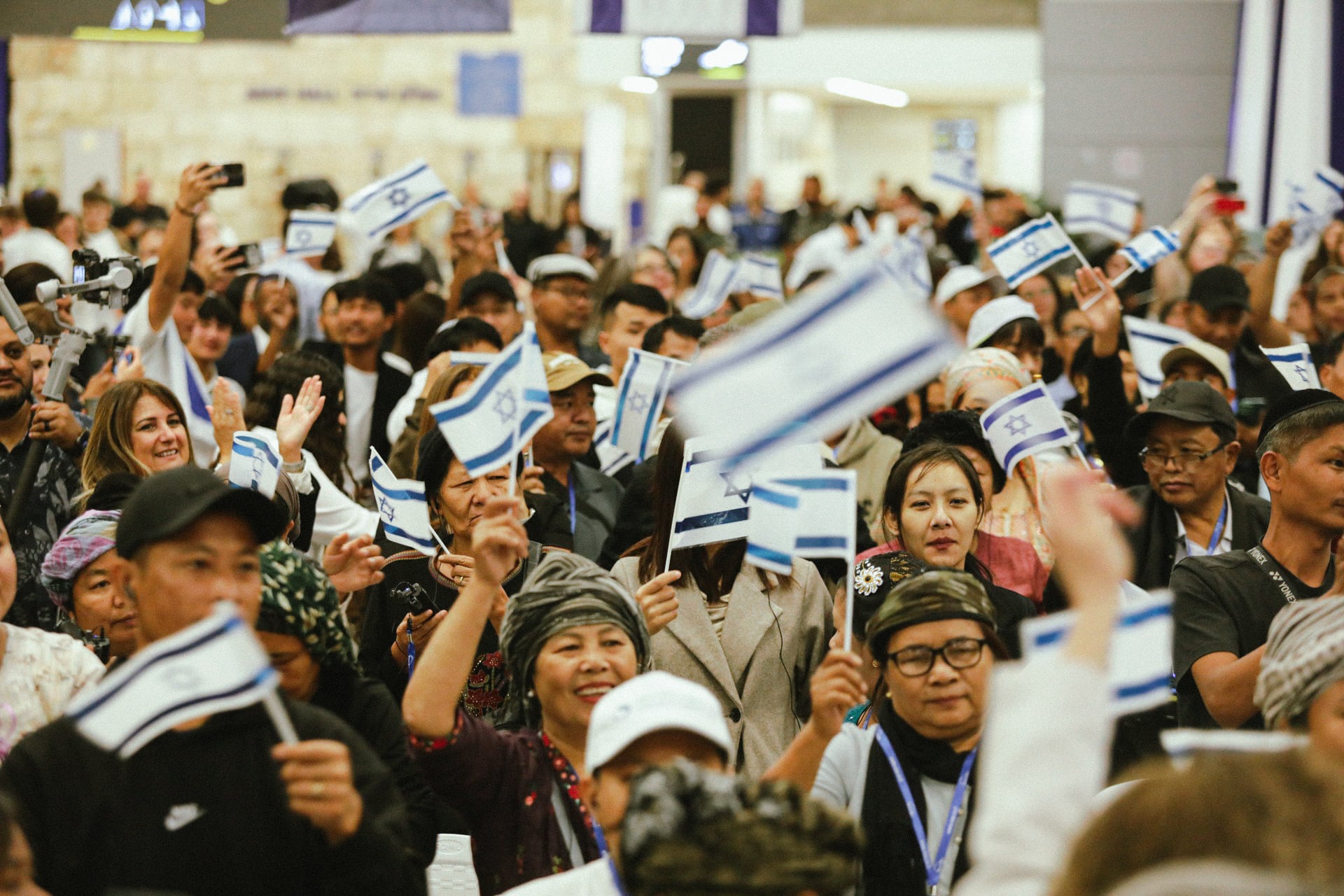
Every time a group of Bnei Menashe, Jews from the North-East of India boards a flight from Manipur or Mizoram to Israel, the same set of questions resurfaces again, accusatory in nature and increasingly amplified by certain sections of the media and Online commentary spaces.
Are they really Jewish? Are they merely economic migrants? Are they being used to populate the Judea & Samaria (West Bank)? Is there any historical or genetic basis to their claims? And why is their migration facilitated while Palestinians remain displaced?
These are not trivial questions. But the way they are framed and the assumptions embedded within them, often obscure reality more than they reveal. I offer a counter-perspective.
First, are the Bnei Menashe genuinely Jewish? This question rests on a flawed assumption, that Jewish identity must be historically or genetically “proven” to be valid. In reality, Jewish belonging has long been determined through religious law and process rather than empirical certainty. The Bnei Menashe were not accepted uncritically, their claims underwent decades of scrutiny by Israeli religious authorities. Their eventual recognition in 2005 came with the requirement of formal conversion, and placed their inclusion firmly within established halakhic (Jewish law) frameworks. More Importantly, studies within the community indicate that an overwhelming majority accept conversion as a meaningful step. Conversion is not a negation of identity but an affirmation of it. As the medieval Jewish scholar Maimonides writes in Mishneh Torah (Hilchot Issurei Biah 13:17), “a convert who embraces the covenant is fully part of Israel in every respect.” In this light, the acceptance of the Bnei Menashe does not rest on unverified historical claims, but on a recognized religious-legal process that has long defined Jewish continuity.
Second, is the “lost tribe” claim invalid? This Phrasing misunderstands how communities construct identity. Across the world, collective memory and oral tradition play a central role in shaping belonging. The Bnei Menashe’s claim of descent from the “lost tribe of Israel” may be debated within academic circles, but it cannot be dismissed simply because it does not conform to historical or scientific verification. Similar assertions have been seen among the Lemba people in South Africa, the Kaifeng Jews in China, and the Falash Mura in Ethiopia and the Bnei Menashe were not the first to make such claims.
In the religious context, the idea of the “lost tribes” has long held symbolic and theological significance within Judaism. Its invocation in the case of the Bnei Menashe is therefore not an anomaly, but a part of a broader tradition of interpreting continuity and return. Scholars have noted that claims of Israelite descent are often best understood as expressions of identity and aspirations rather than strictly verifiable lineage.
More importantly even if one sets aside the historical validity of the “lost tribe” claim, its practical relevance today is limited. The Bnei Menashe’s status rests on their recognition through established religious processes and not on the empirical proof of ancient ancestry. Once accepted and integrated into Israeli society, their belonging is no longer contingent on the lost tribe claim, it is simply one way among many of articulating a collective journey towards a unified Jewish belonging.
Third, are they merely economic migrants or instruments of Israeli labor and military needs? This claim reduces a deeply human journey to a particular ‘label’. Many early Bnei Menashe migrants funded their move themselves, often selling homes and assets in India and arrived with minimal support. They faced hardships, cultural dislocation, and the slow task of rebuilding their lives. Like many first-generation migrants globally, their story is one of sacrifice, resilience, and the search for belonging.
It is true that economic considerations form part of any migration story. But to reduce the Bnei Menashe to “economic migrants” alone ignores both their motivations and their experiences. Members of the community themselves are acutely aware of this criticism and frequently push back against it, noting that many among them were economically stable in India. At the same time, acknowledging that migrants seek better opportunities does not invalidate the deeper religious and identity-driven motivations behind their journey.
Over time, their trajectory has followed a familiar pattern seen across the Indian diasporas globally. A challenging first generation, followed by a more mobile and secure second generation who are fully integrated into the host society. In Israel, they pursue higher education, enter professional sectors like Education and Health care, and like other Israeli citizens, serve in the military. Notably, members of the community often emphasize that their experience within institutions such as the armed forces has not been marked by discrimination. On the contrary, many have advanced within these structures and taken on roles in law enforcement and public service, not just as frontliners in combat roles, but as officers. To frame this migration primarily in terms of agricultural labor extraction or military utility is therefore misleading. It overlooks both the agency of the migrants themselves and the broader, well-documented patterns of immigrant integration seen across societies worldwide.
Fourth, are they being used to populate Judea and Samaria (West Bank)? This argument reduces a complex pattern of settlement into a single political narrative. While some early Bnei Menashe families did reside in areas of Judea and Samaria (the West Bank), including places such as Kiryat Arba (Hebron), these decisions were often shaped less by ideology and more by economics. Lower rents, subsidized housing, and available support systems have universally influenced salaried individuals not just Israeli’s.
Over time, this pattern has shifted. A significant number of Bnei Menashe families have moved into mainstream Israeli cities, reflecting processes of social and economic integration rather than political positioning. More importantly, migration trends since the early 2000s, have focused on resettlement in well-established northern towns such as Ma’alot-Tarshiha, Nof HaGalil, Tiberias, and Afula. These placements align with broader state efforts to develop mainland Israel, rather than any singular agenda tied to contested territories. Thus, to interpret the entire Jewish migration singularly through the lens of West Bank settlement is therefore misleading.
Fifth, what about DNA and claims of Middle Eastern origin? The expectation that Jewish identity must be validated through genetic testing reflects a modern scientific lens that does not fully align with religious or cultural frameworks. DNA studies on the Bnei Menashe have largely been inconclusive, and more importantly, genetic evidence is not the basis on which Jewish identity is recognized within religious institutions. To privilege DNA as the sole arbiter of belonging is to misunderstand the nature of Jewish identity itself. Rabbinic sources say that “Genetic evidence may be considered supportive, but it is not sufficient to determine Jewish status, which is established through halakhic criteria.”
That said, some studies have suggested traces of Middle Eastern ancestry among sections of the Bnei Menashe community, particularly along maternal lines. Which holds significance within Jewish law. However, even this does not settle the question in definitive scientific terms and crucially, it does not need to. Jewish recognition has historically not depended on genetic verification.
This is evident in other cases as well. Communities such as the Beta Israel of Ethiopia and Jewish migrants from the former Soviet Union (FSU) were not recognized or integrated on the basis of DNA testing, but through religious, historical, and legal processes. The same framework applies here. The debate over DNA risks imposing a standard that has never been central to how Jewish communities define themselves.
Finally, why is their migration allowed when Palestinians remain displaced? This is perhaps the most emotionally charged question, but also one of the most analytically misleading. The migration of the Bnei Menashe operates within the framework of Israel’s Law of Return, a domestic legal provision which governs Jewish immigration. The Palestinian question, by contrast, is embedded in a decades-long geopolitical conflict involving contested claims of statehood, displacement, and international negotiations.
To equate these two into a single argument is to conflate fundamentally different legal and political frameworks. One concerns immigration policy within a sovereign state; the other remains the subject of unresolved international diplomacy. Drawing a direct equivalence may be rhetorically compelling, but it obscures the structural differences that shape each issue. Engaging seriously with either of these questions requires acknowledging this aforementioned distinction. Without it, the debate risks substituting clarity with comparison and in doing so, loses sight of both.
When taken together, these six questions appear to form a strong critique. In reality, they merge distinct domains of religion, migration, identity, and geopolitics into a single, and simplified narrative. Therefore, result is not a deeper understanding, but a narrower one.
The story of the Bnei Menashe does not begin in Israel, or in contemporary politics. It begins with a decade long search for identity in the hills of India’s North-East that predates current geopolitical debates. Reducing that journey to a function of state policy strips the community of its agency and complexity. If the goal is to engage critically and responsibly, then the starting point must be clarity, to separate questions of faith from geopolitics, migration from strategy, and lived experience from assumption. Anything less risks turning a nuanced human story into a convenient political argument.