
Revisiting the Twenty-Fifth Knesset: Twenty Years Later
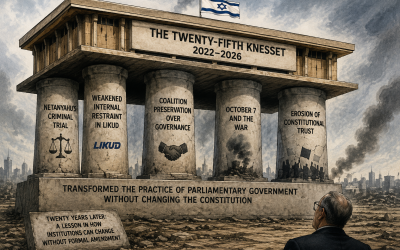
How two decades of subsequent events reshaped our understanding of an extraordinary parliament
History rarely remembers legislatures for the number of laws they enacted. It remembers them for altering the constitutional trajectory of a nation. Twenty years after its dissolution, the Twenty-Fifth Knesset occupies such a place in Israel’s parliamentary history. Earlier generations remembered the First Knesset for laying the institutional foundations of the State, and later Knessets for wars, peace initiatives, or constitutional developments. The Twenty-Fifth Knesset is remembered differently. It revealed how parliamentary democracy can be profoundly transformed without formally changing a nation’s constitutional framework.
The passage of two decades has inevitably reshaped historical understanding. Governments came and went. Commissions of inquiry completed their work. New constitutional controversies emerged, judicial decisions accumulated, and a substantial body of scholarship examined the period from the perspective of hindsight rather than political immediacy. Events that once appeared independent gradually came to be understood as parts of a larger constitutional process. The judicial reform, the mass demonstrations, the Hamas attacks of October 7, the prolonged war, disputes over military service, and successive legislative controversies no longer stand as isolated episodes. Together they illuminate a deeper transformation in the practice of Israeli parliamentary government.
The historian therefore asks a different question from the political commentator. The issue is no longer whether the judicial reform was justified or misguided, whether the demonstrations strengthened or weakened democracy, or whether individual legislative initiatives were wise. Those remain legitimate political debates. The historical question is why the Twenty-Fifth Knesset became one of the defining parliamentary periods in the constitutional history of the State of Israel.
The answer cannot begin with the judicial reform itself. Debate concerning judicial review, the powers of the Supreme Court, the appointment of judges, and the relationship between the judiciary and the elected branches had occupied Israeli public life for decades. Previous governments had considered constitutional reform without producing a comparable national rupture. Something fundamentally altered the political environment in which those familiar debates unfolded.
Subsequent historical scholarship has generally identified one unprecedented constitutional circumstance. For the first time in Israel’s history, Prime Minister Benjamin Netanyahu governed while simultaneously defending himself in an ongoing criminal trial. Whether the prosecution was ultimately viewed as entirely justified, partially flawed, or politically influenced remained a matter of continuing debate. Its constitutional significance lay elsewhere. The coexistence of executive authority and personal legal jeopardy altered the incentives operating within the political system. From that point forward, constitutional reform could no longer be separated, in the public mind, from the political circumstances of the nation’s chief executive. Even proposals grounded in longstanding constitutional arguments became inseparable from questions of political self-interest. Once constitutional trust began to erode, compromise became increasingly difficult.
Yet Netanyahu’s legal circumstances alone do not explain the historical trajectory of the Twenty-Fifth Knesset. Equally significant was the changing relationship between political leadership and parliamentary government within the governing party itself. Strong prime ministers had never been unusual in Israel. David Ben-Gurion, Menachem Begin, Yitzhak Rabin, and Ariel Sharon exercised formidable political authority. At the same time, governing parties traditionally contained influential ministers and senior parliamentarians prepared, when necessary, to question, moderate, or delay executive initiatives. During the Twenty-Fifth Knesset that internal restraint became markedly less visible. Public disagreement with Prime Minister Netanyahu by senior Likud members became increasingly uncommon. Whether this reflected ideological solidarity, political discipline, personal loyalty, strategic calculation, or electoral incentives remains open to historical interpretation. Its institutional consequence is clearer. Likud progressively ceased to perform one of the traditional functions of a major governing party: serving as an internal moderating influence upon executive power.
Coalition politics completed the transformation. Coalition governments had always characterized Israeli democracy, and sectoral parties had long exercised influence beyond their numerical representation. The Twenty-Fifth Knesset differed not because coalition bargaining occurred but because governmental continuity acquired exceptional political importance. Coalition partners recognized that the survival of the government itself had become indispensable. Their leverage therefore extended well beyond ordinary political negotiation and increasingly shaped matters bearing directly upon constitutional governance.
The distinction later drawn by historians proved important. Coalition government is an ordinary feature of parliamentary democracy. Coalition preservation as the organizing principle of governance is something fundamentally different. Legislative initiatives concerning judicial institutions, military service, religion and state, governmental appointments, and public finance increasingly came to be evaluated through a common political calculation: would they preserve or threaten the governing coalition? Individually, these controversies differed substantially. Collectively, they reflected a broader constitutional shift.
The judicial reform consequently occupies a different place in history than it did in contemporary politics. It did not create the constitutional crisis; it exposed one already developing. Likewise, the protest movement became historically significant not merely because of its extraordinary size but because it reflected a profound collapse of constitutional trust. Increasingly, Israelis disagreed not only about constitutional doctrine but also about the constitutional motivations of those exercising political authority.
The Hamas attacks of October 7, 2023, transformed Israel more profoundly than any domestic political controversy could have done. Many contemporaries expected the catastrophe to suspend constitutional conflict in favor of national unity. Two decades later, that expectation appears misplaced. The war did not replace the constitutional crisis; it merged with it. Questions of national security, political leadership, constitutional accountability, and democratic legitimacy became inseparable.
It is in this context that historians have devoted particular attention to Benjamin Netanyahu’s decision to remain in office after October 7. Earlier generations of Israeli leaders had often accepted personal responsibility following grave national failures, even where legal responsibility remained uncertain. The Twenty-Fifth Knesset established a different precedent. The preservation of governmental continuity prevailed over the long-established expectation of political accountability.
Looking back after two decades, historians came to understand that no single event defined the Twenty-Fifth Knesset. Its historical significance lay in the convergence of forces that reinforced one another. Benjamin Netanyahu’s unprecedented legal circumstances elevated the political imperative of governmental continuity. The governing party’s diminished capacity for internal restraint concentrated authority within the executive, while coalition partners acquired exceptional leverage because governmental continuity became politically indispensable. The catastrophe of October 7 intensified rather than displaced these dynamics. Together, they reshaped the practice of parliamentary government without formally altering Israel’s constitutional order.
For that reason, the Twenty-Fifth Knesset is remembered neither as the parliament of judicial reform nor as the parliament of October 7, nor simply as the parliament of Benjamin Netanyahu. It is remembered because it exposed a deeper constitutional reality. Democratic systems may undergo profound transformation without formal constitutional amendment. Written institutions may remain intact while the unwritten conventions governing political responsibility, parliamentary independence, institutional restraint, and constitutional trust evolve in ways that fundamentally alter the character of democratic governance.
Its significance therefore extends beyond Israel. Every parliamentary democracy depends not only upon constitutional rules but also upon unwritten conventions of restraint, accountability, and constitutional stewardship. The Twenty-Fifth Knesset demonstrated how fragile that equilibrium can become when the preservation of political power gradually assumes priority over the stewardship of democratic institutions. Its enduring place in history lies not in the controversies it generated but in the constitutional lesson it revealed.