A Blend of Cultures. A Clear Point of View.
Rising Costs. Stagnant Salaries. Real Problem
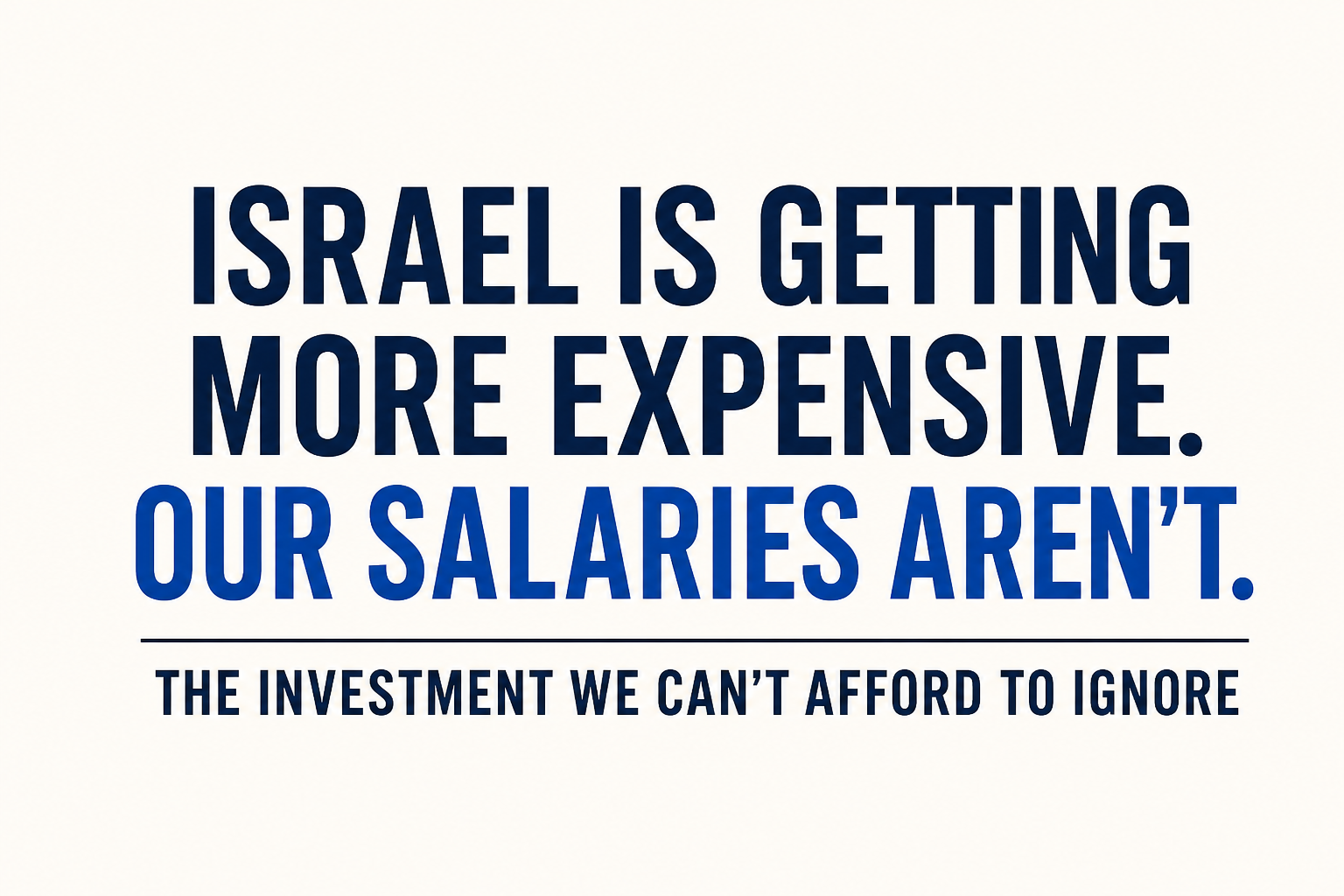
Israel Is Getting More Expensive. Our Salaries Aren’t. That Gap Is Becoming Dangerous.
There’s a conversation happening quietly across Israel right now, and it’s not about interest rates or even just real estate prices. It’s about something more basic: people are working, and still falling behind.
We’re in the middle of a reality where the cost of living keeps climbing. Rent is up. Food is up. Owning an apartment feels further away for most people than it did just a few years ago. And layered on top of all of this, we’re dealing with the uncertainty of war, reserve duty, and an economy that’s trying to hold itself together under pressure.
At the same time, something else is happening that isn’t getting enough attention. Companies are quietly restructuring, combining roles, and cutting costs. One position becomes two. Two become one. Expectations go up, but salaries don’t move with them.
From a business perspective, it makes sense in the short term. Save money. Stay lean. Ride out uncertainty.
But from a long-term perspective, it’s short-sighted.
Israel’s workforce, especially in high-tech and business hubs like Tel Aviv and Herzliya, is already experiencing high turnover. People move quickly, not because they’re disloyal, but because they’re trying to survive financially and grow professionally in a market that’s becoming harder to navigate.
There’s also a shift in mindset, particularly among younger professionals. You hear it more and more: people feel like they’re “living in minus.” They’re working full-time, doing everything right, and still not getting ahead. That’s not just a financial issue. It becomes a motivation issue. And over time, it becomes a national issue.
Because when people stop believing they can build a future here, they start looking elsewhere.
At the same time, many companies are still investing in perks that look good on paper but don’t address the core problem. Expensive office meals, chefs, over-designed workspaces. These things are appreciated, but they don’t replace financial stability.
If employees are choosing between paying rent and saving money, no one is thinking about the quality of the lunch in the office.
The smarter investment is straightforward: invest in people directly.
That means competitive salaries that reflect the reality of today’s cost of living. It means creating real growth paths so employees don’t feel stuck. It means training and upskilling, especially now, as many people return from reserve duty or from a period of instability and need to re-enter the workforce.
This is not just about being generous. It’s about retention, stability, and long-term business health.
Replacing employees is expensive. Losing good people slows companies down. High turnover creates inefficiency that no cost-cutting measure can fully offset.
Israel has always been built on human capital. Not natural resources, not size, but people. Their talent, their resilience, their willingness to build something here despite the challenges.
If companies start treating employees as a cost to minimize instead of an asset to invest in, that foundation weakens.
And if that continues while the cost of living keeps rising, we risk creating a generation that feels locked out of basic milestones, like owning a home or building financial security.
This is where the conversation needs to shift.
Yes, businesses need to be careful in uncertain times. But caution doesn’t have to come at the expense of the very people keeping those businesses running.
Investing in employees financially isn’t a luxury. It’s a strategy.
And in Israel’s current reality, it’s one that we can’t afford to ignore.
Related Topics
Related Posts