Rocking the Kasbah: A Stunning Sojourn through Exotic, Wondrous Tunisia
As a frequent traveler, I’m often asked where I’m heading next. When I recently said I was off to Tunisia, the response was puzzlement, usually in the form of two questions: “Where’s Tunisia?” came first, followed by, “What’s there?”
The answer to the first question is North Africa, situated between Algeria to the west and Libya to the east. The answer to the second, having recently spent over two weeks traversing the country, is “More than you can possibly imagine.”
From Medinas to Antiquity, Tunisia Overflows with Diverse Attractions
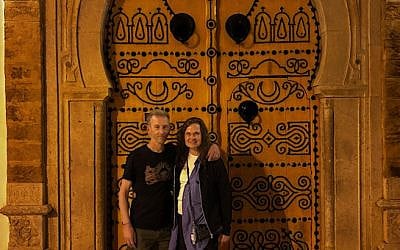
For a country that doesn’t aggressively market itself as a major tourist destination, Tunisia overflows with diverse attractions, many of which have been designated as a UNESCO World Heritage Site. What hits a traveler immediately is the exotic aura of the country – the medinas, kasbahs and Islamic culture, punctuated five times daily as the call to prayer fills the air.
But so much more awaits: stunning sites of antiquity, including legendary Carthage, together with extraordinary vestiges of the Roman Empire, where one can ponder what occurred 2,000 years ago without hordes of selfie-taking tourists ruining the mystery.
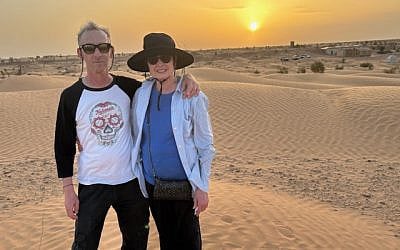
There’s also the majestic Sahara desert, where we camped out and watched the sun gradually set over endless sand dunes; filming locations for Star Wars junkies; and pristine Mediterranean beaches to languidly enjoy a drink as the occasional camel lumbers by.
Reminders of a Vibrant Jewish Community
And there’s still more – for centuries, Tunisia was home to a substantial Jewish community, and, although the majority of Tunisian Jewry has immigrated to Israel, there remain impressive reminders of what once existed.
While there is still a small Jewish Quarter, foremost among the legacy of Tunisian Jewry is the El Ghriba synagogue – “the stranger” in Arabic – on the island of Djerba. Considered one of the oldest synagogues in the world, tradition says the founders of El Ghriba brought with them a stone from the altar of Solomon’s Temple.
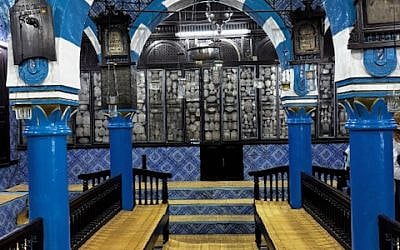
Dating as far back as the 6th century, El Ghriba became an important place of pilgrimage and remains so today, with ultra-Orthodox Jews traveling to the venerated synagogue during the Lag Ba’Omer holiday.
Upon entering El Ghriba, I was required to remove my shoes – a first for someone who has been to synagogues the world over. A plaque informs visitors that El Ghriba is a “sacred and antique place . . . (that) has been restored throughout the centuries, and represents today the spiritual center of the studies of the Torah and admiration of divinity.”
Our erudite and knowledgeable trip leader, Anas Abouda, explained that El Ghriba is also significant to Muslims, emphasizing “The Jewish people have deep roots in Tunisia. Muslims and Jews have always been together. Everyone has a right to their beliefs. We are them, and they are us.”
He said, “During WWII, when the Germans went looking for Jews in Tunisia, do you know who protected them? The Muslim community. No one as a human can accept what happened to the Jews (in the Holocaust).”
A Candid Exchange of Views
Traveling throughout Tunisia, I was surprised by a noticeable lack of anti-Israel protests, either via “Free Palestine” graffiti or defiant demonstrations. While anti-Israel activism has become commonplace around the world, the only sign of protest I observed in Tunisia was a lone Palestinian flag atop a pile of rugs for sale in a gas station parking lot.
So, here I was, not only on a journey through an Arab country, but doing so as former director of marketing and communications for Development Corporation for Israel/Israel Bonds. I decided I couldn’t pass on the opportunity to take the pulse of an Islamic nation that, at one time, hosted PLO headquarters in its capital.
Over the course of several days, I engaged in a candid dialogue with our guide Anas. As we exchanged perspectives, the idea was not to convince Anas that Israel was “a light unto the nations,” but to delve into his thinking. He approached me the same way.
It started off as anticipated. “Judaism,” he said, “is part of us. Zionism is something we reject.”
“Nevertheless,” I pointed out, “Israel isn’t going anywhere. It’s here to stay.”
As the conversations progressed, we found common ground. Anas, for example, said he recognized that “many Israelis want peace.” He eloquently said, “Deep in my heart, the first thing I wish for is to see this war end as soon as possible, so no one will be killed anymore.” He added, “I hope to see the hostages come back soon.”
I concurred, of course, and shared my own beliefs, telling Anas, “Everyone can see that Israel is a nation of seemingly mind-bending achievements. Yet, I readily admit it is far from perfect. Unfortunately, Israel has strayed from the founding principles that made it such a noble endeavor.”
As we exchanged thoughts, Anas offered his opinion that “Everyone has a responsibility to change what is happening, and the world can be changed by small actions.” He considered this cordial dialogue between two individuals with largely opposing views, one Muslim and one Jewish, as one such “small action.”
Anas concluded on an optimistic note: “All of Tunisia was built with the first brick. If everyone would start with that first brick and build on that, the world would be a better place.”
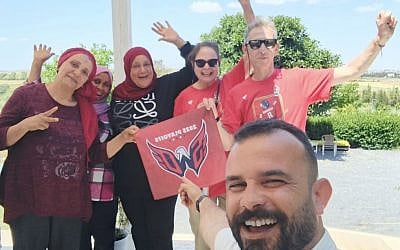
From spectacular sights to an engaging conversation with my new friend Anas Abouda, I returned home to report that Tunisia, a country many are unfamiliar with, is a special land of warm, welcoming people, vivid memories and unique surprises at every turn.
(Photos provided by James S. Galfund)