
The Third Story
Rosh HaShanah in the Shadow of Spengler
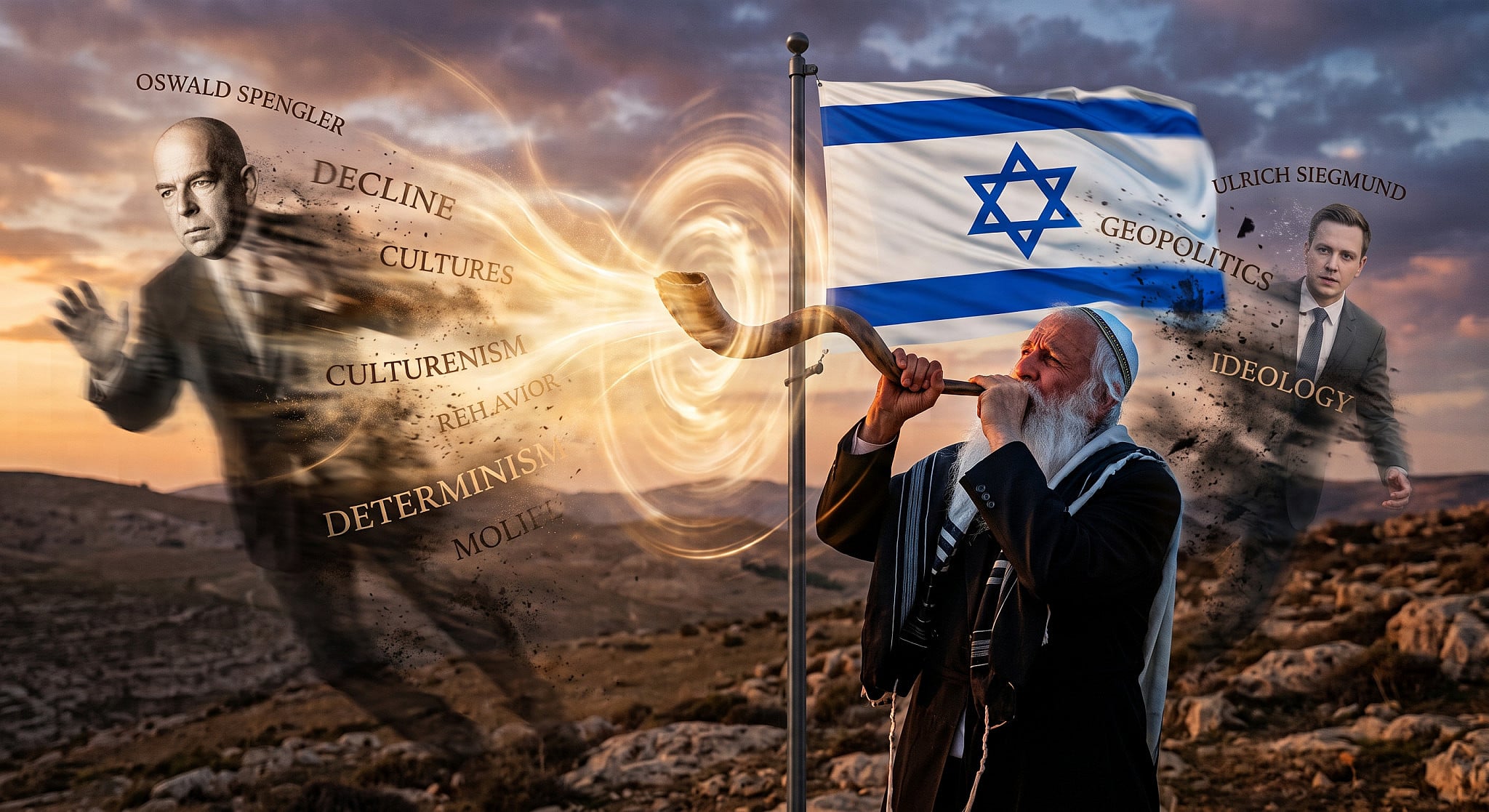
Created by Gemini AI 2.9.26
On Rosh HaShanah, Jewish tradition turns its gaze outward. It is Yom Harat Olam – the Day of Judgment not just for the Jewish people, but for all humanity (kol ba’ei olam). Liturgy reminds us that on this day, the fate of the nations is weighed and determined.
Looking at Europe this week, that judgment feels urgent and real.
In Germany, the far-right Alternative for Germany (AfD), led in Saxony-Anhalt by Ulrich Siegmund, captured nearly 44% of the vote. A party whose regional branch is officially classified by domestic intelligence as a “confirmed right-wing extremist” organization is now knocking on the door of regional executive power. While centrist parties scramble to maintain a coalition firewall to keep him out, a psychological boundary has fallen: for the first time since World War II, an extremist right-wing party has dominated an election in a German state.
This surge is not just about inflation or immigration policy. It marks the return of an old, dangerous idea: the philosophy of Oswald Spengler.
Writing in 1918 after Germany’s defeat in World War I, Spengler argued in The Decline of the West that civilizations operate on biological life cycles. They are born, peak, and inevitably rot into decadence. To Spengler, liberal democracy, cosmopolitanism, and individual rights were merely symptoms of terminal civilizational decay. His answer was grim: abandon liberal universalism, return to blood-and-soil tribalism, and welcome authoritarian “Caesars” who rule by force.
Spenglerian fatalism helped destroy the Weimar Republic. Today, that exact rhetoric is back. The AfD does not run on governance; it runs on existential dread, warning of demographic extinction and pushing radical deportation schemes. Across the West, liberal pluralism is fracturing under the weight of this zero-sum worldview.
Here is where the clash with Rosh HaShanah becomes absolute.
Spengler’s philosophy is pagan, cyclical, and fatalistic. It insists that decline is inevitable, that morality is a weakness, and that survival belongs only to the ruthless tribe.
Rosh HaShanah rejects every word of that premise.
Our tradition does not believe in historical doom-loops. It believes in teshuvah – human agency and moral accountability. Nations are not condemned by fate, nor are they saved by ethnic tribalism. They are judged by their ethical choices.
This carries an urgent warning for Israel.
Faced with vicious enemies and growing international hostility, the temptation for Israelis is to adopt the same cynical fatalism: The world is a jungle, everyone hates us, so let’s discard our democratic guardrails and rely purely on brute force.
Giving in to that mindset imports the very sickness spreading across Europe into our own home.
In Yeshayahu, the prophet charges us to serve as an Or Goyim (אוֹר גּוֹיִם) – a light of nations. Fulfilling that mandate is not about pleasing foreign critics. It means proving to an anxious, fractured world that a nation can fiercely defend its borders without abandoning justice; that we can be deeply rooted in our Jewish identity without dehumanizing the stranger; and that national strength requires the rule of law, not a populist strongman.
Fulfilling that mandate is not about pleasing foreign critics. It means proving to an anxious, fractured world that a nation can fiercely defend its borders without abandoning justice; that we can be deeply rooted in our Jewish identity without dehumanizing the stranger; and that national strength requires the rule of law, not a populist strongman.
As the shofar sounds, its message is anti-fatalist: awake from the despair of the times. The world may be sliding toward cynicism and tribal strongmen, but the Jewish state’s strength depends on proving that national survival and abiding moral integrity can and will stand together.
Related Topics
Related Posts