An Aging Jewish Feminist
Rosh Hashanah, Kingship, and the Danger of Male Power
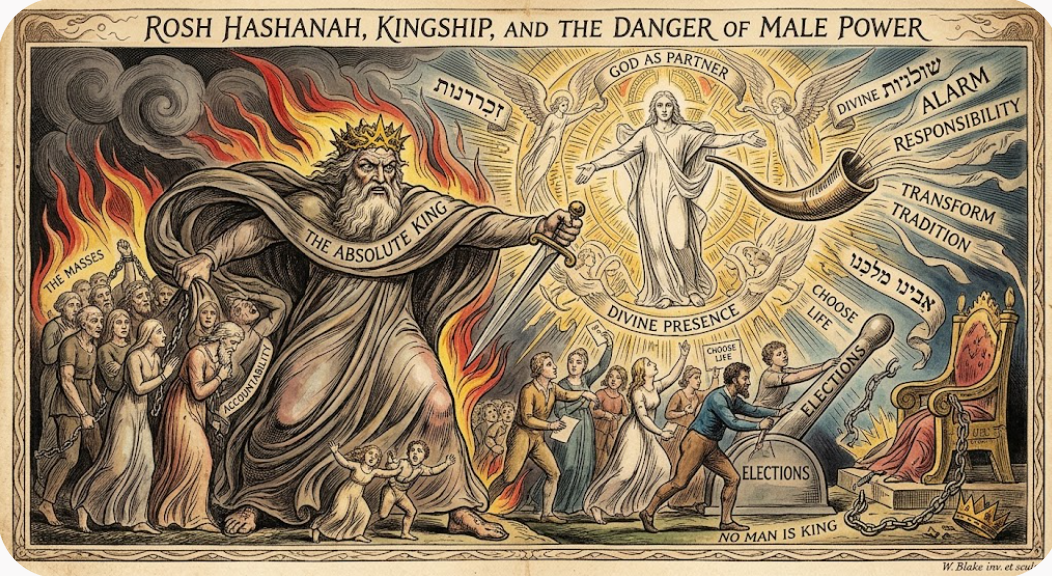
Of the three central themes of Rosh Hashanah—zichronot (remembrance), shofarot (the shofar blasts), and malchuyot (kingship)—it is malchuyot that troubles me most.
As Rosh Hashanah approaches, the liturgy asks us to crown God as King (Melech). For many, this inspires awe; for me, particularly as a woman, it produces deep discomfort. Year after year, we are asked to celebrate an image of God as an absolute male ruler: Avinu Malkeinu—Our Father, Our King. Why should we want to crown a king?
This is not an abstract theological debate. We live in a world where real rulers decide who lives and who dies, who goes to war, and whose homes are destroyed. The absolute ruler—the man who believes power entitles him to obedience, who crushed dissent, and who sacrifices human lives to preserve his own political survival—is not a comforting image. He is a dangerous one.
Yet Kingship is the central metaphor of our highest holidays.
Why is ultimate authority always assumed to be male?
From the Selichot services leading into the New Year, our liturgy reinforces patriarchal power. God is Adonai (Lord), Avinu (Father), and Melech (King)—a creator, judge, and warrior leading armies into battle. Warm melodies and childhood nostalgia soften these images, but they are not neutral. They create a symbolic order where men occupy the supreme place of power, while women remain secondary. As scholar Tikva Frymer-Kensky observed, male-centered God-language reinvests earthly men with ultimate authority, locking women out of the “power loop.”
But my discomfort goes beyond feminist critique. It is a warning about unchecked power itself.
A king stands above his people. His authority flows downward; subjects obey. History gives us endless examples of what happens when men acquire immense power and convince themselves their authority is absolute. They silence opponents, rewrite truth, sacrifice citizens for their own survival, and invoke God to justify remaining in office. The danger is built into the fantasy of absolute rule.
It is deeply disturbing that, at the precise moment dedicated to repentance and restraint, our central liturgical act is crowning an absolute sovereign.
The irony is that God’s kingship is not nearly as central to the Hebrew Bible as we assume. Aside from a few passages (like Exodus 15:18 or Deuteronomy 33:5), the elaborate theology of malchuyot is primarily a later rabbinic construction. If human beings built this metaphor, we have the right—and the duty—to challenge it.
This leaves me in a state of constant cognitive dissonance.
I do not want to abandon the traditional liturgy. I love the melodies and the collective memory embedded in the text. I treasure the piyut Adiri Ayuma, with its refrain Adonai melech, Adonai malach, Adonai yimloch le’olam va’ed (“God is King, God was King, God will be King forever”). I treasured the recording made by a French synagogue during World War II; when I sing it, I don’t think about divine monarchy—I think about Jews singing under siege, holding onto life. The music carries resilience.
Yet words matter. Metaphors shape how we treat real-world power.
Intellectually, I want inclusive language. Sometimes I pray Avinu, Imaynu (Our Father, Our Mother) or replace sovereign language with terms of partnership. Sometimes I sing the ancient words and feel the tension between the beauty of the music and the authoritarianism of the text.
Our tradition offers other models. The Shekhinah (divine presence) is grammatically feminine. Midrash and poetry speak of God as Eym (Mother) and Ruach (Spirit). Contemporary feminist thinkers invite us to imagine God as Source, Breath, or Partner.
However, changing pronouns isn’t enough. Replacing a king with a queen keeps the hierarchy intact. The deeper problem is the pyramid structure itself: the idea that someone sits at the top with total control.
This issue becomes urgent in the Torah portions read before Rosh Hashanah. In Parshat Nitzavim, Moses renews the covenant with the entire community. But in Vayeilech, we confront hester panim—the hiding of God’s face. In the wake of horrific violence, war, and displacement, many have experienced divine absence with brutal intensity. Where was the King when atrocities were committed?
Calling God an all-powerful King during times of mass suffering creates a broken theology. Worse, it encourages human rulers to claim they are acting as God’s instruments on earth, using religious sanctity to shield themselves from accountability.
Teshuvah (repentance) cannot just be a personal act; it must be a political demand.
Stealing from the public is more severe than stealing from an individual, for one who steals from an individual can appease him and return his stolen object, whereas one who steals from the public cannot appease them and return their stolen object (Tosefta Bava Kamma 10:14).
The Tosefta notes that stealing from the public is far worse than stealing from an individual, because a ruler who harms an entire nation can never truly compensate the masses he victimized. When decisions made by self-serving leaders result in widespread death, trauma, and ruin, teshuvah is not a public relations statement. It requires full accountability, genuine remorse, and an immediate end to the damaging policies. When a leader refuses to admit error, attacks critics, and insists that his continued rule is more important than the lives of his people, that is not leadership—it is authoritarian entrenchment.
Democracy was invented precisely to dismantle the myth of the king.
No leader is indispensable. No leader is above the law. No leader is entitled to rule forever.
This brings us to the ultimate purpose of the New Year. As Rosh Hashanah arrives, the shofar must not sound like a coronation trumpet signaling our submission to an absolute sovereign. It must sound like an alarm.
It is an alarm warning us against the dangerous lie of the “strongman”—the leader who claims that only he can save us, that he alone is fit to govern, and that he has a divine right to dominate eternally.
We must stop treating our political leaders like kings. In a democracy, leaders are temporary public servants, not monarchs. They do not own the state, they do not own the nation, and they are not entitled to endless tenure.
True teshuvah for a leader who has brought ruin, division, and trauma means recognizing that power is not a permanent personal possession. And if a leader lacks the humility to accept responsibility and step down voluntarily, then the ultimate act of public teshuvah belongs to the people—at the ballot box.
Elections are our protection against the tyranny of malchuyot on earth. They are the mechanism by which we declare that no man is king, no ruler is eternal, and no leader can dominate us indefinitely.
As Nitzavim commands: “I have set before you life and death, blessing and curse. Choose life.” God will not fix our political realities for us. Human beings choose. Citizens choose.
This New Year, let us reject the worship of power—in our prayerbooks and in our knesset. Let us use our votes and our voices to demand accountability, reject perpetual rule, and replace leaders who treat power as their birthright with leaders who serve human life.
May this year bring an end to political kingship, and lead us to a future where power is limited, leaders are replaced, and human dignity comes first.
Shabbat Shalom. Shana Tova. Chazak ve’emat,
Related Topics
Related Posts