
NAnews - Nikk.Agency Israel News
Russia and Israel: When Moscow’s Destruction of Freedom Becomes Israel’s Problem
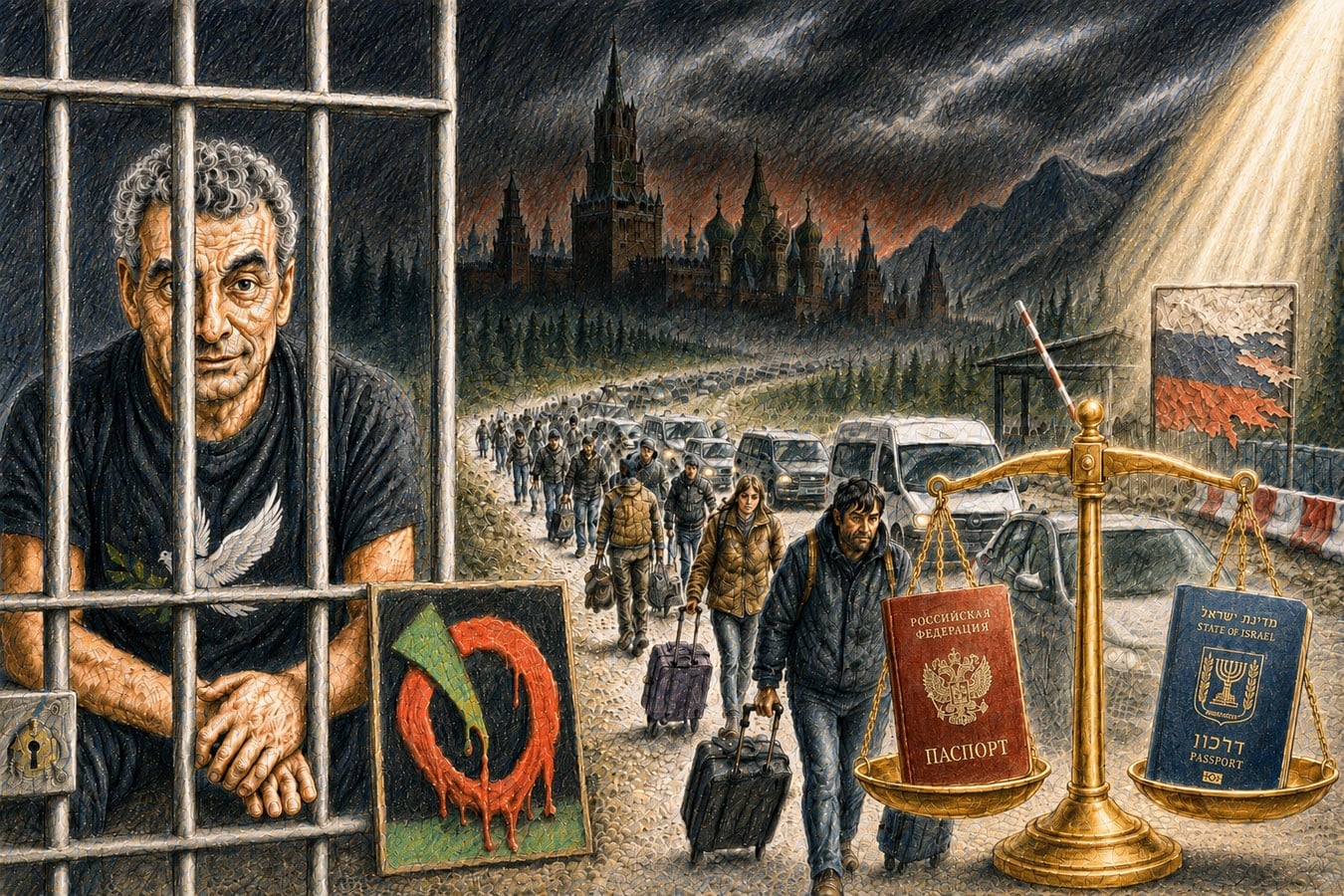
Russia and Israel: When the Destruction of Freedom in Moscow Becomes an Israeli Problem. The image was created using AI.
Israel does not need to adopt Russia’s opposition as its own cause. But it does need to understand what kind of state Russia is becoming — and what that means for Iran, Hamas, Russian Jews and Israelis who still travel there.
This is not another argument about whether one supports Ukraine or Russia.
It is about Russia and Israel.
On August 17, 2026, two things happened in Russia that are easy for an Israeli reader to dismiss as somebody else’s domestic politics.
Lev Shlosberg, deputy chairman of the liberal Yabloko party, was sentenced to 11 years and one month in prison over anti-war statements. At almost the same time, Yabloko’s federal list was definitively kept off the September parliamentary ballot.
Most Israelis have never heard of Shlosberg. Many have only a vague idea of what Yabloko is. That is understandable.
But the important part is not the electoral strength of one small Russian party. It is what the Russian state has decided its citizens should no longer be allowed to do.
Yabloko was not banned. It was not formally dissolved. It still exists.
It simply cannot perform the most basic function of a political party: stand in a national election and offer voters an alternative.
And the alternative it offered was particularly inconvenient — an end to the war, negotiations and peace.
The number the Kremlin may not want to see
Yabloko was never on the verge of defeating Vladimir Putin’s political machine.
It has no faction in the State Duma and only limited representation at the regional level. The case against its electoral list was brought by Rodina, a pro-Kremlin nationalist party. Yabloko rejected the allegations against it as politically motivated; notably, Russia’s Central Election Commission had previously registered the list.
So why bother removing a party that was not going to take power anyway?
Perhaps because its real danger was not the number of seats it could win.
It was the number of votes it could count.
Had Yabloko remained on the ballot, Russians would have had a legal way to vote for ending the war. Whatever the result — 2 percent, 5 percent, 10 percent — the state would have produced an official number showing how many citizens were still prepared to say “no” to the war from inside the Russian electoral system.
Not a Telegram poll.
Not a demonstration in Berlin.
Not an émigré YouTube channel.
An official Russian election result.
Removing that choice from the ballot does something different from merely manipulating an election. It removes the alternative itself.
Then Shlosberg’s sentence demonstrates the possible price of expressing that alternative publicly.
That combination matters.
This is no longer just the old Russian authoritarianism
Authoritarian systems manipulate elections. They disqualify candidates, dominate television, pressure opponents and make sure the final result is safe.
A more totalitarian political logic goes one step further.
It does not merely insist that the opposition lose.
It insists that certain answers should not exist.
There is an important distinction here. Russia in 2026 is not a carbon copy of the totalitarian states of the twentieth century. Russians still have private property, businesses, families and considerable areas of ordinary private autonomy. People can choose where to eat, what car to buy and where to send their children to school.
But public politics is another matter.
War increasingly functions as a loyalty test. Elections increasingly resemble a ritual confirming power rather than a competition for it. Courts can turn political dissent into years behind bars. The state claims ever more authority to decide not only what citizens may do, but which description of reality is acceptable.
And eventually silence is not enough.
Public figures are expected to demonstrate loyalty.
That is the point at which this stops being interesting only to Russian liberals.
Why should Israel care?
An Israeli living in Haifa, Ashdod or Beersheba is entitled to ask a simple question: Why should I care whether some Russian opposition party participates in an election?
We have Iran. Missiles. The IDF. Our own elections. Our own political crises.
The answer is that the internal structure of a state eventually shapes its behavior abroad.
A government constrained by courts, political competition, independent media and public scrutiny has to operate within certain boundaries. A government that has dismantled most of those boundaries can change direction far more quickly.
Today it offers mediation.
Tomorrow it uses the crisis as leverage.
The day after tomorrow it transfers technology or political support to the enemy of yesterday’s negotiating partner.
For Israel, that is not an academic possibility.
Iran is standing right there.
Russia and Iran do not need a NATO-style alliance
In January 2025, Russia and Iran signed a 20-year comprehensive strategic partnership agreement.
It expanded cooperation in security, military training, exercises and military-technical fields.
There is an important caveat that often gets lost in dramatic headlines: the agreement does not oblige Russia automatically to enter a war on Iran’s side.
Russia and Iran are not bound by a NATO-style mutual-defense clause.
But Israel should not find this especially reassuring.
Russia does not need to send troops to fight Israel in order to make Iran more dangerous.
Moscow has launched Iranian satellites. Russian and Iranian forces have held joint naval exercises. Russia used Iranian-designed Shahed drones extensively against Ukraine and later developed large-scale domestic production based on that technology.
Intelligence cooperation, space capabilities, training, military know-how, diplomatic protection and sanctions-evasion networks can strengthen Tehran without a single Russian soldier firing at Israel.
And this relationship does not have to be romantic.
Russia and Iran argue. Their interests sometimes diverge. They bargain hard with each other.
That may actually be the point.
Pragmatic alliances can be remarkably durable. One side needs weapons and technology; the other needs markets, logistical routes, political support and ways around international restrictions.
As I have argued in a longer analysis for NAnews, Israel should judge this relationship by what Moscow and Tehran do for one another, not by whether their leaders appear to like each other.
Then there is Hamas
Russia has continued to maintain contacts with Hamas and has hosted its representatives in Moscow since the October 7 massacre.
Israel has protested those meetings.
There is, however, an uncomfortable fact that should not be discarded just because it complicates the argument: maintaining a channel to Hamas can sometimes serve a practical purpose. Russia had reasons to use its contacts in discussions involving hostages, including people with Russian and Israeli citizenship.
Any channel that can help bring a captive home deserves to be used.
But a useful communications channel is not the same thing as an alliance.
Receiving Hamas officials in Moscow also gives the organization diplomatic visibility and international legitimacy. It allows the Kremlin to turn an Israeli tragedy into another piece on its Middle Eastern chessboard.
Israel should therefore remember a simple rule:
Being able to call Moscow does not mean Moscow shares Israel’s strategic interests.
The Jewish Agency, a rabbi and an airport mob
The same erosion of rules matters for Jews who remain inside Russia.
This does not require claiming that the Kremlin is currently running a centralized antisemitic campaign. There is not sufficient evidence for that claim.
The danger is subtler.
When independent legal institutions weaken, the security of any minority or communal organization depends less on law and more on its relationship with political power.
In 2022, Russia’s Justice Ministry sought the liquidation of the Russian branch of the Jewish Agency, the organization central to helping Jews make aliyah. Moscow framed the dispute in legal terms, including compliance and personal-data issues.
Yet the episode demonstrated how quickly Jewish communal infrastructure can become vulnerable when relations between Russia and Israel deteriorate.
Then there is Pinchas Goldschmidt, the former chief rabbi of Moscow. He left Russia after the invasion of Ukraine. His family said he had faced pressure to publicly support the war. He later urged Russian Jews to consider leaving the country.
And then came Makhachkala.
In October 2023, hundreds of people stormed the airport in Dagestan after a flight arrived from Tel Aviv, searching for Israelis and Jews.
There is no evidence that the Kremlin ordered that mob to storm the airport. That distinction matters.
But there is another lesson.
A state can spend years teaching society to understand the world through enemies, traitors, foreign plots and mobilized hatred — and then discover that it cannot always choose where that hatred goes next.
In Makhachkala, it turned toward passengers arriving from Israel.
For Jewish organizations in Russia, the sensible response is not panic. It is preparation: secure records, backup communications, legal contacts and a plan for what happens if today’s toleration becomes tomorrow’s investigation.
A friendly official is useful.
He is not a substitute for an independent court.
The Israeli passport problem
This becomes even more concrete for Israeli citizens who also hold Russian citizenship.
Israel’s Foreign Ministry has explicitly warned that dual Israeli-Russian nationals are subject to Russian law while inside Russia, including rules relating to military service and restrictions on leaving the country.
That is not theoretical geopolitics.
Imagine an Israeli who has lived here for twenty years. His family is here. His children served in the IDF. He pays taxes here and thinks of himself entirely as Israeli.
But his elderly mother is still in Moscow. Or he has an apartment to sell. Or a funeral to attend.
He flies to Russia carrying an Israeli passport and assumes that, if something goes wrong, Israel will simply get him out.
Russia may see him differently.
Inside Russian territory, his Russian citizenship does not disappear because an Israeli passport is in his pocket.
This is particularly relevant for men of military age, journalists, activists, former soldiers, people working in sensitive technology sectors and anyone who has publicly criticized the war.
That does not mean every Israeli visiting Russia will be detained.
It does not mean every dual citizen will be conscripted.
It means that the old assumption — “I have an Israeli passport, therefore I am protected from whatever Russia decides to do” — is no longer a responsible assumption.
And people are nervous again
No new mass mobilization had been announced in Russia as of August 20.
That point matters.
But fear of one is becoming visible.
This summer, Armenian real-estate professionals reported another sharp rise in demand from Russians seeking rental apartments. Some were looking ahead to late August and September.
At the same time, reports described substantial queues at the Verkhny Lars crossing between Russia and Georgia.
Neither fact proves that another mass exodus has begun.
Neither proves that the Kremlin has decided on another mobilization.
But Russians remember September 2022.
They remember how quickly “nothing is going to happen” became packed suitcases, expensive plane tickets and endless lines toward the border.
Israel should remember it too.
If another departure wave begins, some of those leaving will be eligible for aliyah. Others will be relatives of Israelis already here. Some may already be Israeli citizens caught on the Russian side when the rules change.
Preparing for a wave that never comes is cheaper than improvising after the borders become difficult to cross.
Sanctions are not Russophobia
This brings us to another argument Israel cannot avoid.
Sanctions have not transformed Russia into a democracy. They have not removed Putin. They have not ended the war.
That does not make them pointless.
Sanctions cannot replace domestic resistance, diplomacy or support for Ukraine. Their more realistic purpose is to reduce the money, technology and logistical capacity available to the Russian state for war, repression and weapons production.
They also raise the personal cost for officials, military manufacturers, financial intermediaries and others who sustain the system.
Effective sanctions are not measured by how many names appear in a press release.
They are measured by whether oil revenues are constrained, whether the shadow fleet can operate, whether banks and crypto networks can move money, and whether Russian defense manufacturers can still obtain dual-use components through intermediaries.
Israel has a particular interest here.
It does not need to mechanically copy every European sanctions package. But it should ask whether Israeli banks, technology companies, traders or transport networks are being used to help the Russian military-industrial complex obtain money or technology.
Because the same Russia receiving those resources is deepening military cooperation with Iran.
At that point sanctions evasion stops being merely a dispute between Moscow and Brussels.
It becomes an Israeli security question.
At the same time, sanctions should contain humanitarian exceptions. They should not prevent aliyah, assistance to political prisoners or the work of independent Russian-language media.
Pressure on the Russian state is not a punishment for being Russian.
It is not Russophobia.
And yes, sanctions can hurt ordinary people and can deepen Moscow’s dependence on countries such as Iran. That is a real argument and sanctions should be designed carefully.
But Russia’s turn toward Tehran was not created by the latest European sanctions package.
It was a strategic choice made by the Kremlin.
Removing pressure without a verifiable change in behavior would send a different message: wait long enough, and war and repression eventually become free.
Israel’s “liga acheret” with Moscow
For years, part of the Israeli political imagination has treated Russia as if our relationship existed in a kind of liga acheret — a different league, with separate rules.
We could coordinate in Syria, disagree elsewhere, keep talking, avoid unnecessary confrontation and assume that pragmatism would somehow protect the relationship.
There was logic to that approach.
There may still be logic in maintaining channels with Moscow.
Israel does not need theatrical gestures. It does not need to pretend Russia has vanished from the Middle East. It may still need Moscow on specific diplomatic, humanitarian and security questions.
But there is a line between pragmatic contact and a dangerous illusion.
Where does Israel’s liga acheret with Moscow end — and where does the belief begin that we can still deal with today’s Russia according to yesterday’s rules?
Yabloko removed from the ballot.
Shlosberg sentenced to more than eleven years.
A strategic partnership with Iran.
Hamas delegations in Moscow.
The Jewish Agency dragged into court.
A chief rabbi leaving after pressure.
A mob looking for Jews at an airport.
Israeli citizens being warned that a second passport may expose them to Russian military and exit rules.
These are not one event. They are not one conspiracy.
That is precisely why they should worry us.
A state that has removed most limits on what it can do to its own citizens can also change the rules abroad with very little warning.
Israel does not have to adopt the Russian opposition’s politics.
But it does have to understand the Russia that will remain after the last legal anti-war voices have been pushed out of politics.
An Israeli passport provides enormous protection.
Jewish ancestry provides a route home to Israel.
Neither should be mistaken for a magic shield inside a state where law increasingly follows the political needs of the day.
What is happening to freedom in Russia is no longer only a Russian story.
Related Topics
Related Posts