
Russia Must Explain How Foreigners Promised Civilian Jobs End Up in Its Army
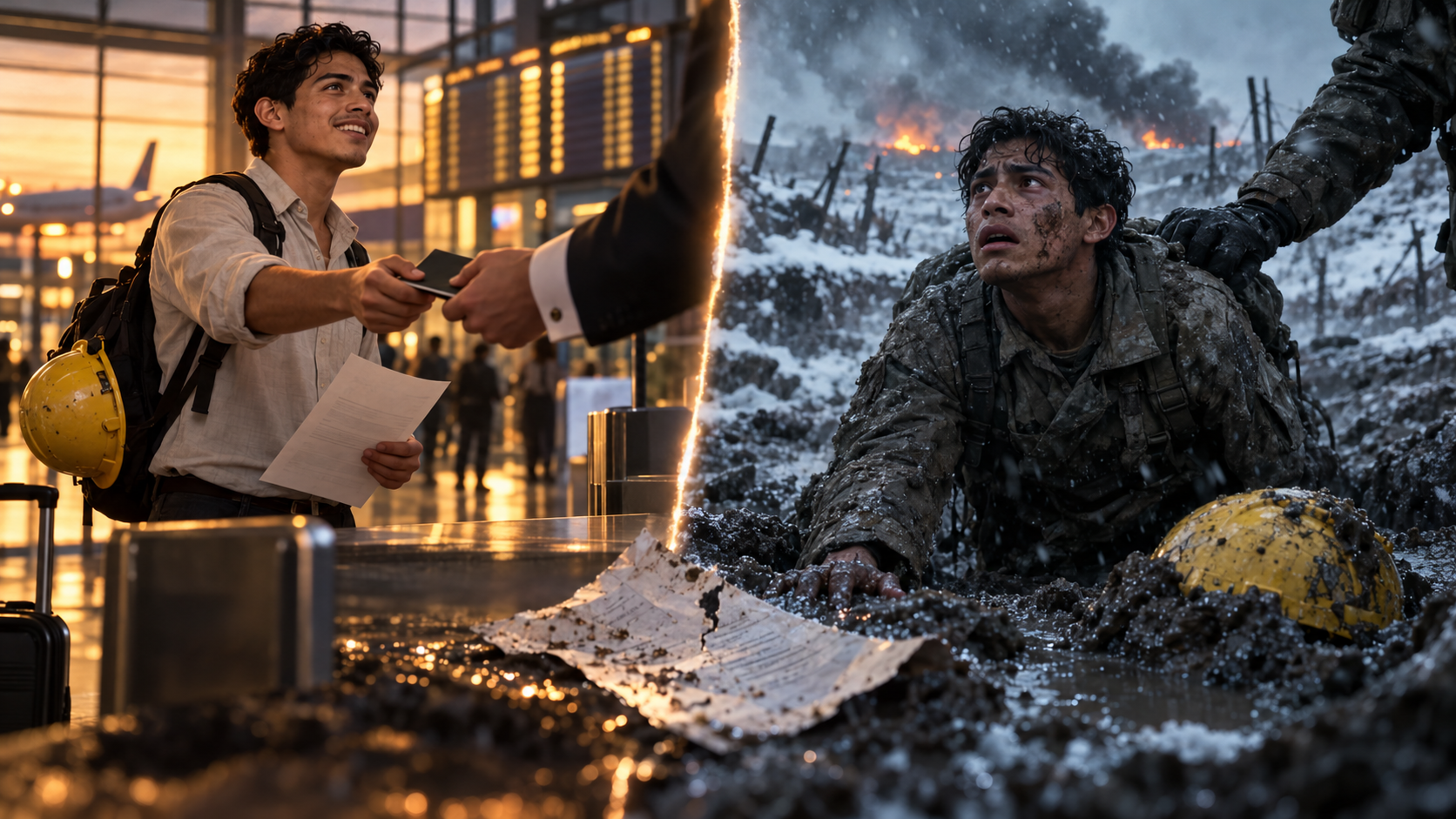
In April, seven Honduran men answered job offers sent over WhatsApp: farm work, masonry, plumbing. In Russia, they were locked in a building watched by cameras. Their passports were taken. Five escaped through second-floor windows. Two older men, in their mid-fifties, could not jump.
In July, a business administrator from a coastal city in Honduras, out of work since losing a government job, accepted an offer from a foreign company to work in logistics and inventory control. The company handled his paperwork and paid for his flight. In Russia, his daughter says, he was taken to a hotel and told to sign contracts in Russian. Then came a training camp, a knee injury, a hospital, and the news that he was going to the front anyway. His last call home was in August. In October, a man from his unit told the family he had probably been killed. No one has confirmed it officially.
Honduras is my country. By late October, its Foreign Ministry had counted 32 Hondurans recruited this way. Three are dead. Ten are missing. When the administrator’s family asked for help in September, officials said there was nothing they could do: Russia considered the contract binding.
On October 26, the UN’s Independent International Commission of Inquiry on Ukraine told the General Assembly that Russian authorities had trafficked men from 29 countries into their armed forces through deception and coercion. Soon after arriving, the men were forced to sign contracts in Russian with the Ministry of Defence. Many have been killed or have gone missing. The commission asked Moscow to discharge them. It had reviewed cases from 48 countries. Honduras is on the list of 29.
Amnesty International reached the same conclusion in September. The jobs on offer were in security, logistics, construction and computer work. Once in Russia, the men were handed papers in Russian to sign. One of them was an army contract. Some say they were never paid. Ukraine has identified at least 28,391 foreigners from 136 countries who have fought for Russia.
Latin America has seen this for years. In 2023, Cuba, one of Moscow’s closest allies, broke up a network that sent Cubans to fight in Ukraine and arrested 17 people. By August, Peru had counted 459 of its citizens in the Russian army: 11 dead, 114 missing. The UN commission’s list also includes El Salvador and the Dominican Republic. In every country the testimonies match: a civilian job offer, a paid ticket, a confiscated passport, a contract in Russian, the front.
The recruiters look for need. Ukraine’s prisoner-of-war coordination office says Russia focuses on the poorest countries and the most vulnerable people in them. The UN commission found that recruiters exploited their victims’ vulnerability and lured them with false promises of work.
Hiring foreigners is not the problem. Many armies do it. A foreigner could join Russia’s army knowing exactly what he is signing, for money or even out of conviction, and that would be his choice. Russian law invites them: a decree Vladimir Putin signed in January 2024 grants citizenship to foreigners who sign a one-year military contract, and to their families. Sergey Lavrov, Russia’s foreign minister, says the foreigners fighting for Russia joined voluntarily and legally.
If that were the whole story, there would be nothing to ask. But a man who loses his passport on arrival, signs a contract he cannot read, and is threatened with prison or death if he tries to run, as Amnesty documented, did not volunteer. At the very least, a contract should be written in the language of the man who signs it.
The lying is usually done by middlemen: job agencies, travel firms, anonymous contacts on messaging apps. They are paid by the head, sometimes by the Russian state itself. In September, the governor of Irkutsk, a Siberian region, signed a decree that pays anyone who brings a foreigner to sign a Defence Ministry contract up to 1.5 million rubles, about $17,800. The recruits get much less. A Journalists for Justice investigation published on October 29 followed 3,034 Africans recruited since 2022. Within 35 days of signing, agencies and Russian handlers had taken 58 to 66 percent of their bonuses straight from their bank accounts.
Why does Moscow need men this way? Since 2022, Russia has relied on contract soldiers, volunteers paid to sign, rather than another mobilization. They keep getting more expensive. A year of service can now pay up to 5.5 million rubles, about $70,000, and regions keep raising their bonuses. Still, analysts cited by The Moscow Times say fewer men are willing to go. In December 2025, according to Ukrainian military figures cited by The Kyiv Independent, Russia lost more soldiers than it signed up for the first time: 33,200 killed and wounded, against 27,400 new recruits.
The alternative is another mobilization. The last one, in September 2022, drove 261,000 men out of the country in four days, according to an FSB count leaked to the independent press. A foreign recruit costs less, in money and in politics. By law, the family of a Russian soldier killed in Ukraine is owed more than 13 million rubles, about $157,000, from the federal budget alone. The Kyiv Post found that no government has documented a single case of that money reaching a foreign recruit’s family. The Atlantic Council adds that Russian deaths can turn people at home against the war, while the deaths of men from faraway countries have almost no effect on Russian opinion.
Governments that have pressed Moscow have gotten results. In March, Kenya’s foreign minister, Musalia Mudavadi, announced in Moscow that Russia would stop recruiting Kenyans. More than a thousand had been drawn into the war, and Kenya had shut down over 600 recruitment agencies. Russia did not deny the recruiting. It stopped it for Kenya once Kenya asked.
The investigation into the African recruits came out while African leaders were in Moscow meeting Putin. Russia courts Africa and Latin America as partners. The men its recruiters deceive come from those countries.
The UN has already asked Moscow to discharge these men. What does Russia check before it pays a bounty for a foreign recruit? Why are men promised civilian work sent to the front? Where are the missing? And if every contract was signed freely, why did so many of these men have to give up their passports first?
Moscow did not answer any of the UN commission’s 41 written requests, and says it does not recognize the commission’s mandate. Asked at the OSCE how it recruits foreigners, Russia’s delegation said only that they sign contracts with the Defence Ministry and receive Russian citizenship. Every government whose citizens are missing in Russia, Honduras among them, must ask Moscow for an explanation and demand that this recruitment stop. Kenya asked and was heard. If Russia cannot explain how these contracts were obtained, it should stop signing them.
In Honduras, Peru, Kenya and dozens of other countries, families do not know whether their sons, brothers and husbands are alive. Russia holds the contracts, the unit rosters and the casualty records. Only Moscow can explain what happened to them.