
Author, America and the Indo-Pacific - Trump and Beyond (Routledge 2021)
Trump-Xi-Putin meet: G3 photo-op, China’s stage
-
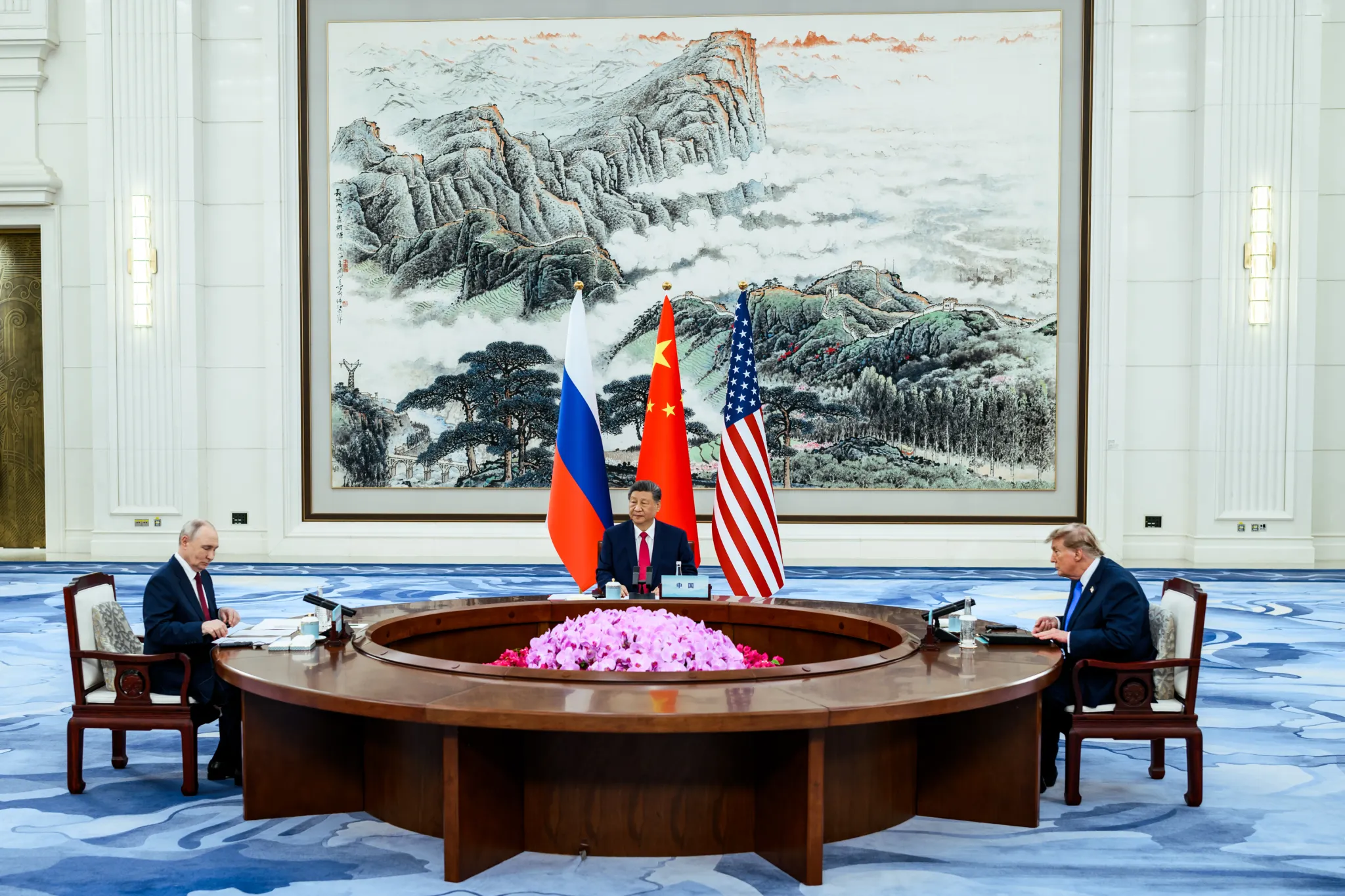
US President Donald Trump, Chinese President Xi Jinping and Russian President Vladimir Putin meet at the Kylin Villa in Shenzhen in southern China’s Guangdong Province, Thursday, Nov. 19, 2026. (Source: White House) - Speculation over the US-China-Russia combine understates bilateral differences among the three powers and China’s outsized leverage in today’s competitive multipolarity
Last week’s trilateral meeting in Shenzhen between US President Donald Trump, Chinese President Xi Jinping and Russian President Vladimir Putin has sparked much speculation over an emergent G3 world.
“We are really making history,” President Trump said as the three leaders sat around a large round table. Commentaries have been rife with assessments of a shifting reality with China, Russia and the US coming together on global governance issues. Whereas, some foresee the three leaders to engage in ‘grand bargains’, trample over other nations’ interests and carve out spheres of influence.
To be sure, the trilateral does raise questions over the fate of ongoing crises (Iran, Ukraine) and some probable ones (Taiwan). However, a trilateral meeting as a convening platform does not render a tripolarity to be an emerging reality. Far from it – today’s world is replete with plurilateral arrangements that cut across binaries or at times even alliance considerations.
In today’s world, a nation’s participation across different bilaterals or minilateral platforms serve different purposes, just as their histories, composition and themes differ.
This sense of issue-based alignments is reflected in recent headlines: ‘China’s BYD in talks to buy French car factory from Ineos Automotive’; ‘Diesel deal opens way for more Russia-US cooperation’; ‘Japan proposes ‘Asian IEA’ to manage oil stockpiles’; ‘China says ready to work with India to facilitate visa issuance for business people’; ‘Trump says Israel has ‘been very helpful to Saudi Arabia’ in fight against Houthis’.
In assessing the G3 meeting as a ‘great power’ pushback against multipolarity, one may draw on the G3 joint declaration’s reference to themselves as UNSC permanent members. Absent any commitment to expanding the UNSC to reflect the realities of today’s power balances, the three nations expressed their commitment to “reform the UN so that the UN can respond more effectively to global challenges and conform to its fundamental mission of international peace and security.”
Interestingly, the three powers committed to making multilateralism “more effective” by first referencing their veto privileges – and doing so in the absence of the other permanent UNSC members (France and the UK).
Nevertheless, referencing the imperatives of multilateralism has been Beijing and Moscow’s long-standing cudgel to decry Washington’s unilateralism – from its military adventurism to long-arm sanctions enforcement.
Whereas, the US under Trump, has begrudgingly come to terms with the utility of multi-party convenings over its go-it-alone impulses. This is evident in Washington’s ongoing efforts with Gulf partners and transatlantic allies in Europe to seek diplomatic resolutions on US-Israel hostilities with Iran and Russia’s war in Ukraine.
Beyond coming to terms with today’s multipolar reality, the three powers have several divergences to work through on their respective bilateral levels.
Earlier this month, the US and China extended their trade war truce on retaliatory tariffs by another two months (until 10 January 2027). Furthermore, this week, China’s Commerce Ministry extended its pause on export curbs over Washington’s access to some critical minerals (chiefly Gallium, Germanium and Antimony). However, US officials have continued to urge China to honour its purchase commitments as part of their negotiated bilateral truce. As per latest estimates, even as China closes in on a target to buy 25 million tons of American soybeans, it is increasingly unlikely that China will meet its separate commitment to purchase an additional USD 17 billion in American farm products this year.
Furthermore, revelations around Nvidia chief Jensen Huang have drawn attention to the Trump administration’s record on tech competition with China. Following which, the US has announced new restrictions on Chinese access to advanced computing via data centres in Southeast Asia. This has been coupled with developments pertaining to other aspects of the US-China tech competition like increasing restrictions on Chinese telecom giants and legal action against Chinese tech entities engaging in theft of trade secrets. Going forward, Congressional scrutiny of US tech exports is set to grow, as the Nvidia scandal accords new momentum to ‘China hawks’ on Capitol Hill – particularly those seeking to regulate AI entities and establish more guardrails around American business activity with Beijing.
However, Beijing leverage points over the US remain – ranging from its hold over critical minerals required for America’s defence manufacturing, being a major market for US agricultural goods, to its tactical support for Iran. Going forward, China seems keen on building more leverage points. For the G3 meeting, President Xi Jinping reportedly accommodated President Trump’s interest in discussing nuclear disarmament, but without committing to any specific action given the fact that China continues building its nuclear arsenal.
On the US-Russia relationship, the incoming Democrat-led Congress may complicate the Trump administration’s efforts to use business deals as an incentive for Russia to end the war in Ukraine. This reportedly includes proposals such as US oil majors restarting sales of Russian oil to Europe via pipelines and resuming access for US airlines to Russian airspace for transit/overflights.
Whereas, in the case of Russia and China, the two nations have struck sustained convergence on the latter’s energy appetite and the former’s sanctions-constrained efforts to export oil/gas.
As per latest estimates, Russian oil exports to China rose 17% to 2.34 million bpd during January-October 2026. This is estimated to be worth around USD 59.6 billion and accounted for about a quarter of Beijing’s oil imports. Yet the Sino-Russian relationship remains highly uneven, with Beijing often stressing cooperation on its terms. Beijing is not just a key market for Russia’s energy exports, but it is also a critical source of dual-use tech components amid transatlantic sanctions against Moscow’s defense industrial base.
Moreover, China seeks to capitalise on Russia’s deteriorating economic and geopolitical standing amid tightening sanctions enforcement. Case in point: China is holding off on finalizing the Power of Siberia 2 pipeline, which can transport up to 50 billion cubic meters of natural gas annually from Russia’s Arctic region to China and in-turn help Moscow mitigate the impact of losing access to the lucrative energy markets of Europe. Chinese officials have reportedly told their Russian counterparts that Beijing will sign up to the pipeline only if Russia sold them gas at the same lower-than-market rate which Moscow considers for domestic consumers.
In all, Shenzhen may have produced a trilateral meeting and a sought-after photo-op, but hardly a trilateral understanding on the cascading crises weighing on global stability. And if it becomes a recurring fixture, the G3 risks turning into a stage for Beijing to exercise its leverage over energy dynamics, critical supply chains and trade flows with Russia and the US.
Related Topics
Related Posts