
Middle East Analyst
Saudi Arabia Isn’t Building an AI Hub. It’s Building the Backbone of the AI Age.
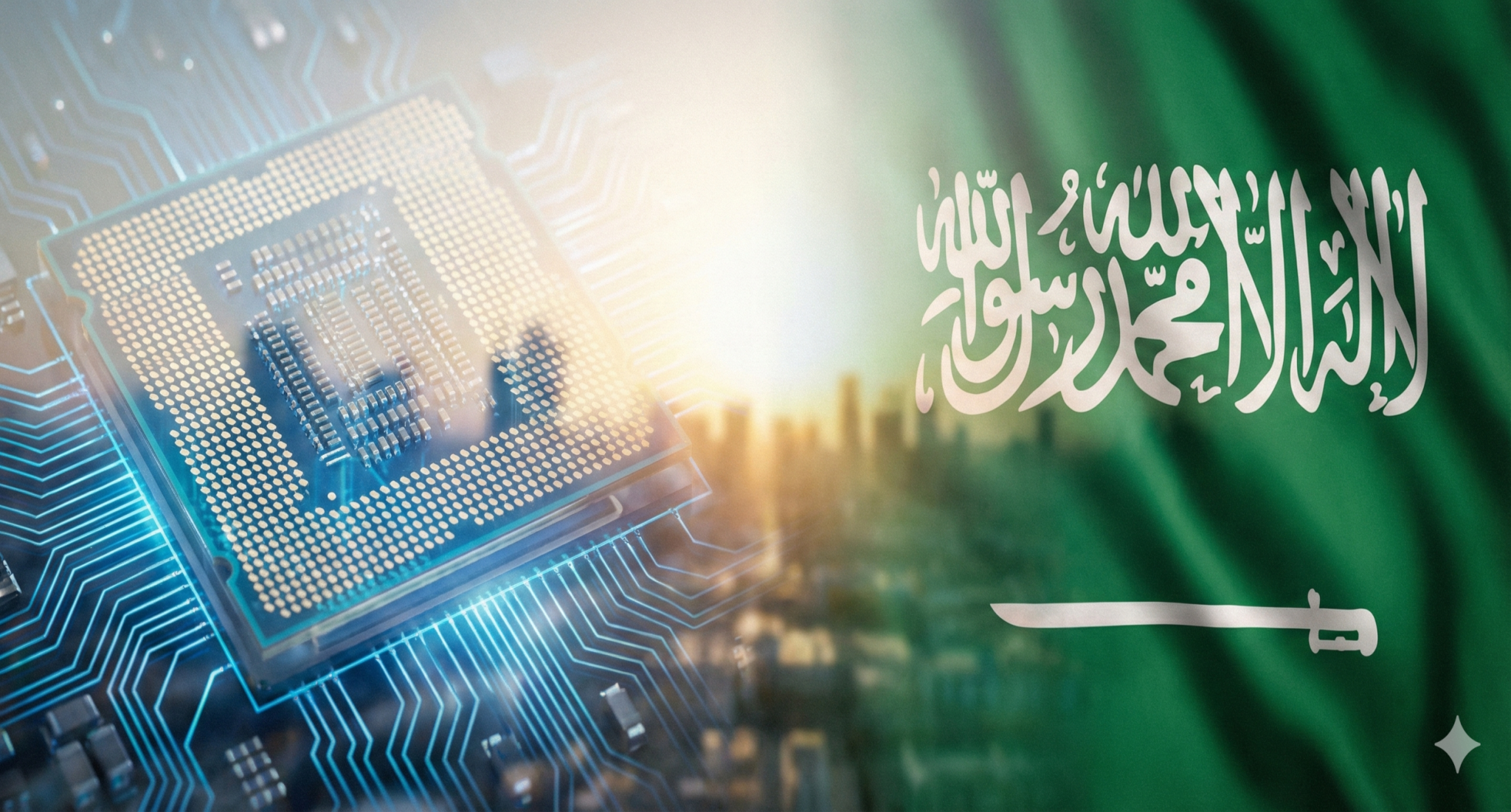
Graphic by author/Nano Banana
For years, the world misunderstood Saudi Arabia’s modernization project. Vision 2030 was read as a glossy diversification plan—tourism, entertainment, privatization, and the architectural spectacle of NEOM. Artificial intelligence barely appeared in the original documents. But something fundamental has shifted. Saudi Arabia is no longer trying to graft AI onto Vision 2030. It is rewriting the vision around AI itself, and in the process positioning the Kingdom as one of the world’s most important energy–compute supernodes.
This is not Silicon Valley transplanted to the desert. It is something more structural: the physical substrate on which Silicon Valley—and its global competitors—will increasingly depend.
From Architectural Futurism to Computational Futurism
The early years of Vision 2030 were defined by iconic skylines and mega‑projects. NEOM was the symbol of a new Saudi Arabia: futuristic, ambitious, and visually arresting. But by 2024–2025, the center of gravity had moved. The Kingdom’s leadership began framing Saudi Arabia not as a tourist destination or a lifestyle brand, but as a global AI hub built on unmatched energy reserves, sovereign capital, and hyperscale infrastructure.
This is a strategic migration from architectural futurism to computational futurism. The new Saudi narrative is not about buildings. It is about chips, power, data centers, subsea cables, and the industrial systems that make AI possible at scale.
The Capital and the State Capacity to Move Fast
Saudi Arabia’s advantage begins with something simple but rare: the ability to act decisively at national scale. The Public Investment Fund can deploy tens of billions into long‑horizon AI infrastructure without the political friction that slows Western democracies. When the Kingdom decides to build a 500‑megawatt data center, it does not spend five years in permitting battles. It breaks ground.
This centralized authority allows ministries, regulators, and state‑owned enterprises to pivot rapidly toward an AI‑first development model. In today’s Saudi Arabia, AI is treated on par with oil and defense—a strategic sector, not an experiment.
The US–Saudi Compute Axis
The most important enabler of Saudi Arabia’s AI ambitions is alignment with the US hardware ecosystem. Anticipated US–Saudi technology and security arrangements have opened the door to large-scale shipments of advanced AI chips—hardware that is tightly controlled and geopolitically sensitive. These chips are destined for Saudi hyperscale data centers, many of them built in partnership with American firms.
The emerging xAI–Nvidia–Saudi axis is a case in point. Saudi Arabia provides the land, the energy, the capital, and the political stability. US firms provide the frontier models and the hardware. The result is a new kind of strategic interdependence: the United States gains a reliable offshore compute partner, and Saudi Arabia becomes indispensable to the global AI supply chain.
The Energy Stack That Changes Everything
What truly differentiates Saudi Arabia from other aspiring AI hubs is its energy system. AI is not just about algorithms; it is about power—massive, stable, 24/7 power.
Saudi Arabia has it in abundance.
- Hydrocarbons provide reliable baseload for industrial-scale compute.
- Green hydrogen projects offer future low‑carbon, long-duration storage and baseload tied to coastal industrial hubs.
- Civilian nuclear cooperation with the United States opens the door to high-density, uninterrupted power ideal for training frontier AI models.
- Desalination capacity solves the water problem that constrains data center expansion in California, Singapore, and Western Europe.
This combination allows Saudi Arabia to operate multi‑gigawatt AI campuses with decades-long power contracts. Only a handful of states on Earth can plausibly do the same.
Talent Is Not a Constraint
Critics often point to Saudi Arabia’s limited domestic AI research depth. But this misunderstands the model. The Kingdom is not trying to become a frontier research powerhouse. It is trying to become the energy–compute substrate for those who are.
Saudi Arabia needs infrastructure engineers, cloud architects, data center operators, and applied AI teams. These roles are globally mobile and readily recruitable—especially in a US tech market marked by layoffs and consolidation. The Kingdom has always been able to attract high-end technical labor, even under stricter social norms than exist today.
The New Role: A Global Compute Supernode
Saudi Arabia is not building “the next Silicon Valley.” It is building something more foundational: the physical backbone of the AI age. The chips come through US alignment. The power comes from hydrocarbons, hydrogen, and nuclear. The water comes from desalination. The land is vast. The capital is sovereign. The talent is imported.
This is the quiet revolution inside Vision 2030. The Kingdom is not trying to be the world’s AI brain. It is trying to be the world’s AI engine room.
And in the geopolitics of the next decade, that may prove even more important.
Related Topics
Related Posts