
Middle East Analyst
Saudi Arabia’s Nuclear Non-Deal: What Riyadh’s Non-Response Reveals
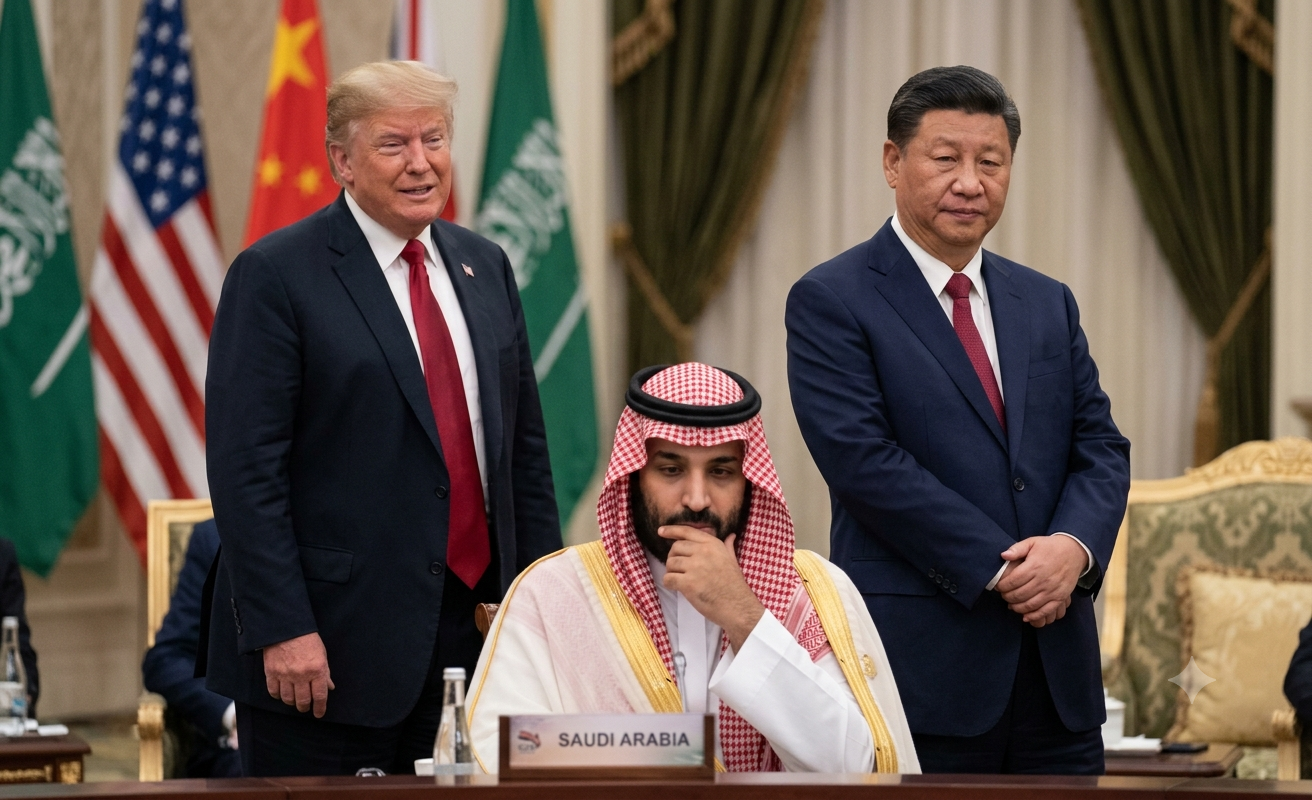
by author (AI)
On July 23, 2026, the United States announced a civilian nuclear cooperation agreement with Saudi Arabia. The Department of Energy’s own release did not include any requirement that Riyadh normalize relations with Israel. Within hours, President Trump declared on Truth Social that the deal was now “totally subject to Saudi Arabia joining the very respected and successful Abraham Accords.” That condition was not part of the signed documents, not part of the negotiations, and not part of the Energy Department’s announcement. White House Press Secretary Karoline Leavitt confirmed hours later that the condition had been added — as far as the president was concerned, the deal would not move without it.
As of this writing, Saudi Arabia’s government has not issued an official response.
The only signal to reach the public has come indirectly, through journalist Laura Rozen, who quoted an unnamed source described as close to Saudi thinking. That source dismissed Trump’s new condition in blunt terms: “It was signed. So nothing to renegotiate. Tweets don’t overturn signed agreements.” The source added that a direct Saudi response was unlikely, and that movement under Trump’s new terms was even less likely.
That is the closest thing to a reaction we have, and it is consistent with the Kingdom’s longstanding, publicly repeated position: no normalization with Israel absent a credible pathway to Palestinian statehood along the lines of the 2002 Arab Peace Initiative. That position hasn’t moved in two decades. There is no particular reason to expect it moves now because of a demand appended after a signing ceremony.
This distinction matters more than it might first appear. Trump could have attached any number of conditions to the deal — additional inspection requirements, a longer congressional review, revised enrichment caps — and Riyadh would have had room to negotiate, stall, or partially concede. Instead, the condition selected is the one position Saudi Arabia has held with total consistency for two decades and has never shown any sign of softening: normalization without a Palestinian statehood pathway.
We cannot say with 100 percent certainty that Riyadh will never join the Abraham Accords on those terms — certainty of that kind is rarely available Middle East politics — but the inference that it is highly unlikely is based on twenty years of unbroken public position, the Arab Peace Initiative’s continued status as the Kingdom’s stated baseline, and MBS’s own repeated statements on the subject. Functionally, then, this is not one condition among several. It is the specific condition that removes American nuclear technology from the set of options Riyadh can actually choose, regardless of how much Washington still has to offer on the technical merits. A superior product that cannot be purchased on the terms attached to it is not a viable option.
The China-Russia option: real, but contested
Newsweek’s Tom O’Connor reported the clearest version of the pivot argument on July 24. Mohammed al-Sabban, a former senior adviser to the Saudi energy ministry, told Newsweek that Riyadh has alternatives in China, Russia, and other willing partners, and warned that continued deference to Israeli preferences risks costing Washington its cooperative relationships in the region. Saad Abdullah Al-Hamid, a former Saudi diplomat, outlined a three-phase trajectory for the region: first, civilian nuclear capability as a form of “virtual deterrence”; second, diversification of strategic partnerships with China, Russia, and Asian states; and third — the most dangerous scenario — a “multipolar nuclear Middle East” triggered if any regional state successfully weaponizes.
Some of the underlying infrastructure for a pivot already exists. China’s CNNC has operated a Middle East headquarters in Riyadh since 2022, and Riyadh and Moscow have a nuclear cooperation agreement dating to 2015 covering research and joint exploration. Rosatom and CNNC have reportedly entered bids for Saudi Arabia’s first commercial reactor — reportedly being the operative word, since Newsweek’s own sourcing hedges this claim rather than confirming it outright.
The same article that carries al-Sabban’s and Al-Hamid’s warnings also carries a rebuttal from Gary Samore, the Brandeis scholar and former NSC senior director for nuclear policy, who reads the Saudi threat to turn to Moscow or Beijing as negotiating leverage rather than a realistic near-term alternative. His reasoning on the technical merits is sound as far as it goes: neither China nor Russia has offered the enrichment technology transfer the U.S. has put on the table, which is a genuine asymmetry in what each supplier can provide. But Samore’s expectation that Riyadh simply waits Trump out is not a nuclear-policy judgment — it is a prediction about Saudi political tolerance for the current U.S. position, and that is a call about Middle East politics, not nonproliferation architecture. It’s worth weighing his forecast against his domain: Samore’s expertise establishes that China and Russia can’t yet match the U.S. offer technically; it doesn’t establish that Riyadh will accept an offer that structurally cannot be accepted while the normalization condition stands, however superior the underlying technology is.
On the political calculus itself — whether Riyadh waits or moves — the more directly relevant voices are al-Sabban and Al-Hamid, both speaking from inside Saudi political and diplomatic experience rather than from nuclear-nonproliferation expertise. Their reads point the other way: al-Sabban frames the current posture as a threshold Washington keeps testing at its own cost, and Al-Hamid’s own account of Trump’s move — a calculated negotiating tactic banking on Riyadh’s known alternatives — implies Washington itself does not expect the Saudis to fold on normalization; it expects to extract concessions elsewhere before the deal, if it survives at all, gets finalized.
Weighted this way, the picture is not “both readings are equally live.” It’s that the near-certainty of continued Saudi non-normalization (a political judgment, well-evidenced) makes the deal dead on arrival in its current form, while the open question — genuinely open, and outside anyone’s confident forecasting range right now — is the slower-moving one of how far and how fast Riyadh actually leans toward Beijing or Moscow as a result. Those are two different questions, and collapsing them into one has been the main source of confusion in the coverage so far.
Why this still matters for Washington, regardless of which reading is right
Set aside for a moment whether Riyadh pivots. The more durable problem for U.S. strategy is what the sequence itself demonstrates: a signed nuclear cooperation agreement was reopened unilaterally, within 24 hours, over social media, without prior consultation with the counterparty. That is true regardless of whether Saudi Arabia ever actually executes a turn toward Beijing or Moscow. It is a data point any future negotiating partner — Gulf state or otherwise — will weigh when deciding how much to invest in a signed U.S. commitment.
The Kingdom has also watched, over the last four months, as U.S. and allied air defenses failed to fully intercept Iranian missile and drone strikes that severely damaged U.S. regional bases and its Riyadh embassy, disrupted Saudi Arabia’s own east-coast Gulf access, while a separate Houthi campaign recently targeted vessels tied to Saudi west-coast Red Sea ports. That backdrop doesn’t prove Riyadh has concluded the U.S. security guarantee is unreliable — but it is the kind of evidence that would inform such a conclusion if Riyadh were forming one, and is likely weighing it alongside the nuclear question rather than as a separate track.
The warning, stated as a warning rather than a prediction
Washington retains real advantages on the merits: superior nuclear technology and a security relationship that has survived numerous prior crises. Neither is in question. What is in question is whether those advantages matter if they’re attached to a condition Riyadh cannot meet. As currently conditioned, the deal is not merely at risk — it is dead on arrival, because the one thing on offer that Saudi Arabia cannot accept is the price Washington has attached to everything else it’s offering. That’s a conclusion that Trump himself seemed to acknowledge Friday when he claimed Riyadh would “at some point” join the Abraham Accords.
The genuinely open question — how far, how fast, and how durably Riyadh leans toward Beijing or Moscow as a result — is a separate and slower-moving one, and it is the one Washington still has some ability to influence. If the U.S. wants to know whether the pivot risk is real, the way to find out is not to wait on Truth Social for Riyadh to blink on a condition it has never once shown willingness to accept. It is to ask whether a different, achievable deal is still possible — and whether Washington is willing to demonstrate, here and in the next negotiation, that a signed U.S. commitment stays signed. That is the variable still within Washington’s control. The normalization condition almost certainly is not.
Related Topics
Related Posts